
Bryan Clark, a senior fellow at the Center for Strategic and Budgetary Assessments, penned a report last month detailing his plan to realign U.S. Navy surface warfare in a way that deals with the threats of a post-Iraq and post-Afghanistan world. The report is titled “Commanding the Seas: A Plan to Reinvigorate U.S. Navy Surface Warfare.”
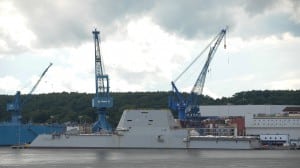
We at Virtual Analyst discussed with him what his recommendations are for various types of ship programs. Here are Clark’s comments on the DDG-1000 Zumwalt-class destroyer and the role he believes it should play in the future fleet.

 “[The Zumwalt has] got a smaller number of VLS [vertical launch system] cells, but still uses the same ranged weapons mix as the DDG-51 would have. More importantly, I recommend the Navy look at putting on a 64-megajoule railgun they’re developing. Right now, that is going on the Millinocket [a Joint High Speed Vessel (JHSV)]. It’s a 32-megajoule railgun. The math shows that 32 megajoules makes sense as an air defense weapon mostly, with some strike capability at 100 miles, but if you’re going for a 64-megajoule railgun, it doesn’t do much more for you in terms of air defense, but it gives you 200 miles of strike capability with a hypersonic projectile. So I said the Navy should take advantage of the power capacity and size of a DDG-1000 and put on the 64-megajoule railgun and give it the ability to do the long-range land attack mission that complements its role as a littoral land-attack-type ship.”