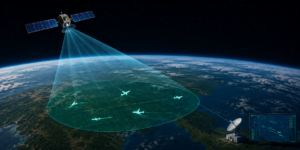
Golden Dome Funds. During the annual Space and Missile Defense Symposium on Aug. 11, Gen. Michael Guetlein, Golden Dome for America direct reporting program manager, said the team has been trying to get all of its contracts out. Of the $22.5 billion the program has been funded so far, “we’re 90 percent obligated, 95 percent committed. We have radars on contract, we have launchers on contract, we have space-based interceptors on contract, hypersonic ballistic tracking system on contract, space data network is on contract…and we are moving out with haste to get after what the president asked us to do in the summer of 2028.” Guetlein previously said they plan to have an initial operational capability ready to present to President Donald Trump by summer 2028.
New RIMES Award. The Navy and Defense Innovation Unit (DIU) last week said they have awarded Shield AI a $50 million contract to advance Runway Independent Maritime Expeditionary Strikes (RIMES) capabilities. The award expands existing work that the Portfolio Acquisition Executive Rapid Capability Cell is leading. Mach Industries in June said they had won a RIMES award to serve as an aircraft integrator (Defense Daily, June 16). DIU and the Navy in February launched the RIMES program to find runway independent long-range drones for one-way attack, or to return after delivering a munition (Defense Daily, Feb. 11). The Navy on Aug. 13 said the award to Shield is an “investment to rapidly scale our unmanned aviation portfolio.”
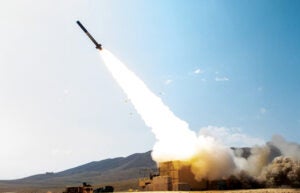
Containerized Launcher. Lockheed Martin announced on Aug. 12 it has completed the first integrated live fire test from its new Kodiak containerized launcher. The test involved firing a Reduced-Range Practice Rocket. “By proving the possibility to containerize both offensive and defensive fires, Lockheed Martin is providing the Department of War with cost-efficient and low-observable weapon capability options. Containerized launchers enhance flexibility and lethality for any mission,” the company said in a statement. “The ability to have offensive fires weapons in a containerized launcher gives the customer agility to move operations as needed.”
…Rheinmetall Test. Rheinmetall on Aug. 13 also announced a test launch from its Containerized Missile Launcher solution, firing its FV-014 loitering munition system. “The FV-014 was developed for highly mobile operations on the modern battlefield. It combines reconnaissance, target identification and precision strike capabilities within a single system and is designed for operational ranges of up to 100 kilometers. State-of-the-art sensor technology, network capability and strong resilience to GNSS interference through a high degree of autonomy enable deployment even in demanding operational scenarios. The system is suitable for engaging both armored and unarmored targets,” Rheinmetall said in a statement. “Launching takes place from a transport and launch container using a booster. These launch containers can be integrated into the Containerized Missile Launcher on a modular basis.”
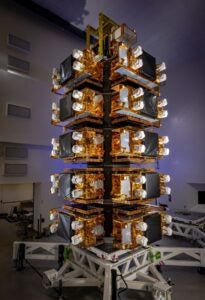
Whirlwind in Space. Venture-backed startup Space Kinetic last week said the Space Force has awarded the company a $50 million contract to develop its technology for space maneuverability. The California-based company is developing an electromechanical system it calls Whirlwind that looks like a pitching arm that continuously spins across the axis of a host spacecraft, whipping microsatellites into orbit without the need for propellant. “We have a mission to make the space domain more secure and more prosperous and this technology will enable us to ‘boldly go’ into the era of abundant space maneuver,” Scott Ziegler, co-founder and chief technology officer of Space Kinetic, said in a statement. The award is the largest in the company’s history.
USSF on Japanese Satellite. Japan on Aug. 10 launched a U.S. Space Force space domain awareness payload integrated on the country’s Quasi-Zenith Satellite 7, which was lifted by an H-3 launch vehicle from Tanegashima Space Center. The Space Force payload will be operated by Combat Forces Command’s Mission Delta 2, which conducts space domain awareness operations. “The payload will deliver near real time data to the Space Surveillance Network bolstering the U.S. Department of War understanding of the Geosynchronous Orbit regime above the Indo-Pacific region,” the Space Force’s Space Systems Command said. The Massachusetts Institute of Technology Lincoln Laboratory designed and built the payload.
More SALO News. The payloads for the Space Force’s VICTUS SALO 2 and 3 in-space maneuvering missions that will be based on Impulse Space’s Mira spacecraft “will integrate the HANDLE Modular Systems Open Approach hardware interface, enabling rapid plug-and-play integration across space vehicle buses, ground systems, and auxiliary payloads, paired with an advanced space domain awareness sensor package developed by the Massachusetts Institute of Technology’s Lincoln Laboratory,” Space Systems Command (SSC) told Defense Daily last week. Impulse Space on Aug. 12 said SSC has awarded it a $28 million contract for the SALO 2 and 3 tactically responsive space (TacRS) missions (Defense Daily, Aug. 12). The SALO 2 and 3 missions will follow the SALO 1 mission, which is slated for 2027. The additional in-space maneuvering spacecraft “expands the U.S. Space Forces deployment of prepositioned, highly maneuverable space assets on orbit,” demonstrating that TacRS “can rapidly deliver space domain characterization and dynamic space operations at the speed of operational relevance,” SSC said.
SGT STOUT Test. Leonardo DRS said on Aug. 11 the Army’s SGT STOUT Stryker-mounted short-range air defense platforms, for which the company provided the mission equipment package (MEP), successfully defeated Group 1 and 2 small drones during a recent government test event. “While SGT STOUT was originally designed to counter larger Group 3 and above UAS as well as fixed-wing and rotary-wing threats, this government test event demonstrated expanded effectiveness against smaller Group 1-2 UAS enabled solely through updates to detection and fire control software, without adding any new hardware to the MEP,” the company said in a statement. Leonardo DRS’s MEP for SGT Stout includes Moog’s Reconfigurable Integrated-weapons Platform turret, the XM914 30mm cannon and M240 machine gun, Stinger and Hellfire missiles and Rada USA’s Multi-Mission Hemispheric Radar.
HADALUS UUV. In a recent Navy exercise, RTX’s Raytheon business and Composite Energy Technologies (CET) demonstrated submerged undersea launch capabilities of their 34-foot HADALUS low-cost, long-endurance unmanned undersea vehicle (UUV), the company said Aug. 10. The demonstrations occurred at an unspecified undersea Navy test range and RTX said it was the first time the service had seen the integrated capability operate in the water. The companies said the system shows how a single UUV can perform detect, reacquire and engage functions in a single mission. Jen Gauthier, vice president of naval systems & sustainment at Raytheon, said this shows how the companies can tightly couple design, integration and at-sea experimentation to prove “we can bring new autonomous solutions to the fleet quickly and cost‑effectively.” HADALUS has a six-foot cross section, an endurance distance of 2,000 nautical miles and is designed to cost one-third to one-fifth of comparable long-endurance vessels, the companies said. The builders also noted the companies moves from conceptual sketch to complete prototype in the water in under 18 months, driven by internal investment funds from both companies. CET provided an advanced composite vehicle architecture while Raytheon provided mission systems, sensors and integration knowledge.
Bonus Order. As a reward for being the first company to successfully complete delivery, and receive acceptance, of its small, attritable drones for the Pentagon Drone Dominance Program’s Gauntlet 1, Neros Technologies recently received an order for 2,000 more of its Archer first person view (FPV) unmanned aircraft systems (UAS). Neros, which came in second during the Gauntlet 1 competition, originally received an order for 2,400 Archer drones. The bonus order brings the total to 4,400.
…Drone Raise. Neros last week said it raised $250 million in a Series C funding round co-led by Sequoia Capital and American Strategic Technology Fund that will be used to develop new drone products. These include Archer AI, “an FPV platform augmented with autonomy features including terminal guidance and GPS-denied position hold,” and the Bandit UAS that intercepts Groups 2 and 3 drones, including Shahed-type UAS. The investment values Neros at $2.5 billion post-money. “These platforms are being developed with the hardware and compute required for multi-asset control, often termed ‘swarming,’ while retaining the cost efficiency Neros is not for, and that’s essential to achieving true attritable mass,” the company said.
New Credit. As expected, shortly after announcing a $1.4 billion Series D investment, Hadrian last Friday said it closed a $360 million revolving credit facility to continue building out its U.S. advanced manufacturing footprint, including infrastructure, machinery and related hardware (Defense Daily, Aug. 6). The additional capacity will help the company scale production for defense and aerospace customers, it said.
Advanced Manufacturing. Siemens Government Technologies (SGT) said on Aug. 10 it’s received an $80 million deal from the Army to deliver “an integrated digital and physical advanced manufacturing environment for Army controlled production of unmanned aircraft system electric motor stator assemblies.” Under the one-year award, “SGT will use a holistic approach spanning the digital to the physical, effectively converting a World War II era facility into a modern 21st Century advanced manufacturing hub. The company will do so using a ‘born digital’ approach, providing an integrated digital production environment driven by process-rich digital twins, directly informing and validating the commissioning of optimal stator assembly production lines with digitally connected advanced manufacturing elements, all before a single bolt is turned,” the company said in a statement.
MDA Sims. Lockheed Martin on Aug. 11 announced it was picked for a Missile Defense Agency (MDA) contract to develop, evolve, modernize and sustain its Modeling & Simulation (M&S) Objective Simulation Framework. This framework is billed as a virtual testing environment for the U.S. missile defense system, called M&S Vistas Framework. “M&S Vistas Framework will deliver software-driven innovation and a transformative testing environment that will efficiently deliver capabilities to our operators, reducing risk and ensuring America and its allies are ready for the threats of tomorrow,” Marshall, vice president of enterprise mission command and control at Lockheed Martin, said in a statement. The announcement noted Lockheed Martin will partner loosely with MDA’s Directorate of Engineering to provide a next generation capability in the testing framework. A Lockheed Martin spokesperson told Defense Daily this contract entails working closely with MDA to transition the test environment to a cloud-based architecture and expand engineering capacity.
STINGRAI Award. HII’s Mission Technologies segment has received a $2.2 billion task order to deliver Surveillance, Tracking, Intelligence, Network Services, Global Reconnaissance, Analysis, and Interceptions (STINGRAI) to support U.S. Southern Command. “STINGRAI will enhance SOUTHCOM’s ability to detect, monitor, and disrupt illicit activity across Central America, South America, and the Caribbean,” HII said in a statement. The award was made under the General Services Administration’s ASTRO indefinite delivery, indefinite quantity contract and has a base year and six one-year options.
L3Harris Providence. L3Harris Technologies on Aug. 12 announced it opened a new 50,000-square-foot maritime production facility at ProvPort in Providence, R.I. This is the completion of a $6 million investment to design, produce and deliver advanced undersea training systems for the U.S. Navy and allied forces, the company said. L3Harris added the site will bring additional jobs via local partnerships, port operations and specialized maritime services.
Air Base Defense. Air Combat Command’s (ACC) last week said it is fielding a specialized Mobile Training Team to deploy to the command’s domestic installations to give local Airmen a two-week training course on new technology and tactics to protect air bases from the range of airborne threats, from drones to cruise missiles. The training team’s efforts stem from ACC’s Point Defense Task Force that was stood up two years ago as an agile battle lab to help the Air Force assess the best ways to protect air bases from airborne threats.
Launch Extension. Firefly Aerospace has secured a two-year contract extension of its multi-launch agreement with Lockheed Martin out to 2031. The deal still calls for Firefly to provide 25 launches with the Block II configured Alpha rocket. The Block II “configuration allows us to increase Alpha’s production rate and fills a void at a time when launch options are in high demand, but payload capacity is scarce and launch site diversity is limited,” Firefly CEO Jason Kim said in a statement last week.