 By
By 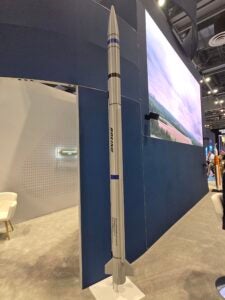
HUNTSVILLE, Ala. – Boeing [BA] this week revealed its design for the Army’s competition for a second interceptor for the Indirect Fires Protection Capability (IFPC) Increment 2 in the run up to an expected downselect shortly.
The company displayed its new design for the medium-range interceptor missile at its booth here this week at the annual Space and Missile Defense Symposium.
Boeing is teaming with Anduril Industries, which will supply the solid rocket motors. Last December, the Army awarded Boeing an Other Transaction Agreement for the prototype competition in 2026 for a second IFPC Inc. 2 interceptor (Defense Daily, Dec. 18, 2025).
The competition also includes Lockheed Martin [LMT], teamed with AeroVironment [AVAV], and RAFAEL Defense Systems, teamed with Kratos Defense & Security Solutions [KTOS].
The IFPC Inc. 2 launcher is in production by Leidos’ [LDOS] Dynetics unit. The current interceptor is the AIM-9X Sidewinder supplied by Raytheon, a division of RTX [RTX].
“We’re anxiously awaiting for the downselect decision from the government. We think that what we’ve offered the government fits well within their their requirements set, and we’re excited to see what those decisions are,” James Leary, senior director for weapon systems business development at Boeing, told Defense Daily here Thursday.
Leary said they do not know exactly when the decision will be since it is pending but “we sort of heard August. These are important decisions, so I don’t think it’s going to be rushed. I think the government is methodically doing the due diligence that they do on these huge future franchises that are going to be around for decades. You know, sometimes slower is faster.”
The company previously said its low-cost design uses a modular open systems architecture approach that can quickly adapt as threats change.
Several military leaders mentioned the importance of interceptor systems using open systems architecture by default going forward.
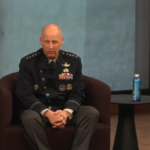
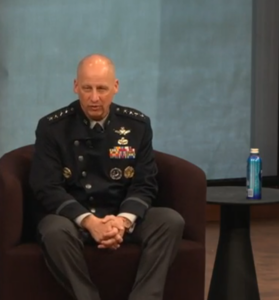
During his closing keynote here Thursday, Missile Defense Agency Director Lt. Gen. Heath Collins told the audience that going forward “open systems architecting is a requirement, it’s not a nice to have in the fight of the future. We need to be able to adapt at the pace the threat is adapting, and we don’t have the agility today in the systems to do that.”
Collins added while the Defense Department has software and tactics updates that get pushed to the field every week, “when the new capability comes on the market, we can’t wait for a six or seven or eight or even a four-year program to bring some capability to bear against that. We need to instantiate agility in everything we do.”