Search

Bi-Partisan Future of Defense Task Force Advises ‘Manhattan Project’ on AI

Bi-Partisan Future of Defense Task Force Advises ‘Manhattan Project’ on AI
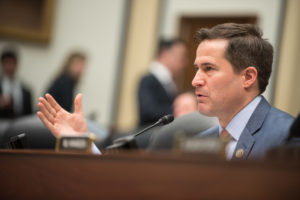
U.S. Rep. Seth Moulton questions senior military leaders during a House Armed Services Committee hearing on Capitol Hill, March 7, 2017. U.S. Air Force Gen. Selva, Vice Chairman of the Joint Chiefs of Staff, testified alongside U.S. Air Force Gen. John E. Hyten, commander of U.S. Strategic Command; U.S. Navy Adm. Bill Moran, Vice Chief of Naval Operations; and U.S. Air Force Vice Chief of Staff Gen. Stephen Wilson. They spoke about the continuing relevance of U.S. nuclear forces for our national security and the steps the Joint Force is taking to modernize and replace them. He also stated that U.S. weapons, delivery systems, the infrastructure that supports them, and the personnel who operate, monitor, and maintain them are prepared today to respond to any contingency. (DoD Photo by U.S. Army Sgt. James K. McCann)

The House Armed Services Committee's bipartisan Future of Defense Task Force on Sept. 29 released its final report laying out required military capabilities in the coming decades--chief among them artificial intelligence (AI). "Using the Manhattan Project as a model, the United States must undertake and win the artificial intelligence race by leading in the invention and deployment of AI while establishing the standards for its public and private use," per the report. "Although the Department of Defense has increased investment…


Subscriber-only content. Please log in below.

Not a subscriber or registered user yet?

Please contact us at clientservices@accessintel.com or call us at 888-707-5814 (Monday – Thursday 9:00 a.m. – 5:30 p.m. and Friday 9:00 a.m. – 3:00 p.m. ET.), to start a free trial, get pricing information, order a reprint, or post an article link on your website.


Congress Updates

Pentagon May Make ‘Tradeoffs’ For Low-Cost Autonomous Tech Without Reconciliation Funds, CTO Says

The Pentagon’s chief technology officer has said the department may need to make “tradeoffs” on certain capability priorities if Congress doesn’t pass a reconciliation with $350 billion in requested defense […]


SASC’s FY ‘27 NDAA Sticks With Army’s Plan For Legacy Aviation Procurement Cuts

The Senate Armed Services Committee’s (SASC) version of the next defense policy sticks to the Army’s proposed plan to cut procurement of its legacy aviation fleet, and does not authorize […]


SASC Approves $1.14 Trillion FY ‘27 NDAA With ‘Right to Repair’ Reform, Stock Buyback Restriction

The Senate Armed Services Committee (SASC) has approved its $1.14 trillion version of the next defense policy bill, adopting “right to repair” reform to provide the military services’ greater ability […]


House Appropriators Unveil $1.07 Trillion FY ‘27 Defense Bill, Restore Funds For E-7, Army Aviation

House appropriators on Wednesday released their $1.07 trillion fiscal year 2027 defense spending bill, with the legislation reversing Army aviation cuts, restoring funding for the Air Force’s E-7 Wedgetail program […]