 By
By 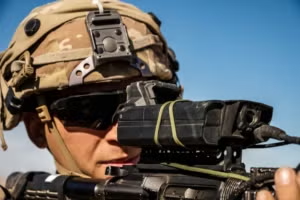
Based on feedback from individual soldiers, an Army science and technology (S&T) center broadly focused on advanced technology development around C5ISR needs is assessing how to improve counter-drone capabilities at the lowest tactical level, Army officials said on Wednesday.
The Army Combat Capabilities Development Command C5ISR Center for the past year been surveying industries’ developments in being able to provide counter-unmanned aircraft system (C-UAS) solutions to individual soldiers and small units and is looking for industry partners, Jami Davis, assistant director for soldier and platform mission equipment, told reporters.
“And our goal is to really focus on new technologies that integrate with existing soldier kit or leverage kit they already have, so that we’re not adding tremendous amounts of size, weight, and power and unique equipment specifically that only address counter-UAS,” Davis said during a media roundtable at the annual Association of the U.S. Army conference.
Beth Ferry, director of the C5ISR Center, said that the user community is saying a priority requirement of an individual solider is “knowing he’d being observed by a UAS.”
One takeaway from the survey has been that there is existing “unique equipment, extra equipment” on the market “that probably isn’t sustainable for every tactical soldier,” Davis said. Another lesson is that not every soldier necessarily needs the same equipment for C-UAS and could instead be “formation-based” to “distribute the load within the formation or small unit,” she said.
Software-based solutions that leverage sensors soldiers already use is an area of interest, Davis said.
Earlier this year, L3Harris Technologies [LHX] introduced Wraith Shield, a software upgrade to existing waveforms used in its soldier-worn Falcon 4 tactical radios, turning them into sensors that leverage radio frequencies to detect and defeat small, low-cost drones (Defense Daily, May 13). Wraith Shield successfully cleared the Army’s Jailbreak process that allows vendors to prove their systems can be integrated with the service’s data layer to enable real-time information sharing (Defense Daily, May 12).
Davis acknowledged that companies are introducing solutions, but the center’s goal “is just to try and make those better, smaller, lighter, more integrated, so that the tactical soldier doesn’t have to carry more unique equipment.”
Integration a Focus
The C5ISR Center’s solider-focused C-UAS effort isn’t tied to individually-borne equipment. “Layered sensing” could include equipment on an Infantry Squad Vehicle, an unmanned ground vehicle and personnel that can be networked into a common solution, she said.
Maj. Andrew Durfee, military deputy for the Research and Technology Integration Directorate, highlighted sensor data integration to be able to do “cross-cuing” as a key effort in obtaining localized C-UAS solutions that include defeating drones. He cited the Army’s Next Generation Command and Control modernization initiative to compress kill chains.
“There really is, I think, a lot of room for innovation there, both from a software and a hardware perspective,” Davis said. “But our starting point is looking at what gear the soldier…already has and how we can start with that equipment and then add as necessary.”
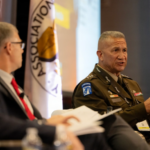
A new innovation effort underway is looking at lightweight sensing technology soldiers can wear to perform acoustic detection, Ferry, the center’s director, said during the panel discussion. The different drone platforms have different acoustic signatures and sensors that are integrated with other equipment that could detect a drone, resulting in an alert, she said.
The soldier-focused C-UAS effort is still in the laboratory stage and testing has not occurred yet, Ferry said. A “layered and diversified approach is what we’re focused on,” she said.
C-UAS is a core competency of the center, she said.