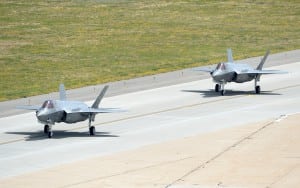
The first two combat-coded F-35A Lightning II aircraft arrive at Hill Air Force Base, Utah, Sept. 2, 2015. Photo: Air Force.
Language included in the newly enacted federal budget agreement will allow the Air Force to proceed with “critical” construction projects for its F-35A Lightning II program, according to a congressional panel.The provision, or “anomaly,” is part of a continuing resolution (CR) included in the two-year budget agreement, the Senate Appropriations Committee said Feb 8. The CR will fund the government through March 23. While CRs generally prevent new programs from beginning, the anomaly will "provide authority for new construction starts for…
President Donald Trump on Wednesday called on Congress to pass and send a second reconciliation bill to his desk by June 1. The deadline follows congressional Republicans’ backing a pursuit […]
Upgrades to the GPS ground system–the Architecture Evolution Plan (AEP)–is an option under consideration by the Defense Department’s space acquisition chief, as problems continue in fielding the GPS Next Generation […]
Senate Budget Committee Chair Lindsey Graham (R-S.C.) said Wednesday, with the White House’s backing, his panel will move “expeditiously” on crafting a second reconciliation bill, citing priorities for defense and […]
Defense Secretary Pete Hegseth on Thursday acknowledged the Pentagon could potentially ask Congress for $200 billion in supplemental funding to support the ongoing operation against Iran and replenish munitions used […]
Language included in the newly enacted federal budget agreement will allow the Air Force to proceed with “critical” construction projects for its F-35A Lightning II program, according to a congressional panel.
The provision, or “anomaly,” is part of a continuing resolution (CR) included in the two-year budget agreement, the Senate Appropriations Committee said Feb 8. The CR will fund the government through March 23.
The first two combat-coded F-35A Lightning II aircraft arrive at Hill Air Force Base, Utah, Sept. 2, 2015. Photo: Air Force.
While CRs generally prevent new programs from beginning, the anomaly will “provide authority for new construction starts for urgently-needed projects associated with the F-35A program to avoid schedule delays and anticipated cost increases identified by the Air Force,” the committee wrote in a summary of the new CR.
An Air Force official told Defense Daily Feb. 10 that the anomaly specifically applies to Eielson Air Force Base in Alaska, one of seven bases the Air Force has so far slated to host the F-35A, the conventional-takeoff-and-landing variant of the Lockheed Martin [LMT]-built fighter jet.
The Air Force announced in 2016 that Eielson will host two F-35A squadrons. Those aircraft are supposed to begin arriving at Eielson in 2020.
The anomaly “ensures the stationing of the F-35s at Eielson Air Force Base remains on track,” said Sen. Dan Sullivan (R-Alaska).
The budget agreement, which President Donald Trump signed into law Feb. 9, calls for spending $700 billion on defense in fiscal year 2018 and $716 billion in FY 2019. Those figures represent increases of $80 billion in FY 2018 and $85 billion in FY 2019 above previously enacted budget caps
Congress will now try to finish its FY 2018 appropriations bills to make the $700 billion figure a reality. In the meantime, the government will be funded by the new CR, the fifth such stopgap measure for FY 2018. The fourth CR expired Feb. 8.
U.S. Northern Command (NORTHCOM) used a counter small unmanned aircraft system (sUAS) flyaway kit (FAK) in the early hours of the strikes against Iran on Feb. 28, according to Air […]

 By
By