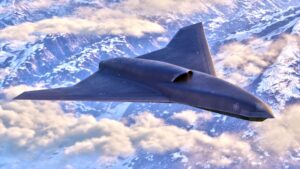
Lockheed Martin‘s [LMT] Skunk Works unit said that its Vectis drone under development for flight in the next two years will likely fit the needs of Increment 2 of the U.S. Air Force Collaborative Combat Aircraft (CCA) program.
“I do think it [Vectis] would be a great candidate for any of the specific needs,” Orlando “O.J.” Sanchez, vice president and general manager of Skunk Works, told reporters last week. “We have a lot of overlap with the U.S. Air Force and are supporting their approach to find the right requirements for their specific mission sets. Should the U.S. Air Force find that they need a highly survivable platform with the flexibility that Vectis enables for Increment 2, I think it would be a great candidate. We respect their process, as they go through and see what’s needed.”
Vectis “sits squarely in the category of a survivable, reusable, and flexible CCA, and I absolutely think, if that’s what the Air Force thinks they need, this will be a great candidate to meet those requirements.”
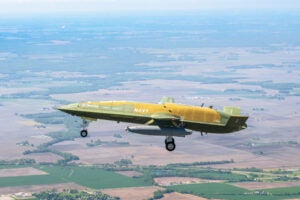
A large, runway dependent drone, Vectis is to be in the Group 5 class of the General Atomics‘ MQ-9 Reaper. The name of Vectis stems from the Latin word for “lever.”
Vectis “leverages decades of experience in stealth advancement to deliver best in CCA class survivability,” “will be offered at a CCA price point,” and is “built to avoid vendor lock by aligning to government reference architectures,” according to Lockheed Martin. The Vectis design is to draw upon Skunk Works’ decades of experience on internally-funded drones, including the X-44 Multi-Axis No-Tail Aircraft (MANTA) and the P-175 Polecat.
General Atomics said its YFQ-42A Gambit CCA prototype flew for the first time in California last month ahead of what the Air Force expects to be a CCA Increment 1 downselect in fiscal 2026, which starts Oct. 1 (Defense Daily, Sept. 11). For Increment 1, the YFQ-42A is competing against an Anduril Industries‘ YFQ-44A Fury prototype, which has not yet flown.
The Air Force has also said that it expects to start the development of CCA Increment 2 next year.
The latter increment is likely to move beyond the air-to-air mission.
“We absolutely see at Skunk Works that the integration of manned and unmanned teaming is going to provide battlespace effects that solve our problems,” Sanchez said last week. “Vectis creates a unique space where a survivable platform can deliver effects–in both air-to-ground and air-to-air…as well as provide critical information through an ISR and targeting role, as we look at domestic and international force design.”
A retired Air Force colonel who was the vice of Air Education and Training Command’s 325th Fighter Wing at Tyndall AFB, Fla., Sanchez joined Lockheed Martin in 2014 and became the vice president of Skunk Works in January. Sanchez was an F-15 and F-22 pilot, according to his service biography.