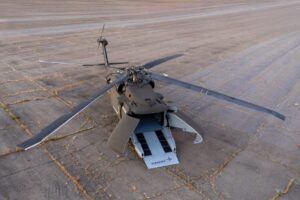
Lockheed Martin‘s [LMT] Sikorsky is developing what it calls its “Black Hawk Next” for the venerable UH-60 family of helicopters.
The company has four focus areas in the effort–GE Aerospace‘s [GE] T901 under the Army’s Improved Turbine Engine Program (ITEP); Black Hawk airframe enhancements, including strengthening it, expanding internal fuel tanks and a modular nose for new sensors and avionics; a digital backbone; and autonomy using the company’s MATRIX system to accommodate upgrades like launched effects.
As a successor to the delivery of the first autonomous Black Hawk to Fort Eustis, Va., in March, Sikorsky is to build three more autonomous Black Hawks with MATRIX, and those aircraft are to provide the company with soldier feedback on that autonomy, according to Sikorsky.
Sikorsky wants to increase Black Hawk payload by at least 1,000 pounds and at least 100 more nautical miles in range and 45 minutes more time on station.
“That new nose will give Black Hawk crews more than twice the internal volume to house their sensors and electronics, opening up new mission options and applications,” Wrigley said. “Coupled with the digital backbone, we’re creating a reconfigurable space and open architecture that makes integrating, swapping, and upgrading electronics faster and easier.”
In August, GE Aerospace said that it anticipates qualification of the T901 by the end of next year, and Sikorsky said it has begun flight testing (Defense Daily, Sept. 1). “We’re in the shakedown phase right now,” Wrigley said last week. “We’ll then get into the requirements testing where we go and prove that. Another big milestone coming up is testing in the high altitudes and very hot weather, which is a key performance parameter that this engine is designed to leap ahead at.”
The Army is to move the T901 into production no later than 2031. GE Aerospace has said that the Army is considering a first long lead order for T901 in 2028 and then ramping up to full production later.
Sikorsky said that it has logged more than 70 flight test hours with the ITEP engine so far. “The engine is no longer the limit on the Black Hawk,” Bill Felt, a Sikorsky test pilot, told reporters last week.
The Army awarded Sikorsky a $517 million engineering and manufacturing development (EMD) contract in February 2019 to develop the T901 engine under ITEP, which the Army had planned to cut under its transformation initiative but which Congress has sustained, including $63 million in last year’s reconciliation bill to continue testing and $175 million for development in fiscal 2026 (Defense Daily, Jan. 22).
The T901 is to be a 3,000-pound shaft horsepower engine, compared to the average 2,000 pounds of its predecessor, the T700, the first of which rolled off the production line in 1978.
GE Aerospace has said that 1,700 T700s have gone to Army AH-64 Apache attack helicopters by Boeing [BA] and 4,100 T700s to Army UH-60 Black Hawks.
The Army has said that the T901 will require no major modifications to the helicopters, as it will fit within the current engine nacelles of the Black Hawk and Apache.