NASA’s TEMPO Air Pollution Space Sensor Completed
PR Newswire
HAMPTON, Va., Dec. 7, 2018
HAMPTON, Va., Dec. 7, 2018 /PRNewswire/ — An Earth science instrument to measure air pollution over North America has successfully completed development by Ball Aerospace and Technologies Corp. in Boulder, Colorado, and has been formally accepted by NASA.
NASA and Principal Investigator Kelly Chance from the Smithsonian Astrophysical Observatory (SAO) in Cambridge, Massachusetts, partnered with Ball to design, manufacture and test this Earth science instrument. The rigorous environmental test campaign conducted by Ball verifies the Tropospheric Emissions: Monitoring of Pollution, or TEMPO, instrument will survive all of the challenges related to launch, as well as sustained operations in geostationary orbit.
TEMPO will be the first space-based instrument to monitor major air pollutants across the North American continent hourly during daytime. In doing so, it will revolutionize air quality forecasts and emission control strategies, and enable effective early public warning of pollution events.
“TEMPO exploits 30 years of our development of ultraviolet and visible atmospheric spectroscopy to make air quality measurements at revolutionary spectral and spatial scales,” said Chance.
“With completion of the instrument and full spaceflight qualification by Ball, we are extremely excited about the acceptance of TEMPO, which will lay the framework for NASA and SAO’s critical air quality measurements,” said TEMPO Project Manager Stephen Hall at NASA’s Langley Research Center in Hampton, Virginia.
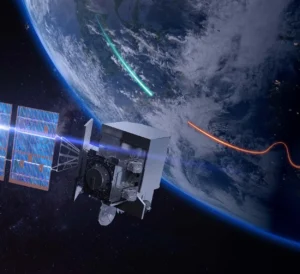
While NASA has taken ownership of the TEMPO flight hardware, the instrument will remain in storage at Ball until a host spacecraft is selected. NASA will partner with the U.S. Air Force’s Space and Missile Systems Center in El Segundo, California, to employ their Hosted Payload Solutions (HoPS) contract to issue a request for proposals from commercial companies to provide satellite integration, launch services and ground operations for TEMPO. Flying on this commercial spacecraft, TEMPO will make observations from a geostationary vantage point, about 22,000 miles above Earth’s equator.
TEMPO is the first instrument to be awarded by NASA’s Earth System Science Pathfinder Program in the Earth Venture Instrument (EV-I) Class Series. TEMPO is a UV-visible spectrometer, sensitive to visible and ultraviolet wavelengths of light. It detects pollutants and other elements of atmospheric chemistry by measuring sunlight reflected and scattered from the Earth’s surface and atmosphere back to the instrument’s detectors.
Learn more about the science behind the TEMPO instrument in a video produced by SAO: tempo.si.edu.
For more information about Langley Research Center, visit:
 View original content to download multimedia:http://www.prnewswire.com/news-releases/nasas-tempo-air-pollution-space-sensor-completed-300761930.html
SOURCE NASA