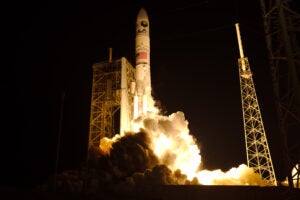
NASA will launch a satellite that will measure carbon dioxide in the atmosphere and track down its source, with liftoff on a Taurus XL rocket set for 1:51 a.m. PT Feb. 23 from Vandenberg Air Force Base, Calif., NASA officials said. The Orbiting Carbon Observatory (OCO), costing $278 million including two years of operation, will detail the buildup of carbon swirling around Earth, the officials said in a media briefing at NASA headquarters in Washington. OCO will enter a 438-mile-high…
Recommended
Trending
Congress Updates
Warren And Sheehy Renew Call for “Right to Repair” In NDAA
Sen. Elizabeth Warren (D-Mass.) and Sen. Timothy Sheehy (R-Mont.), two members of the Senate Armed Services Committee (SASC), are renewing their call for “Right to Repair” language in the National […]
HASC Looks To Restrict USV Deliveries Without Navy CONOPS And Strategy
The House Armed Services Committee’s (HASC) fiscal year 2027 defense policy draft bill aims to restrict the Navy’s use of unmanned surface vessels (USV) until it decides on key factors […]
Gaps In Army’s Tactical Counter-Drone Capabilities Remain Concern Of HASC
A draft defense policy bill released this week says the Army is fielding counter-drone capabilities for defense of fixed sites and maneuver forces but suggests that troops at the lowest […]
HASC Wants Closer Look At Army’s SBMC Program, Cites Avoiding Past IVAS Missteps
The House Armed Services Committee (HASC) wants a closer look at the Army’s Soldier Borne Mission Command (SBMC) effort, citing support for the development program while expressing caution to avoid […]
Job Feed
-
Principal Computer Scientist
Anser - Reston, VA -
Detection Engineer Analyst Subject Matter Expert (SME)
RMC - Resource Management Concepts Inc. - Quantico, VA -
Junior Systems Engineer Missile Defense / Space Systems (Secret)
Aegis Aerospace Inc. - Colorado Springs, CO -
Solutions Architecture & Sales Engineering
Salesforce - Aleut Federal, LLC - Arlington, VA