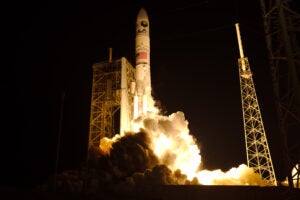
By Marina Malenic After a day-long weather-related delay, NASA Oct. 28 launched a next-generation moon rocket that could replace the Space Shuttle. At 1130 EST, the 177-foot-tall Ares I-X took off from Kennedy Space Center, Fla., and flew for six minutes before splashing down into the Atlantic. Ares prime contractor ATK [ATK] hailed the successful launch of the rocket and, potentially, a new moon mission by 2020. "This flight test is the culmination of four years of progress and is…
Recommended
AV Expects Upgraded LOCUST X3 Laser To Be ‘Forward Deployed’ In Coming Months
Trending
Congress Updates
Upgrading Current GPS Ground System “Now a Viable Option,” As GPS OCX Problems Continue, Space Official Says
Upgrades to the GPS ground system–the Architecture Evolution Plan (AEP)–is an option under consideration by the Defense Department’s space acquisition chief, as problems continue in fielding the GPS Next Generation […]
Graham Says GOP To Move Ahead On Second Reconciliation Bill, With Defense Funds As Priority
Senate Budget Committee Chair Lindsey Graham (R-S.C.) said Wednesday, with the White House’s backing, his panel will move “expeditiously” on crafting a second reconciliation bill, citing priorities for defense and […]
Hegseth Acknowledges Potential $200 Billion Iran Supplemental Request, Final Figure ‘Could Move’
Defense Secretary Pete Hegseth on Thursday acknowledged the Pentagon could potentially ask Congress for $200 billion in supplemental funding to support the ongoing operation against Iran and replenish munitions used […]
Counter-Drone Flyaway Kit Used In U.S. In Early Hours Of Iran Strikes, NORTHCOM Head Says
U.S. Northern Command (NORTHCOM) used a counter small unmanned aircraft system (sUAS) flyaway kit (FAK) in the early hours of the strikes against Iran on Feb. 28, according to Air […]