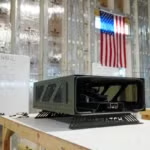

More MQ-25A Flying. Boeing on July 10 announced the first MQ-25A Stingray carrier-based unmanned tanker aircraft completed its second test flight, which included landing gear cycles testing and a new software load for future envelope expansion tests. The milestone “further validates the autonomous flight controls and performance capabilities, moving it closer to carrier operations,” Boeing said. During the test, Boeing and Navy air vehicle pilots sent aircraft commands from the Unmanned Carrier Aviation Mission Control System MD-5 Ground Control Station at MidAmerica St. Louis Airport. The aircraft received commands and then autonomously managed the propulsion, subsystems, guidance and flight controls needed for landing gear movement. Next steps include Boeing applying Navy livery to the aircraft and additional test fights from MidAmerica, which is in Illinois. The announcement comes weeks after the MQ-25 T-1 demonstrator aircraft was loaded aboard the USS Nimitz (CVN-68) during U.S. 250th anniversary celebrations.
Smith On NDAA. As the House is set to take up the fiscal year 2027 National Defense Authorization Act (NDAA) the week of July 20, Armed Services Committee Ranking Member Adam Smith (D-Wash.) has signaled that he is “likely to oppose the bill” due to the large defense topline increase and the potential adoption of “poison pill amendments” during floor debate. “Our country faces threats and DoD has modernization needs, but I cannot and do not support meeting these needs by making massive cuts to critically important domestic programs and slashing taxes. We need to be more fiscally responsible and DoD needs to become more innovative and efficient in terms of developing capabilities to meet our national security needs in a more cost-effective manner,” Smith said in a July 17 statement. “Finally, based on the rule that failed on the House floor two weeks ago, the bill is likely to be loaded up with toxic amendments that continue the right-wing culture war assault on the LGBTQ+ community and preempts State and local laws under the guise of military readiness. That same rule included almost no democratic amendments that would have allowed debate on serious issues such as the topline budget number, Trump’s Battleship, the war against Iran, domestic deployments of the military, defending free press, speech, and elections, and ethical issues and corruption by the Trump Administration.”
Jackson Joins Race. Rep. Ronny Jackson (R-Texas) announced on July 13 he will join the race to serve as the next top Republican on the House Armed Services Committee. Jackson, a retired Navy rear admiral and former White House physician, is vying for the spot to replace the term-limited HASC Chair Rep. Mike Rogers (R-Ala) against the more senior Reps. Rob Wittman (R-Va.) and Trent Kelly (R-Miss.). “As chairman, I will fight to advance military readiness, make critical investments in our national defense and always put our servicemembers and their families first. With the support of my colleagues, I will lead the committee in delivering the authorities necessary to ensure our military is prepared to meet the growing threats posed by our adversaries,” Jackson said in a statement. Jackson, who has represented Texas’ 13th district since 2021, currently leads HASC’s Intelligence and Special Operations Subcommittee.
Budget Resolution. The White House on July 16 issued a statement that it “strongly supports the immediate passage” of the House’s budget resolution for a third reconciliation bill, which includes $60 billion for defense. “This budget resolution is a crucial first step in allowing congressional Republicans to quickly pass a budget reconciliation bill that protects America’s elections, strengthens America’s national defense and supports American farmers,” the Trump administration said. The statement of support followed the House Budget Committee’s 20-14 party line vote to approve the $95 billion budget resolution. The $60 billion figure for defense in House Republicans’ blueprint for the next reconciliation bill is slightly below the administration’s request to cover Iran war costs and a far cry from the $350 billion the Pentagon is seeking as part of its fiscal year 2027 budget request. The White House said the funding provided for defense is “necessary for the [Pentagon] to cover increased operational costs and readiness expenses, while making investments to support critical capabilities, munitions procurement and strengthen the U.S. industrial base.”
Trump/Pennsylvania DIB. President Donald Trump on July 15 detailed plans for at least $10 billion in defense industrial base investments in Pennsylvania, noting the figure could “end up being about $19 or $20 billion.” “And these investments will create more than 4,000 jobs. Pennsylvania workers will build the ships, submarines, trucks, weapons and industries that will ensure America remains the strongest and most powerful nation in the history of the world,” Trump said during remarks at the Pennsylvania Defense and Innovation Summit. Trump noted the U.S. will be building “two massive national security multi-mission vessels” at the “beautiful and historic” Philadelphia shipyard and announced that General Dynamics Electric Boat would be investing $2.5 billion into Philadelphia-based Rhoads Industries to help with building Navy submarines. “I hate to mention [GD’s] name now because they’re a little slower than we want, but that’s okay,” Trump said. Trump also cited Philadelphia firm Day & Zimmermann’s new $2.3 billion contract to support Hawthorne Army Deport, Voyager Technologies plans for investing “hundreds of millions of dollars in turning Pittsburgh into an international robotics and space technology hub,” Mack Defense’s $222 million contract to build heavy dump trucks for the Army and AI firm Air’s aim to spend $450 million expanding its Pittsburgh office.
More HDTs. Mack Defense recently announced the latest order from the Army to deliver 115 more M917A3 Heavy Dump Trucks (HDTs) for the National Guard. The deal was placed under the company’s five-year, $221.8 million production contract with the Army awarded in June 2025. “This latest order reinforces the critical value and importance of our long-standing partnership with the U.S. Army. These rugged, mission-ready Granite-based HDTs directly support the warfighter by enabling essential construction, infrastructure maintenance and disaster relief operations worldwide,” Derik Beck, Mack Defense’s senior director of sales and marketing, said in a statement.
Green Wolf DiSCO. L3Harris Technologies’ Green Wolf electronic warfare drone-launched effects munition, introduced by the company a year ago, has run an initial flight test of the Distributed Spectrum Collaboration and Operations (DiSCO) electromagnetic battle management ecosystem outfitted with Shield AI’s Hivemind mission autonomy software. “Unmanned aircraft systems detected, analyzed and responded to electromagnetic threats without human intervention on a live flight test range,” according to L3Harris. “Hivemind, on board the Green Wolf, commanded the aircraft based on threat data from DiSCO, autonomously rerouting follow-on unmanned systems through a safe operating zone without human input…L3Harris and Shield AI will continue to expand mission applications and autonomy though open architecture for electronic warfare at the tactical edge.”
JASSM Advanced Manufacturing. Machina Labs, a Los Angeles-based advanced manufacturing and robotics company founded in 2019, said that Lockheed Martin–a Machina investor–has awarded the company a qualification contract for an assembly for the Air Force Joint Air-to-Surface Standoff Missile (JASSM), an award that “marks the first time an assembly produced in a Machina factory has advanced to qualification for a defense missile system.” Machina said that it used its RoboForming technology and precision laser welding to build the assembly for JASSM. Machina CEO and co-founder Edward Mehr said in a statement that “missile programs are not constrained by design,” but “by production and that “Machina’s factory is built to address that constraint, forming and assembling complex metal structures directly from digital design with dramatically shorter lead times.” The Air Force wants to increase the production of JASSM by nearly four times to 16,450 missiles in the next seven years.
Crane Innovation Cell. Naval Surface Warfare Center, Crane Division (NSWC Crane), on July 15 announced it was launching the Crane Rapid Capabilities Cell (CRC2) to quicken delivery of critical technology to warfighters. NSWC Crane said the cell will act as a direct pipeline for identifying and delivering solutions “to meet the most urgent and emerging needs of the U.S. Navy.” The warfare center added that CRC2 is meant to be aligned with the Navy Rapid Capabilities Office and PAE Rapid Capability Cells to bridge operational needs with NSWC Crane’s technical capabilities while collaborating across warfare centers. “CRC2 monitors Fleet demand, coordinates response options such as rapid acquisitions, supports problem curation efforts such as with Warfighter Driven Challenges, and facilitates proposal development, partnerships, and outreach,” the NSWC Crane said in a statement.
Parsons Space Ground. Parsons’ subsidiary Space Ground System Solutions, Inc., won a five-year $254 million contract from the Naval Research Laboratory (NRL) on July 14 for mission-critical satellite ground systems software and operations. The award covers software development, sustainment and operations support for satellite mission systems under the Blossom Point Tracking Facility Software and Operations Support contract. This follows 30 years of similar work advancing NRL’s government-owned applications including the Neptune Software for automated satellite command and control and ground equipment control and status, and the Virtual Mission Operations Center for satellite mission management. The contract work includes designing, testing, maintaining, and enhancing mission-critical software modules.
German Navy Laser. The German Federal Office for Equipment, Information Technology and Use of the Bundeswehr on June 9 signed a contract with the High-Energy Laser Naval Demonstrator Working Group (ARGE HEL) consisting of MBDA Deutschland GmbH and Rheinmetall Waffe Munition GmbH to develop a high-energy laser weapon system for the German navy. According to a July 9 MBDA announcement, the German government aims for the laser weapon system to be operational by 2029. The ARG HEL is based on an integrated system demonstrator that previously underwent a year of testing and over 1,000 shots at sea undergoing operational conditions while proving out capability against air, sea and land targets. This contract covers development of a complete system for maritime applications and will cover “the entire chain of operations, from reconnaissance and target tracking to engagement, MBDA said. The company also noted the joint venture is focused on using German domestic supply chains to “safeguard national sovereignty in this key technology.” The laser effector is to be containerized and meant to be cost-effective for use in port security as well, Thomas Gottschild, executive vice president strategy & future growth at MBDA, added.
DDG-131. The Navy christened the future USS George M. Neal (DDG-131) Flight III Arleigh Burke-class destroyer on July 11, the fourth built at HII’s Ingalls Shipbuilding division in Pascagoula, Miss. The ship is named after a Korean War veteran and Navy Cross recipient. Other Flight III destroyers under construction by HII include the future USS Jeremiah Denton (DDG-129), George M. Neal (DDG-131), Sam Nunn (DDG-133), Thad Cochran (DDG-135), and John F. Lehman (DDG-137). HII also has several ships in the pre-planning phase, include Telesforo Trinidad (DDG-139), Ernest E. Evans (DDG-141), Charles French (DDG-142), Richard J. Danzig (DDG-143), Intrepid (DDG-145), Robert Kerrey (DDG-146), and Ray Mabus (DDG-147).
Cutters to PACOM. The Coast Guard last week said it has moved its small fleet of Fast Response Cutters from the U.S. Central Command area of operations (AOR) to the Western Pacific, U.S. Pacific Command’s AOR. The Expeditionary Cutter Squadron (ECS) was previously called Patrol Forces Southwest Asia during its operations in the Persian Gulf region for more than 20 years. In PACOM’s AOR, the ECS is “conducting maritime security operations and cooperative maritime activities with allies and partners in the region, in response to national security requirements,” the Coast Guard said. These operations include protecting “maritime approaches” to Guam and the Pacific islands.
Steel Cut. Bollinger Shipyards last week said its shipyard in Houma, La., cut steel on the first Arctic Security Cutter in April, two months before the company finalized its $2.2 billion contract to build four of the medium polar icebreakers for the Coast Guard. Bollinger cited reporting by the Naval Institute’s independent USNI News organization, which first reported the story.
Rocket Motor Test. Firehawk Aerospace last week successfully conducted a static fire test of the Hydra 70 rocket motor, a milestone the startup said is a step toward becoming a second source supplier. General Dynamics’ Ordnance and Tactical Division is the current supplier of the solid rocket motor for the Hydra 70, which can be outfitted with the Advanced Precision Kill Weapon System laser guidance kit to become a precision guided weapon. Firehawk noted that the Hydra 70 is increasingly being used to defeat drone threats.
Space Force Award. Slingshot Aerospace has received a $69.2 million contract from the Space Force artificial intelligence-based mission rehearsal and operational testing capabilities that Guardian’s will use to train for defending U.S. and allied interests in space, the company said last week. The Small Business Innovation Research Phase III award is the largest contract ever for Slingshot. Under the MENTAT program, Slingshot is providing its TALOS AI operational training and strategy agent that “models realistic spacecraft behaviors, generates strategic response options, processes vast amounts of complex data, and supports mission rehearsal across continuously evolving space scenarios,” the Colorado-based company said.
ATACMS For Taiwan. The Army on July 15 awarded Lockheed Martin a $439.4 million contract to procure ATACMS guided missiles that will be provided to Taiwan under a previously-approved foreign military sale. Work on the deal is expected to be completed by the end of February 2031, according to the Pentagon.
Canada/GD. Canadian Prime Minister Mark Carney on July 16 announced a new strategic partnership with General Dynamics Land Systems-Canada (GDLS-Canada) that includes investing nearly $1.4 billion over four years to build 190 additional Armoured Combat Support Vehicles (ACSVs). The deal will expand Canada’s ACSV fleet to 500 vehicles, the country noted. “The new ACSVs will keep soldiers protected, mobile and mission-ready in the most demanding environments. They combine advanced armor to protect against mines, improvised explosive devices and enemy fire, with the mobility to keep pace with front-line forces,” the Canadian government said in a statement. “Every vehicle will be designed by Canadian engineers, built with Canadian materials, and assembled by Canadian workers at the GDLS-Canada factory in London, Ontario.”
Blue UAS Addition. AIRO Group Holdings says its Group 1 RQ-35 Heidrun fixed-wing drone has been added to the Defense Contract Management Agency’s Blue UAS List, ensuring it meets certain supply chain and cybersecurity compliance measures and makes it easier to sell to Defense Department and other government customers. The hand-launched RQ-35 can fly autonomously and can fly for 2.5 hours. The drone was developed by AIRO’s Denmark-based Sky-Watch business unit. AIRO recently opened a manufacturing facility in Phoenix, Ariz., to be its main domestic facility for production, delivery and lifecycle support to meeting growing U.S. demand.
GEOINT Delivery. HawkEye 360 last Friday said it partnered with Lockheed Martin during the recent Valiant Shield 2026 exercise in the Pacific to rapidly deliver geospatial intelligence across “vast areas) for tracking targets and passing the data to tip and cue other systems. HawkEye said it demonstrated tactical direct downlink of its space-based radio frequency GEOINT data to Lockheed’s edge processing node, enabling the generation of “high precision track custody for advanced defense systems such as the LM Aegis Combat System.” Valiant Shield, a multinational exercise hosted by U.S. Pacific Command, “highlighted the warfighter demand for high quality commercial signals intelligence in support of joint force operations in contested environments,” the company said.
Solar Cell Help. The Defense Department has invested $7.1 million in Ohio-based Martin Materials Solutions LLC, to establish and scale advanced manufacturing processes for the domestic supply of space solar cell coverglass, which protects the cells from radiation and micrometeorites, and provides selective wavelength filtering. DoD is using Defense Production Act Title III funds for the investment. The investment is part of the Trump administration’s goal to boost the domestic space industrial base. Coverglass is used on all satellites.
Sea Breeze. The Navy announced the second iteration of Exercise Sea Breeze, 26-2, kicked off in Portland, United Kingdom on July 13. Participating forces will conduct mine hunting operations utilizing Mine Countermeasure Vessels, explosive ordnance disposal teams, dive and salvage operations, unmanned underwater vehicles and unmanned surface vessels for a focus on operations in the Black Sea region. Participating naval forces include those from the U.S., Bulgaria, Denmark, Estonia, France, Georgia, Greece, Japan, Latvia, Poland, Spain, Sweden, Türkiye, NATO Maritime Allied Command, Ukraine, and the U.K.