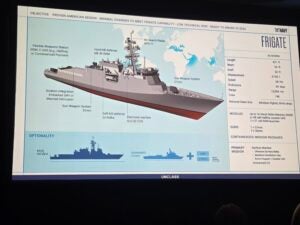
HII Frigate Work. HII has started build work on a preliminary basis on the Navy’s new FF(X) frigate, which is based on the Legend-class Coast Guard cutters built by the company, Tom Stiehle, HII’s chief financial officer, said last week. The company expects to be put under contract for the build work potentially later this year, he said during HII’s second quarter earnings call. HII was first awarded a $283 million contract in April to start work on the frigate, with the initial focuse on lead yard support.
…Battleship. Stiehle also said HII had also done “the initial start of the design work for the [Trump-class] battleship [BBG(X)] as well on a limited basis with support and cooperation with the Navy.” In May, Jason Potter, then-performing the duties of assistant Navy secretary for research, development and acquisition, told the House Armed Services Seapower subcommittee they believe Dry Dock 12 at HII’s Newport News Shipbuilding shipyard can be used for final assembly of the battleship program when sequencing it between aircraft carriers.
…MUSV Testing. HII President and CEO Chris Kastner said on the call the company’s Romulus Medium Unmanned Surface Vessel (MUSV) is scheduled to perform in the Navy’s MUSV at-sea testing phase in September. The Navy first picked HII and six other companies to prototype MUSVs in an at-sea testing phase that was billed to last from June to October. The Navy plans to field the first operational production-version MUSV under this program in fiscal year 2027.
Missile Defense Goals Unmet. The Government Accountability Office (GAO) on July 30 published a classified report, titled “Missile Defense: Annual Goals Remain Unmet As Missile Deliveries and Testing Continue.” GAO said the report is on a list of products determined to include either classified or controlled unclassified information “by the Executive Branch audited agencies and therefore cannot be publicly released.” While this report is restricted, a GAO report with the same title published in 2023 said the office found at the time the Missile Defense Agency did not meet the goal for the systems it plans to deliver and test in fiscal year 2022.
Aussie Steel. The Australian government on July 29 announced Australia’s Bisalloy Steel received a $2 million purchase order from U.S. submarine shipbuilder General Dynamics Electric Boat, the first time an Australian company received such an order under the tripartite AUKUS agreement. It specifically covers an order for HY80 steel plate to support production and construction of Virginia-class submarines following the company’s qualification for the U.S. Navy’s structural steel standards. Bisalloy was qualified via the Australian government’s Defense Industry Vendor Qualification, first established in 2024. This qualification allows Australian companies to enter the U.S. submarine supply chain. The qualification process included a “close collaboration” between Bisalloy, Bluescope, the Australian Submarine Agency, GD and the U.S. Direct Reporting Portfolio Manager for Submarines to demonstrate Australian industry’s ability to meet the standards for submarine construction.
…Aussie Dry Dock. Separately, the government selected the Australian subsidiary of Leidos Gibbs and Cox to lead primary design for a “contingency dry dock” the government plans to establish in Western Australia to support the future nuclear-powered attack submarine (SSN) capability. The government said selecting the designer now for floating dry dock services will ensure Australia is ready to perform the repairs and maintenance for the future SSN fleet starting in the early 2030s. The government plans to be ready to conduct submarine depot-level maintenance starting in the late 2030s. It also said this dry dock capability is a “pre-condition of Australia receiving its first Virginia-class submarine and will provide a critical contingency capability for Australia and its partners.” The dry dock work is part of the government’s initial $8.4 billion investment for the Henderson Defence Precinct to perform submarine work.
Big Space Raise. Satellite manufacturer K2 Space last week said it raised $500 million in a Series D round that will be used to expand its factory, add employees, scale its newest satellite and meet delivery schedules for customers. K2 is building large satellites for payload mass and plans to introduce the 100 kilowatt Giga-class spacecraft in the second half of 2028 as the “foundational platform for deploying massive amounts of compute on orbit,” the California-based company said. K2 has a 180,000 square foot manufacturing facility where it says it will build up to 100 satellites per year. K2 is partnered with Anduril Industries on space-based interceptors for Golden Dome and is the bus provider for the Space Force’s Protected Tactical Satcom-Global program. The investment was led by Kleiner Perkins and ICONIQ and values the company at $6.8 billion.
Satellite Manufacturing Help. Satellite developer and manufacturer Fortastra has a new memorandum of understanding with advanced manufacturing startup Hadrian to explore opportunities to apply Hadrian’s capabilities in precision machining and 3D printing to speed spacecraft production. The agreement would also allow Fortastra to leverage Hadrian’s platform for greater visibility across the manufacturing lifecycle. “This partnership with Hadrian brings world-class manufacturing expertise directly into our engineering process, positioning us to pursue funded prototype efforts that validate advanced manufacturing’s impact on satellite development for national security missions,” Fortastra CEO Mike Smaydra said in a statement.
Hidden C-UAS Award. Hidden Level, which has developed passive radar and radio frequency systems to detect drone threats, received a $100 million Other Transaction Authority contract from the Defense Department to further mature and produce its systems for detecting, tracking and identifying crewed and uncrewed aircraft over military installations, test ranges and the U.S. border, the company said last week. The award allows DoD customers to work with Hidden Level on rapid prototyping and sensor deliveries. “Hidden Level’s passive radar distinguished itself as a top performing sensing capability the Technology Readiness Experimentation 25.2,” Mike Tran, director of prototyping in DoD’s Office of Research and Engineering, said in a statement. The R&E Office issued the OTA through the Army Contracting Command-Rock Island.
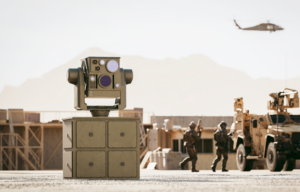
C-UAS Laser Deployments. U.S. Forces in Europe and U.S. Forces Africa have deployed Boeing’s Compact Laser Weapon System (CLWS) to location across the theater to counter drone threats as part of a layered counter-unmanned aircraft system (C-UAS) defense, the forces said last Thursday. Specific locations where the CLWS are deployed were not disclosed due to operational security, the forces said “it is integrated into the base’s broader air defense network and if employed, coordinated with host nation authorities.” A 5-kilowatt CLWS was successfully demonstrated in 2024 in the U.S. Central Command area of operations against Group 3 UAS (Defense Daily, Oct. 11, 2024). USAFE-AFAFRICA has also tested the ground-based Advanced Precision Kill Weapons System, a laser-guided 2.75-inch rocket, to intercept drones up to six kilometers away.
Hivemind for Thunder Tiger. Shield AI and Taiwan’s Thunder Tiger Corp. on July 29 announced they successfully validated the former’s Hivemind AI pilot aboard the latter’s unmanned surface vessels (USVs), completing the artificial intelligence system’s first multi-asset autonomous teaming demonstration on water. In the demonstration, Thunder Tiger’s SeaShark 600 and SeaShark 800 USVs were equipped with Hivemind and autonomously performed a coordinated intelligence, surveillance, and reconnaissance mission in Taiwan using maritime radar, imagery, and Automatic Identification System data. The companies said the Hivemind AI software autonomously planned mission waypoints, searched a designated maritime area, identified a target vessel of interest, and coordinated the USVs to escort the vessel out of the designated search zone. This milestone marked Hivemind’s first multi-asset autonomous teaming demonstration on water and Hivemind’s first maritime radar and AIS integration. Shield AI earlier this year formed a partnership with Thunder Tiger to support dual-use missions.
UAS Edge Compute. Industrial internet of things and edge AI compute technology provider is working with drone autonomy software developer Swarmer to create a custom compute platform for Group 1 unmanned aircraft systems (UAS) for use by Ukraine, U.S. and allied defense forces. The companies aim for a solution that will provide four times the processing power on first person view drones to bolster visual navigation, automated target recognition, pixel lock and advanced teaming algorithms. “For military operators, this will result in the ability to field increasingly autonomous, software-defined Group 1 UAS that can adapt to evolving mission requirements through software updates rather than hardware replacement,” the companies said. Group 1 UAS weigh up to 20 pounds
C-UAS Support. Teledyne FLIR Defense last week said it has received a subcontract from AeroVironment to supply its Argus XL sensor package and command-and-control software as part of AV’s recent $500 million Titan counter-drone contract with the Pentagon’s Joint Interagency Task Force-401. The fixed-site Argus XL includes the radar, electro-optical and thermal imaging sensors, and C2 software as the core detection capabilities for the Titan Multi-Sensor counter-unmanned aircraft system.
OTHR Timing. In March 2025, the office of Canadian Prime Minister Mark Carney announced a collaboration with Australia on a more than $4 billion Arctic radar for the North American Aerospace Defense Command–the Canadian Over-the-Horizon Radar (OTHR), which is to leverage Australia’s BAE Systems’ Jindalee Operational Radar Network (JORN). First conceived in 1984, JORN has three sites in Australia that provide high frequency, wide area surveillance of ships and aircraft out to 1,800 miles. “As we looked at what we wanted to do for an OTHR, the timing just wasn’t matching up [with Canada’s],” says Lea Kirkwood, the U.S. Air Force’s program acquisition executive for the electronic systems directorate. “But we have been working at a pretty swift clip since we received the latest NORTHCOM [U.S. Northern Command]/NORAD requirements. I don’t know if we’ve released the actual dates yet.” In 2024, NORTHCOM said that it wanted up to six OTHRs by 2028–the first two in the U.S.–to counter advanced missiles, including hypersonic ones.
…Two Sites. For the OTHR, the U.S. is looking at two sites–White Horse Ranch in a remote area of southeastern Oregon and nearby Christmas Valley Air Force Station, Oregon–the location of a former OTH-backscatter radar. The U.S. deactivated the site in 2002. “Right now, our focus is on the first [OTHR] system and getting the initial capability out to the field,” says Air Force Col. Mark Wuertz, the senior materiel leader for the ground-based air defense sensors division of the electronic systems directorate. “We approach anything on the table to see if the amount of land is enough and if it’s quiet enough to be able to support us.”
Helicopter Upgrades. Bell said on July 27 it has received a deal that could total $300 million to provide upgrades for 49 Marine Corps AH-1Z Viper and UH-1Y Venom aircraft. The contract covers Phase 3 of the Structural and Power Improvements for NextGen Effects (SPINE) upgrade effort, with deliveries of the modified aircraft to begin in 2028. Bell said the SPINE program “provides greater electrical power capacity for modern warfighting capabilities and improved ability to integrate next-gen technology for enhanced lethality and survivability.” “Beginning SPINE Phase 3.0 emphasizes the importance of this essential modernization effort and enables the USMC H-1 fleet to remain competitive with current and future capabilities,” Danielle Markham, Bell’s program chief, said. “SPINE will enable H-1 operators and maintainers to implement the equipment and technology needed to keep the aircraft as a fully interoperable member of the modern joint force throughout the lifetime of the H-1 fleet.”
AI-Powered Detection. Safe Pro, which describes itself as a “developer of artificial intelligence-enabled defense, security and situational awareness solutions,” said on July 30 it participated in the Army’s Project Convergence Capstone 6 (PC-C6) experiment at Fort Irwin in California, to demonstrate how soldiers can utilize small drones integrated with its “AI-powered threat detection and mapping solutions operating on the edge.” The demonstration specifically utilized Safe Pro’s “backpack-sized” Navigation Observation & Detection Engine-X (NODE-X) and OnSight software. “Under realistic combat training conditions, soldiers utilized NODE to analyze drone imagery and create detailed maps of threats including landmines and cluster munitions, rapidly sharing data across U.S. Army planning platforms in support of operational decision-making,” Safe Pro said in a statement. “The platform can identify more than 150 types of explosive threats and objects of interest across large-scale, high-risk environments, turning drone-based video data into detailed 2D & 3D models.”
…Black Hawk Launched Effects. The Army on July 31 said it conducted another demonstration firing an Air-Launched Effects capability from a Black Hawk helicopter at PC-C6, which follows a successful test fire in June at Fort A.P. Hill in Virginia. “The A-LE equipped [Black Hawk] is a critical force multiplier, enabling ground units to penetrate contested airspace while maintaining essential standoff distance,” the Army said in a statement. The demo has further “fast-tracked” development of the Long-Range Precision Munition (LRPM), the lethal variant of the Army’s Launched Effects program, the service noted.
NROL-95. The National Reconnaissance Office’s (NRO) NROL-95 mission launched aboard a SpaceX Falcon 9 from Cape Canaveral Space Force Station, Fla., last Thursday. “NROL-95 is the third NRO mission launched with SpaceX from the National Security Space Launch Phase 2 contract awarded in August 2020,” according to the NRO. Since May, 2024, the NRO has launched 14 missions for the agency’s proliferated architecture consisting of smaller satellites in different orbital planes. The last of the 14 missions launched on June 19.
Mach’s Viper in Europe. Mach Industries last week said its Viper vertical takeoff cruise missile conducted a demonstration flight at the multinational Military Live Experimentation Exercise VANGUARD 2026 hosted by the Lithuanian Armed Forces. “The Lithuanian Armed Forces need what is modern, efficient and effective in the real environment,” Minister of Defence Robert Kaunas, said in a statement. “Such technologies tested under realistic conditions help us move towards solutions capable of enhancing Lithuania’s airspace protection and reinforcing NATO’s eastern flank.” Mach has previously flight-tested Viper under a U.S. Army contract (Defense Daily, March 4, 2025).
ESB-8. The future USNS Hector A. Cafferata Jr. (ESB-8) successfully finished acceptance trials on July 17 after a three-day underway event off the coast of southern California. ESB-8 is the last Expeditionary Sea Base ship in production and is scheduled for delivery later this summer. During the underway period, the ship conducted comprehensive tests to demonstrate the ship’s major systems and its ability to operate safely and effectively. ESBs are flexible platforms designed to support various maritime mission and deployment of forces, rotorcraft, equipment, supplies and warfighting capabilities.
LCS-3 Decom. The Navy decommissioned the second Freedom-variant Littoral Combat Ship, USS Fort Worth (LCS-3) on July 29 at Naval Base San Diego, Calif. LCS-3 dates back to the contract with Lockheed Martin for the first two LCS Freedom-variant hulls and was commissioned in 2012.
UGV Team. American Rheinmetall said on July 31 its team supporting its work on the Army’s “Project Sustainment” effort to deliver unmanned ground vehicles for supply distribution includes Harbinger, Forterra and Primordial Labs. “The partnership with Harbinger brings significant commercial technology and vehicle expertise to the program, enabling rapid development and scalable production pathways. Forterra provides the autonomous capabilities that enable distributed, mission-aware, and resilient military operations in contested environments. These capabilities strengthen the solution’s ability to operate with minimal human intervention while further reducing risk to soldiers,” American Rheinmetall said. “Primordial Labs’ next-generation human-machine interface, Anura, transforms robotic systems into battlefield teammates. By distilling commander’s intent through intuitive, natural language commands, Anura scales the Soldier-to-robot ratio, reduces cognitive burden, accelerates training timelines, and enables heads-up, hands-free operation.” Along with American Rheinmetall, the Army said in July it had selected AM General, Carnegie Robotics, HDT Robotics and Stratom for Project Sustainment, with a goal to deliver prototypes to a unit in the second quarter of fiscal year 2027.