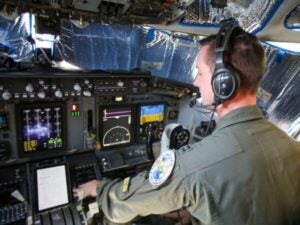
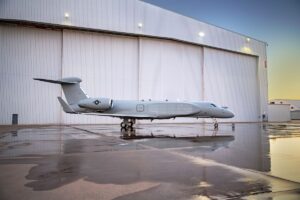
More EA-37Bs? The Air Force’s EA-37B saw its first combat use in Operation Epic Fury, according to U.S. Central Command, and the service’s fiscal 2027 budget requests $660 million for three more EA-37B Compass Call electronic warfare aircraft by BAE Systems and L3Harris Technologies. While the Air Force wants 10 EA-37Bs, the companies and lawmakers, including Rep. Don Bacon (R-Neb.), want a buy of a dozen more. The Air Force’s fiscal 2026 budget requested no funding, but lawmakers provided $474 million for two aircraft. In a Mitchell Institute for Aerospace Studies wargame, set in 2035 against China, the two “blue teams” underutilized EA-37B and Boeing’s E-7 Wedgetail aircraft initially, “as they were very concerned that they would lose too many of these high value aircraft too early in the fight,” says Mark Gunzinger, Mitchell’s director of future concepts and capability assessment. Ten EA-37Bs is less than half the number needed in a China scenario, he says.
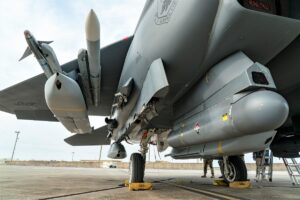
Dutch F-35s. Last month, the U.S. Air Force’s 388th Fighter Wing at Hill AFB, Utah, and the Royal Netherlands Air and Space Force (RNLASF) tested their F-35s in the largest F-35 deployment by the RNLASF, according to the 388th Fighter Wing. The RNLASF was to generate two lines of sorties daily and load live and inert weapons on the fighters. “A key element of that training is the Utah Test and Training Range itself,” the 388th Fighter Wing said. “The range’s advanced threat emitters and realistic target sets allow the Dutch pilots to employ the F-35’s full capabilities in ways they cannot back home.”
ADOC Operating. A new Army data hub that ingests data from across the service enterprise and get it to the right people at the right time reached initial operating capability on April 3, the service said last week. The Army Data Operations Center (ADOC) will “serve as the operational engine for the Army’s transformation into a data-centric force,” the service said. “By enabling seamless access to trusted, actionable data, ADOC ensures that our commanders and Soldiers are equipped to make precise, timely decisions,” Lt. Gen. Christopher Eubank, commanding general of Army Cyber Command, said in a statement last week.
World Cup Protection. Ondas Inc. last week said its Sentrycs subsidiary will be supplying its cyber-over-radio frequency (CoRF) solution across most venues hosting FIFA World Cup matches this summer. Ondas said its CoRF technology enables passive detection, tracking, identification and controlled mitigation—that is, take control of unauthorized drones and land them without jamming or kinetic measures. The company has multiple contracts from federal, state and local public safety and security organizations worth millions of dollars in support of lower airspace security operations at the World Cup venues.
MOSSAIC Award. L3Harris Technologies last week said the Space Force’s Space Systems Command awarded the company $150 million to sustain and modernize ground systems under the Maintenance of Space Situational Awareness Integrated Capabilities, or MOSSAIC, program. The MOSSAIC program began in 2020 to provide sustainment of ground-based space domain awareness sensors and space battle management command and control. The program is potentially worth $1.2 billion over 10 years.
Minotaur Launch. Northrop Grumman’s Minotaur IV rocket on April 7 successfully launched the Defense Department’s Space Test Program S29A mission from Vandenberg Space Force Base, Calif., delivering the STPSat-7 space vehicle with five department experiments and additional research CubeSats into low Earth orbit. The launch was managed by the Space Force’s Space Systems Command and the rocket lifted off from Space Launch Complex 8 at 4:33 a.m. PDT. The STPSat-7 is an Evolved Expendable Launch Vehicle secondary payload adapter satellite designed and built by DoD’s Space Test Program.
AFCENT UAS Award. Kraus Hamdani Aerospace (KHA) has received a potential $270 million contract from the Air Forces Central to accelerate deployment of K10000ULE ultra long-endurance long-range unmanned aerial system (UAS) platform. The electric Group 2 UAS features in-flight solar recharge. “When beyond-line-of-sight operations are critical, the K100ULE’s secure SATCOM capability enables both ISR and resilient connectivity for U.S. forces and partner nations across the Middle East,” Stefan Kraus, KHA co-founder and chief technology officer, said in a statement.
Space Domain Upgrade. LeoLabs, which develops and operates ground-based radars for space situational awareness, has launched a new artificial intelligence-powered platform that integrates its radar network and catalog of activity to provide customers with “detection and characterization tools to identify meaningful activity and surface it in real time,” the company said last week. LeoLabs Delta replaces LeoLabs Guard which was focused on delivering data and visibility for space domain awareness and surveillance. “Instead of requiring operators to interpret large volumes of data and event notifications and alerts, Delta highlights what matters most and provides actionable insights and alerts that are tailored to each customer’s mission,” LeoLabs said.
Windward Acquisition. Windward, which brands itself an artificial intelligence-powered maritime intelligence company serving government and commercial customers globally, has acquired Prominent Edge, which brings experience mission specialists that deploy and manage technology in high-security environments. Windward, a portfolio company of FTV Capital, strengthens its position with the U.S. government. “They bring proven U.S. government delivery, deep geospatial and maritime expertise, and the mission-grade execution that strengthens our ability to solve the hardest challenges facing U.S. national security,” Jon Goldman, Windward’s chief revenue officer, said in a statement. Deal terms were not disclosed.
Space Force AI Agents. The Space Force’s Space Systems Command (SSC) has awarded EdgeRunner AI a contract to develop domain-specific artificial intelligence agents for the service’s secure software environment to speed the acquisitions process, the company said last week. EdgeRunner said it will partner with SSC over the next six months to deploy its platform into the Space Force’s Impact Level-5 environment, “providing Guardians with mission specific guidance and increasing workforce productivity. EdgeRunner AI will work with SSC to develop Space Force Specialty Code-specific AI agents, including an agent designed for acquisitions use cases.”
From Raytheon to AeroVironment. On Apr. 13, Robert Smith, formerly the vice president of radio frequency solutions at RTX’s Raytheon, is to succeed Brad Truesdell as executive vice president and chief operating officer of AeroVironment. Smith is to manage AeroVironment’s autonomous systems and space, cyber, and directed energy business units and to report to AeroVironment CEO Wahid Nawabi. AeroVironment said last month that it has received orders for its 30 kilowatt LOCUST X3 laser weapon and that it will reach the field in the coming months. The U.S. Army has chosen the LOCUST technology, including for the service’s Multi-Purpose High Energy Laser for Infantry Squad Vehicles.
Whittier Returns. George Whittier, who suddenly departed Fairbanks Morse Defense last May after six years as CEO to take the same role at Barnes Aerospace, is back again as CEO, FMD said last week. In January, about eight months after Whittier joined Barnes, the company announced a new CEO. “George’s leadership positions the company to move faster, think bigger, and execute with even greater precision,” FMD said in a statement. “He will play a pivotal role as we scale our operations, strengthen our impact within the defense industrial base, and deliver the next generation of solutions our customers rely on every day.”
SAIC Board News. Science Applications International Corp. last week named to new board members, retired Navy Adm. Mike Rogers and Paul Eremenko, increasing the number of directors to 13. Rogers’ last assignment in uniform was leading U.S. Cyber Command and the National Security Agency. Eremenko is founder and CEO of the artificial general intelligence company P-1 AI. Their initial term began April 8 and will end with SAIC’s annual meeting this year. Both men are members of the board’s Audit and Technology committees.
PAE Visit. Navy Portfolio Acquisition Executive (PAE) for Maritime Christopher Miller visited HII’s Ingalls Shipbuilding division in Pascagoula, Miss., on April 9. Miller met with company leadership, toured the shipyard and received ship program updates as well as information on facility investments and Ingalls’ expanding production capacity. HII noted this was Miller’s first visit to the shipyard since assuming the PAE Maritime role in March. This followed a similar visit by Miller to HII’s Newport News Shipbuilding facility in Virginia in late March. “Together, the visits reinforced the shared commitment between HII and Navy leadership to deliver the platforms that strengthen the fleet, advance future capability and ensure sailors and Marines have the ships they need,” HII said.
NAVSEA Staffing. The Navy appointed Peter Reddy as the Executive Director of the Naval Sea Systems Command (NAVSEA) Naval Surface and Undersea Warfare Centers. Reddy previously served as Deputy Assistant Secretary of the Navy for Research, Development, Test and Engineering (RDT&E)), under the Assistant Secretary of the Navy for Research, Development and Acquisition), where he was responsible for executive oversight of all matters related to RDT&E budget activities, science and engineering, advanced research and development, prototyping and experimentation, and test and evaluation. From 2019 until 2025 Reddy served as Executive Director of Naval Information Warfare Center Atlantic.