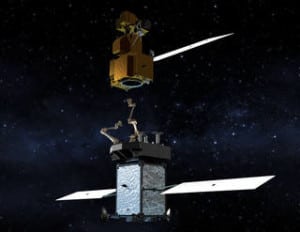
An artist's rendering of Restore-L. (Photo courtesy of NASA)
The Senate Appropriations Committee (SAC) has moved to preserve NASA's Restore-L satellite-servicing mission, rejecting the agency's proposal to nix the program.The committee, which approved its fiscal year 2018 Commerce, Justice, Science (CJS) appropriations bill July 27, included $130 million to continue Restore-L. The legislation now heads to the full Senate for its consideration.Acting NASA Administrator Robert Lightfoot testified before the SAC’s CJS subcommittee in late June that his agency had decided to de-fund Restore-L and focus instead on developing servicing-related…
President Donald Trump on Wednesday called on Congress to pass and send a second reconciliation bill to his desk by June 1. The deadline follows congressional Republicans’ backing a pursuit […]
Upgrades to the GPS ground system–the Architecture Evolution Plan (AEP)–is an option under consideration by the Defense Department’s space acquisition chief, as problems continue in fielding the GPS Next Generation […]
Senate Budget Committee Chair Lindsey Graham (R-S.C.) said Wednesday, with the White House’s backing, his panel will move “expeditiously” on crafting a second reconciliation bill, citing priorities for defense and […]
Defense Secretary Pete Hegseth on Thursday acknowledged the Pentagon could potentially ask Congress for $200 billion in supplemental funding to support the ongoing operation against Iran and replenish munitions used […]
The Senate Appropriations Committee (SAC) has moved to preserve NASA’s Restore-L satellite-servicing mission, rejecting the agency’s proposal to nix the program.
The committee, which approved its fiscal year 2018 Commerce, Justice, Science (CJS) appropriations bill July 27, included $130 million to continue Restore-L. The legislation now heads to the full Senate for its consideration.
An artist’s rendering of Restore-L. (Photo courtesy of NASA)
Acting NASA Administrator Robert Lightfoot testified before the SAC’s CJS subcommittee in late June that his agency had decided to de-fund Restore-L and focus instead on developing servicing-related technologies, which industry could then use to build robotic systems to refuel or repair low-Earth-orbit satellites. (Defense Daily, June 30). But subcommittee members expressed skepticism that industry would actually do so.
Restore-L has been slated to launch in 2020 to refuel the U.S. Geological Survey’s Landsat-7 Earth-imaging satellite. Space Systems Loral (SSL) is building the mission’s spacecraft bus.
In a report accompanying the CJS bill, the SAC urged NASA to work with the Defense Advanced Research Projects Agency (DARPA) on satellite servicing. DARPA’s Robotic Servicing of Geostationary Satellites (RSGS) program is collaborating with SSL to develop a spacecraft to service geostationary satellites.
Overall, the SAC bill provides $19.5 billion for NASA, $124 million below the FY 2017 enacted level and $437 million above the agency’s request. It includes $2.15 billion for the new Space Launch System (SLS) rocket, $212 million above the request, and $1.35 billion for the new Orion crewed capsule, $164 million above the request.
Sen. Bill Nelson (D-Fla.) said the bill includes $640 million for Kennedy Space Center in Florida to upgrade a launch pad and related facilities needed to send SLS and Orion to Mars.
“Getting this additional money for the launch pad is a big win for KSC and the effort to land humans on Mars,” Nelson said.
U.S. Northern Command (NORTHCOM) used a counter small unmanned aircraft system (sUAS) flyaway kit (FAK) in the early hours of the strikes against Iran on Feb. 28, according to Air […]

 By
By