NRL, Georgetown School of Foreign Service Talk Autonomous Systems
PR Newswire
WASHINGTON, March 26, 2019
WASHINGTON, March 26, 2019 /PRNewswire/ — The U.S. Naval Research Laboratory hosted students from Georgetown University’s School of Foreign Service for a two-day academic exchange with a classroom lecture and tour of the Laboratory for Autonomous Systems Research facilities (LASR), Feb. 26-27.
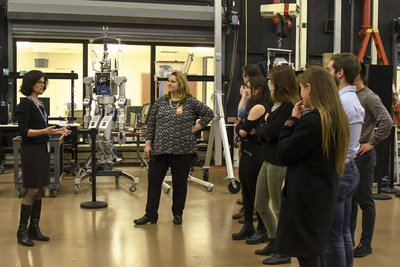
Karen Swider-Lyons, Ph.D., Director of the Laboratory for Autonomous Systems Research (LASR) at NRL, talked about autonomous systems research with the Georgetown students.
“Engaging students in fields like these is invaluable, as the research created here [at NRL] will influence policies these students will face in their careers,” Swider-Lyons said.
Georgetown Professor Cara LaPointe, Ph.D., with the Science, Technology and International Affairs program, said her students’ career interests are geared toward national security, a field that relies heavily on science and technology (S&T).
“The goal is to de-mystify these technologies and teach students what it takes to integrate technologies into the complex socio-economic system that is the national security apparatus,” LaPointe said.
“We’ve covered block chain, artificial intelligence, additive manufacturing, and autonomous systems.”
For the second-day of the academic exchange, Georgetown students traveled to NRL’s DC-campus to tour LASR’s facilities.
They visited specialized facilities supporting autonomous systems research including intelligent autonomy, human-autonomous system interactions, sensor systems, power and energy systems.
“Touring LASR facilities and seeing the research performed is a great help toward educating the next generation of policy leaders,” said Swider-Lyons. “I am impressed by their passion to understand S&T capabilities in national security environments and NRL’s role for the military.”
The U.S. Naval Research Laboratory provides the advanced scientific capabilities required to bolster our country’s position of global naval leadership. With more than 2,500 personnel scientists, engineers and support staff, it has served the U.S. Navy and the nation for nearly 100 years, advancing research further than you can imagine. For more information, visit the NRL website and join the conversation on Twitter, Facebook, and YouTube.
By Jonathan B. Holloway, U.S. Naval Research Laboratory Public Affairs
jonathan.holloway@nrl.navy.mil
202-404-8121
 View original content to download multimedia:http://www.prnewswire.com/news-releases/nrl-georgetown-school-of-foreign-service-talk-autonomous-systems-300818781.html
SOURCE The U.S. Naval Research Laboratory