Lockheed Martin Secures U.S. Army Exoskeleton Development Agreement
PR Newswire
ORLANDO, Fla., Nov. 29, 2018
ORLANDO, Fla., Nov. 29, 2018 /PRNewswire/ — Lockheed Martin (NYSE: LMT) received a $6.9 million award from the U.S. Army Natick Soldier Research, Development and Engineering Center (NSRDEC) to enhance the ONYX™ exoskeleton for future soldier demonstrations. ONYX is a powered, lower-body exoskeleton with artificial intelligence (AI) technology that augments human strength and endurance.
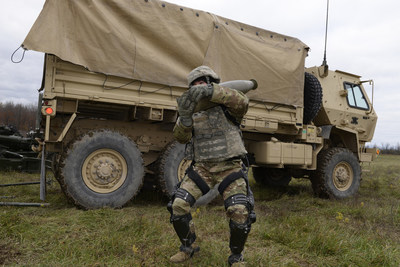
Under the two-year, sole-source agreement, Lockheed Martin will optimize ONYX components. The improvements will be evaluated by the University of Florida in advance of NSRDEC soldier demonstrations scheduled for 2019.
“Innovative human/machine technologies like ONYX can improve human performance, decrease injury and reduce fatigue to help soldiers accomplish physically demanding tasks,” said Keith Maxwell, exoskeleton technologies program manager at Lockheed Martin Missiles and Fire Control. “This award brings us one step closer to equipping future forces with advanced exoskeleton capabilities.”
Developed by Lockheed Martin through a license from B-TEMIA, ONYX counteracts overstress on the lower back and legs. Using electro-mechanical knee actuators, a suite of sensors, and an AI computer, ONYX learns user movements and delivers the right torque at the right time to assist with walking up steep inclines, lifting or dragging heavy loads. An independent study by the University of Michigan confirmed these benefits by showing how ONYX users exerted less energy while walking up an incline with a 40-pound backpack.
Recently, ONYX received Popular Science magazine’s Grand Award in the Security category in their annual Best of What New 2018 Awards. Each year, Popular Science reviews thousands of new products in search of the top 100 tech innovations of the year. The brand selects 100 winners as well as 10 Grand Award winners – one from each of the categories. To win, a product or technology must represent a significant step forward in its category.
About Lockheed Martin
Headquartered in Bethesda, Maryland, Lockheed Martin is a global security and aerospace company that employs approximately 100,000 people worldwide and is principally engaged in the research, design, development, manufacture, integration and sustainment of advanced technology systems, products and services. This year the company received three Edison Awards for ground-breaking innovations in autonomy, satellite technology and directed energy.

 View original content to download multimedia:http://www.prnewswire.com/news-releases/lockheed-martin-secures-us-army-exoskeleton-development-agreement-300757509.html
SOURCE Lockheed Martin