 By
By 
The Missile Defense Agency (MDA) is starting market research to determine an “innovative missile defense launcher” and support equipment technologies that could be delivered within two years as part of the Golden Dome initiative.
A new Request For Information (RFI) published Tuesday said the agency is seeking responses encompassing system-level, component-level, upgrades to existing systems, architectures, and Concepts of Operation (CONOPS) for employment.
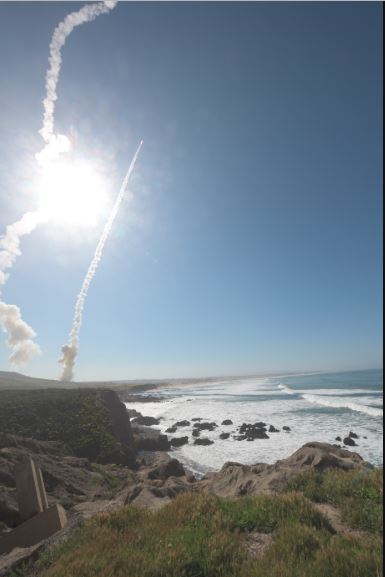
MDA said the RFI is oriented towards understanding potential industry concepts to develop and deploy “an Under Layer, Glide Phase, and Terminal Phase Intercept capabilities to maintain a rapidly deployable next-generation missile defense shield to defeat ballistic, hypersonic, advanced cruise missiles, and other next-generation aerial attacks from peer, near-peer, and rogue adversaries.”
It noted the intercept capabilities will be postured to defeat a countervalue attack, which in nuclear weapons policy refers to targeting civilian and population centers rather than focusing on military targets, like bases or nuclear weapons silos.
While a smaller nuclear weapons state like North Korea has missiles that are likely less accurate to long-range targets, Russia and China have many of nuclear warheads deployed on missiles that could hit the U.S. According to open-source analysis by the Federation of American Scientists, Russia has over 1,700 nuclear warheads on deployed long-range missiles and bombers.
While the notice does not explicitly say so, the descriptive terms of the launcher encompass the Trump administration’s new Golden Dome initiative.
MDA also said responses should be able to incorporate the current missile defense interceptors “and be suitable to accommodate future interceptors.”
The notice said it is seeking launcher attributes that include the capability to launch current and future interceptors against various kinds of attacks; interoperability with DoD communications networks and systems; optimized and adaptable missile launch selection utilizing remote track data; be modular, transportable and relocatable; have scalable inventory management; be self-sufficient if external power is unavailable; minimize facility footprint to reduce the reliance on prepared sites; logistically maintainable when deployed; survivable in all continental U.S. weather environments; maximized firepower/weapon capacity; and have high altitude electromagnetic pulse and seismic survivability.
MDA also wants the design’s maximum size to be 40 feet by eight feet by seven feet nine inches.
Importantly, the RFI points to having a potential system with its first production unit ready within 24 months of contract award.
The agency said it intends to use the RFI to also help MDA make decisions related to understanding the marketplace and industry capabilities to “immediately demonstrate and deliver an initial launcher capability within 24 months” as well as understand the ability to iteratively develop, demonstrate, produce and deliver more launcher capability.
This also includes receiving industry recommendations on acquisition strategies that allow for rapid delivery and demonstration, identify major technical and programmatic risks and determine industry data needs to support the accelerated delivery timelines.
MDA said it anticipates responses from both small and large businesses as well as Federally Funded Research and Development Centers (FFRDCs), University Affiliated Research Centers, Academia, and Non-traditional Defense Contractors. The responses are due by Aug. 18.