
The fiscal 2025 reconciliation law includes $1.5 billion over the next four years for low-cost cruise missiles–$1 billion for DoD and another $500 million for “exportable” low-cost cruise missiles.
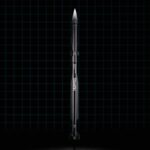
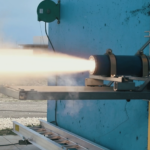
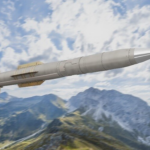
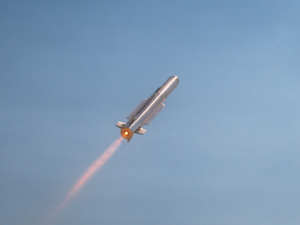
Possible missiles include Lockheed Martin‘s [LMT] Common Multi-Mission Truck System (CMMT–“comet”) that the company said could serve in a variety of roles, including a high-subsonic cruise missile; and the Black Arrow Small Cruise Missile by Leidos‘ [LDOS] Dynetics unit.
U.S. Special Operations Command has said it envisions the Small Cruise Missile as fielding in the arsenals of the services, including the U.S. Marine Corps, which is interested in a modified version of the system for launch from a Lockheed Martin High Mobility Artillery Rocket System, better known as HIMARS.
Air Force Special Operations Command started testing Black Arrow on an AC-130J Ghostrider gunship in 2023 (Defense Daily, Oct. 4, 2024).
“Right now, we’re at the point where it [Black Arrow] is gonna be about speed to ramp,” Doug Jones, vice president of technology for Leidos’ defense sector, told reporters on Thursday in a briefing at the company’s supplier day at National Harbor, Md. “We’ve proven the capability. It works, and they’re confident it works. One of the biggest things is gonna be scale. Reconciliation passed. That money now just needs to flow, and I think that’s where you’re gonna start to see a bunch of these things scaling up and contracts scaling up, as the money flows, because most of that money has not been contractually obligated yet.”
SOCOM’s fiscal 2026 budget request includes $25.2 million for 84 Small Cruise Missiles–about $300,000 per missile.
The command’s requirement for the 250-pound class Small Cruise Missile was at least a 500 nautical mile range and a greater than 50-pound payload capacity. The price point is between $215,000 and $300,000 per copy–on the upper side for those with advanced payloads, such as electronic warfare.
Existing cruise missiles, such as the Lockheed Martin AGM-158A Joint Air-to-Surface Strike Missile and AGM-158C Long Range Anti-Ship Missile, can price out at $1.5 million and above.
SOCOM’s budget request said that the command is buying the Small Cruise Missile “in lieu of Small Guided Munitions for near-peer competition” to meet the requirement “for stand off attack in contested environments with next generation guidance.”
In addition to the Small Cruise Missile funding, the SOCOM fiscal 2026 request includes $10.5 million to modify 175 AGM-114 Hellfire missiles by Lockheed Martin with a dual-mode Selectable Precision Effects Articulated (SPEAR) warhead to allow “the user to select different firing modes (radial or forward blast) depending on the targets,” SOCOM said.
“This new [Hellfire] variant [with SPEAR] will be integrated on both the AC-130 gunship and the MQ-9 platforms,” the command said. General Atomics builds the MQ-9.