 By
By 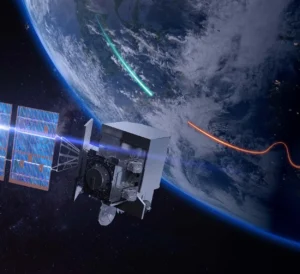
HUNTSVILLE, Ala. – The Space-Based Interceptor (SBI) competition cleared the first of four “gates” in the Space Force’s competitive prize competition, with all competitors moving forward, the head of the Golden Dome program said Tuesday.
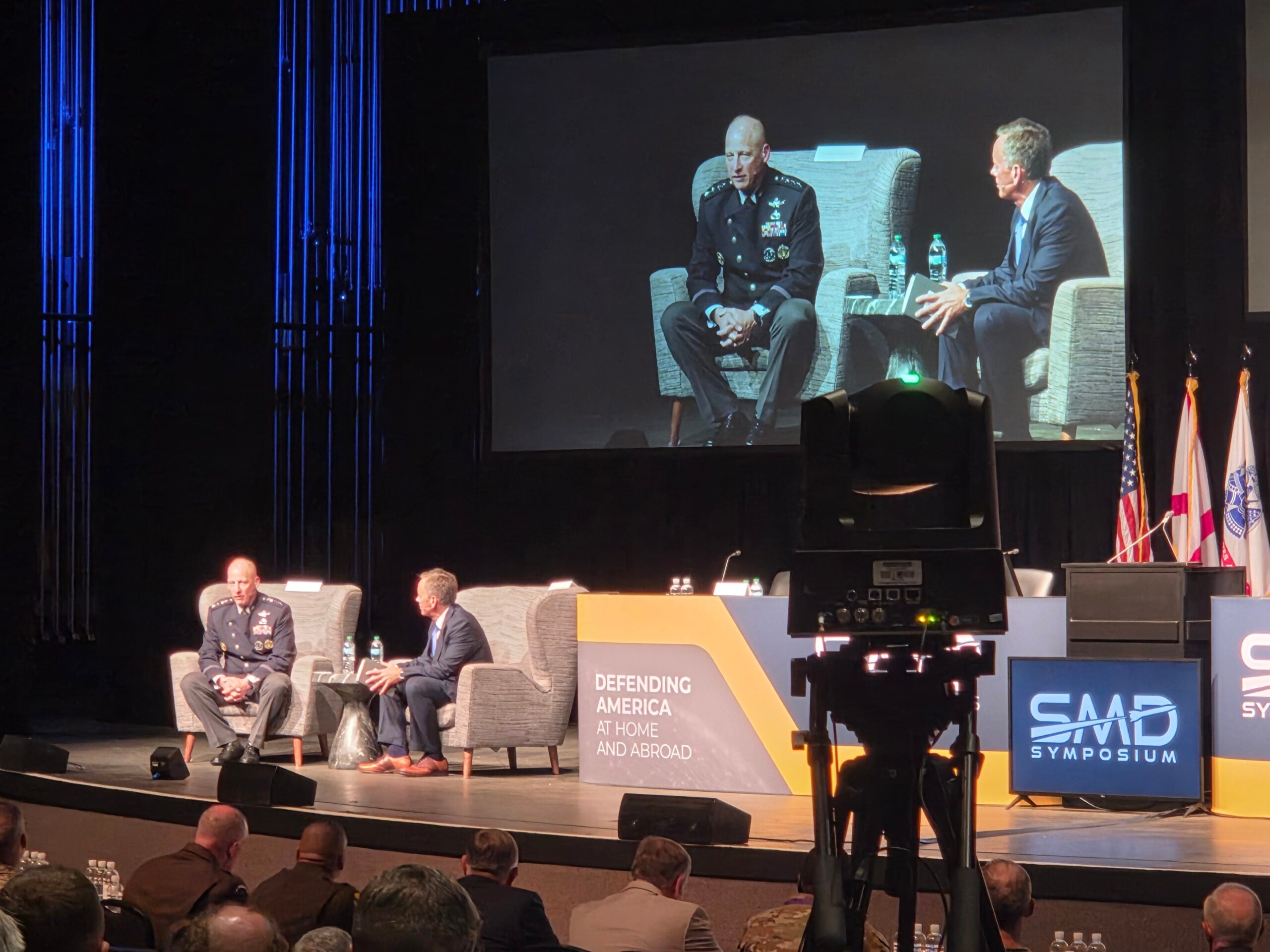
“All of the providers that are part of the competition are progressing exceptionally well, and Gate One just came to a closure. I have not seen the results of Gate One, but as I have heard back from Space Systems Command, all providers look positive and will continue into Gate Two,” Gen. Michael Guetlein, direct reporting program manager of Golden Dome for America, told reporters here following his remarks at the annual Space and Missile Defense Symposium.
Guetlein explained Space Systems Command put four gates, or tests, into the competition that competitors must pass through before the Pentagon decides to move forward with the system.
“Gate One is to get the design in place and do component level testing. Gate Two is to build a capability that can go into outer space. Gate Three is to prove that that capability works in outer space. Gate Four is to prove that the capability actually works as part of the broader Golden Dome architecture,” he said.
Guetlein underscored that only once the competitors pass through all four gates, “in a prize-based competition, then we will make a decision — is it affordable? is it scalable?”
In April, the Space Force announced 12 companies won $3.2 billion in Other Transaction Authority (OTA) contracts for SBI prototypes between late 2025 and earlier this year, including Northrop Grumman [NOC], Anduril Industries, Booz Allen Hamilton [BAH], General Dynamics [GD] Mission Systems, GITAI USA Inc, Lockheed Martin [LMT], Quindar Inc, RTX’s [RTX] Raytheon Company, Sci-Tec Inc, SpaceX [SPCX], True Anomaly Inc, and Turion Space Corp. (Defense Daily, Apr. 24).
The SBI program is aimed at developing a missile defense interceptor system that can demonstrate on-orbit capability to integrate into the Golden Dome architecture by 2028. The Space Force’s said SBI is planned to be a proliferated low Earth orbit constellation of interceptors that can engage ballistic missiles in their boost and midcourse phases as well as glide phase missiles.
Guietlein reiterated his perspective that SBIs are physically effective, but they will use this process to determine if they are affordable and will not put in operational requests for production capabilities “until after they prove through the prize-based competition that those capabilities are effective, but more importantly that they’re scalable and affordable. At that point, we will then make a decision if we are going to move into production or not.”
Last year, Space Systems Command’s Space Combat Power program executive office had sought SBI ideas in four areas: exoatmospheric and endoatmospheric interceptors, common ground elements, and fire control elements (Defense Daily, June 30, 2025).
Last month, the Space Force selected Johns Hopkins University’s Applied Physics Laboratory (APL) to serve as the technical direction agent for SBI, an independent advisor to ensure system-architecture consistency across all industry partners (Defense Daily, Aug. 3).
First Golden Dome Site
Guetlein’s remarks noted Golden Dome also has its “first operational site, we are digging dirt around the homeland, getting ready for the capabilities that the president asked us to deliver in the summer of 2028.”
He confirmed to reporters this refers to the program’s site at Joint Expeditionary Base Little Creek-Fort Story, Va., which had a small public rollout in April.
“I cannot comment on where the rest of the sites are nor how many of them there. But we did do a public rollout of Fort Story,” he said.
On April 23, Undersecretary of Defense for Research and Engineering and the DoD Chief Technology Officer Emil Michael, Guetlein, and Deputy Director of Operations at North American Aerospace Defense Command (NORAD) Maj. Gen. Mark Piper spoke with industry as they announced the site.
Fort Story also hosts testing for the Army Long-Range Persistent Surveillance (ALPS) system, which the Defense Department calls a “key terrestrial sensor” whose data informs development of the larger Golden Dome architecture.
Guetlein said Fort Story is a Golden Dome site because “the capabilities that we deployed at that site are part of our integrated architecture, networked architecture.”
He declined to name other systems active at Fort Story that are part of Golden Dome.
Relatedly, Guetlein said any Patriot or Terminal High Altitude Area Defense (THAAD) forces that Golden Dome plans to station in the U.S. for the architecture would not inherently come at the expense of other globally deployed forces, because “the Joint Staff will apportion assets globally to include the homeland, depending on the priority of all the conflicts.”
AI and Automation
In his remarks, Guetlein also described how important automation and artificial intelligence is to Golden Dome and that they plan to essentially create a dial so operators can decide how much automation is necessary, depending on the scenario.
While Aegis, THAAD, Patriot and other systems deployed overseas have their own sensors, radars and effectors, he said the challenge in bringing these systems stateside is getting it to operate together seamlessly.
“There should be no seams between a THAAD, a Patriot, Aegis, the air layer, the sea layer, what have you. It all needs to be one system in order to make sense out of that amount of data. That number of effectors across that amount of geography, you’re going to have to take advantage of automation and artificial intelligence. So we are using AI primarily to bring to bear the broad array of sensing data, whether that be passive, active, DOW, commercial, in some cases allied, civil,” Guetlein said.
Golden Dome needs to bring all the sensor data together, make quick sense of it, pick the best effector for each threat, close the fire control loop, execute the defensive action and also do battle damage assessment, he said.
“That all requires a bunch of artificial intelligence,” Guetlein said. “So, we have architected that in as the foundation. And then what we want to do is give the warfighter the ability to select how much automation is going to be in the process, from none to fully automated. Because as the fight starts to become exceptionally dynamic, we’re going to want to go further and further towards automation because it’s going to be progressing at a faster than at machine speed, faster than human speed.”