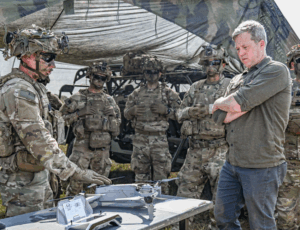

Michael on Mythos. Emil Michael, the Pentagon’s chief technology officer, said there is broad interest across the U.S. government in assessing Anthropic’s new Mythos artificial intelligence-powered cyber security model, which he said is “independent” of the department’s current effort to move on from using the technology firm’s Claude AI model. “When you have a model that has cyber vulnerability capabilities where you can find those kind of [vulnerabilities] in a step function change way, that means you have to look at your own networks, the country’s networks and find out what vulnerabilities they have so they can’t be exploited,” Michael told reporters on May 6 at the Pentagon. “The whole government has to look at what this model can do, not only [for] the government hardware and software infrastructure but to the private sector…so that we have the ability to patch [vulnerabilities] before adversaries get the same ability.” President Donald Trump in February ordered the federal government to halt the use of Anthropic’s products after the company said it wanted oversight safeguards for its Pentagon work.
…LUCAS Drones. Michael also said the Pentagon is working on how it may scale up production of the Low-Cost Unmanned Combat Attack System (LUCAS), used for the first time in combat as part of the U.S.’ Operation Epic Fury campaign against Iran. The SpektreWorks-built LUCAS drones were reverse engineered from Iran’s Shahed one-way attack systems. “So based on a real world field test where you’re not just right on a range [but] you’re actually trying it, you get data faster. That means the chances that we can put it on an order path where it becomes a program of record are much higher. And we’re working on that right now,” he said.
Oh, DARC Early. The Space Force said that it “has fast tracked the employment” of Northrop Grumman’s Deep Space Advanced Radar Capability (DARC) that Australia, the United Kingdom and the U.S. are to field under the AUKUS agreement. The schedule has called for Australia to field DARC this year, the U.K. in 2028, and the U.S. in 2029. Last September, U.S. Space Command approved DARC for early use through “streamlining” test and evaluation and proving system readiness in the support of “joint and combined force objectives,” according to Space Force’s Combat Forces Command. The 20th Space Surveillance Squadron’s Integrated Radar Operations Center at Eglin AFB, Fla. is conducting the early use of DARC, which is to provide “space domain awareness out to geosynchronous orbit and enable tactical timelines and multiple space control kill chains,” according to Space Force.
X-Plane Flight. The Defense Advanced Research Projects Agency (DARPA), working with Northrop Grumman and the Air Force Research Laboratory, last week said it flew its unmanned X-Plane, the XRQ-73 hybrid-electric experimental aircraft at Edwards AFB, Calif., in April. The flight was part of DARPA’s Series Hybrid Electric Propulsion AiRcraft Demonstration, dubbed SHEPARD. The 1,250-pound Group 3 unmanned aircraft system had been expected to fly in 2024 (Defense Daily, June 28, 2024). The agency said the flight is step toward demonstrating military utility of hybrid-electric propulsion, which could drive new aircraft designs.
Rocket Lab SBI. Rocket Lab on May 7 announced it is partnering with RTX’s Raytheon for its participation in the Space Force’s Space Based Interceptor (CBI) program. Last month, the government revealed 12 companies won Other Transaction Authority agreements in late 2025 and early 2026 to work on SBIs, including RTX. The companies did not specify what technologies or systems they are developing in the SBI work. Rocket Lab manufactures spacecraft and launch vehicles.
Classified York Awards. York Space Systems has won positions on multiple classified indefinite-delivery, indefinite-quantity contracts “across two mission areas critical to national security and defense,” the Colorado-based satellite manufacturer and operator said last week. “These awards expand York’s role in next-generation space and defense architectures.” The company also said the work supports systems like the Golden Dome homeland missile defense program.
SWO Boss. Secretary of Defense Pete Hegseth on May 5 announced the nomination of Rear Adm. Joseph Cahill to become a three star admiral as the next commander of Naval Surface Forces/commander, Naval Surface Force, U.S. Pacific Fleet, also known as SWO Boss. Cahill currently served as commander of Naval Surface Force Atlantic (SURFLANT), a position he has held since 2023. Cahill’s sea tours include serving as commander of the Arleigh Burke-class destroyer USS Preble (DDG-88), integrated air and missile warfare commander of Carrier Strike Group 9, and commander of Carrier Strike Group 15. If confirmed, Cahill will succeed current SWO Boss Vice Adm. Brendan McLane, who himself came into the position in late 2023 following his own stint leading SURFLANT.
RHIB Awards. Naval Sea Systems Command on May 1 awarded eight vendors contracts with a base value of $326 million for up to 474 composite rigid hull inflatable boats (RHIBs). The winners include ASIS Boats USA LLC (doing business as Ocean Craft Marine), Brig USA LLC (doing business as Fluid Marine Response), Ghostworks Marine Inc., Ribcraft USA LLC, St. Johns Ship Building Inc., Structural Composites Inc., United States Marine Inc., and The Whiskey Project Group USA LLC. The firm-fixed-price, indefinite-delivery, indefinite-quantity multiple award contracts, if exercised, plan to ultimately raise the value to $650 million over 10 years to all eight vendors combined. The first orders are expected to be finished by July 2026. The Navy said it received 15 offers.
T-ATS Start. Master Boat Builders, Inc. on May 5 announced the start of module fabrication for Navy Navajo-class Towing, Salvage, and Rescue Ship (T-ATS) program under a partnership with Austal USA. The company is building two T-ATS hull modules at its Coden, Ala., shipyard, which it highlighted is only 30 minutes away from Austal USA’s shipyard where final erection and outfitting will occur. The company first announced its partnership to work under Austal USA in March, with hopes to gain experience working to Navy standards and production requirements for large-scale programs so it can later expand into more government shipbuilding programs.
LCU 1714. Austal USA on May 4 announced it started construction of its fifth Navy Landing Craft Utility (LCU) 1700-class vessel, LCU 1714, at its Mobile, Ala., shipyard on April 27. The Navy awarded the company a $91.5 million contract in 2023 to design and construct up to 12 of these vessels, with five construction contracts awarded so far. The LCUs are deployed from amphibious assault ships for heavy-lift capability from ship to shore and back. The first vessel in the program Austal built, LCU 1710, recently completed acceptance trials and the company noted it will soon be delivered to the Navy.
ABMS. L3Harris Technologies has been working on digital infrastructure for the Air Force’s Advanced Battle Management System (ABMS) for the last several years, and the company now says it “has been selected to develop key features of the secure and resilient digital infrastructure” as the backbone of the system. “L3Harris will strengthen the [ABMS] data integration and networking capabilities,” the company said. “This effort will be foundational to combining data from multiple sources and providing the warfighter with a real-time, comprehensive view of the battlefield.” ABMS is a key piece of the Pentagon’s future Combined Joint All-Domain Command and Control architecture. Kathy Crandall, the president of mission networks for L3Harris’ pace and mission systems business, said in a company statement that ABMS’ “new digital infrastructure will provide the warfighter with more secure, timely and usable information, allowing them to connect sensors and shooters across domains – in complex operational environments.”
New U.S. Drone Maker. Orqa, the Croatian-based manufacturer of first person view (FPV) drones and a supplier to the Ukrainian military, has partnered with By Light Professional IT Services to begin manufacturing drones in the U.S. Orqa U.S. LLC will produce drones at By Light’s 180,000 square foot facility in Port Orange, Fla., with full-rate production expected in October. Orqa’s expansion to the U.S. is a result of the Defense Department’s focus on expanding American-made drone production, supply chains and capacity through the Drone Dominance Program.
New InSar Provider. IonQ last week launched Inferometric Synthetic Aperture (InSAR) capabilities through its Capella Space business unit that operates radar-based satellites. IonQ said its InSAR capabilities enable “millimeter-precision ground deformation monitoring with fully automated tasking and data delivery, enabling customers to detect and track physical change on the Earth’s surface consistently, at a frequency and scale never previously available from a commercial SAR provider.” IonQ also said its solution offers automated tasking and frequent revisit rates based on customer needs.
Another Draper Flight. Ursa Major last week said the Air Force Research Laboratory recently conducted another flight of the Affordable Rapid Missile Demonstrator (ARMD) using the company’s Draper liquid rocket engine. The ARMD flight came 45 days after a previous flight test, demonstrating a rapid turnaround and further expanding the flight envelop, Ursa said (Defense Daily, March 12). The company is under contract to the lab to characterize Draper in flight.
Space Raise. Astranis, which develops and manufactures satellites for high-Earth orbit, last week said it raised $455 million in new capital to accelerate production for commercial customers and scale up to support U.S. government programs of record as the Space Force looks to dramatically increase its budget. The funding includes a $300 million Series E round led by Snowpoint Ventures and Franklin Templeton, and a $155 million delayed-draw credit facility by Trinity Capital. San Francisco-based Astranis highlighted that it is a prime contractor for the initial phases of the Defense Department’s Protected Tactical Satcom-Global, Resilient GPS and Andromeda programs.
…And Another. Scout Space last week said it raised $18 million in Series A funding expand its manufacturing and execute an upcoming mission. The Scout’s Owl sensor will be on Blue Origin’s Blue Ring maneuverable spacecraft for a Space Force space domain awareness mission. The funding round was led by Washington Harbour Partners.
ANELLO Funding Round. Navigation technology developer ANELLO Photonics raised $25 million in a Series B-2 round to accelerate the California-based company’s production and product development. ANELLO has developed the Silicon Photonics Optical Gyroscope for precision navigation in GPS-denied environments in land, air and sea domains. The funding round was led by MESH and included Washington Harbour Partners, a new investor, and existing investors such as Lockheed Martin Ventures.
Space Acquisition. Rocket Lab plans to acquire Motiv Space Systems in a deal that further vertically integrates the company with motion control systems, precision mechanisms and solar drive assemblies for spacecraft. The acquisition will give Rocket Lab the in-house component supply to allow it to scale satellite constellation manufacturing. The pending deal, expected to close in the second quarter of 2026, will also give Rocket Lab robotics technology proven on Mars. Motiv, which is also based in California, has 50 employees.
Kodiak and GD. Kodiak AI and General Dynamics Land Systems on May 7 announced a new strategic collaboration to work on autonomous ground vehicles, with plans to pursue both U.S. Army and international opportunities. “Through this collaboration, Kodiak will provide the Kodiak Driver, its Physical AI-powered virtual driver that is operating driverlessly today, demonstrating the ability to scale autonomous operations beyond controlled testing. General Dynamics Land Systems will lead vehicle integration, power systems, communications and ruggedized platform development,” Kodiak said in a statement. “Their collaboration establishes a scalable autonomy capability that can be applied across multiple military vehicle platforms and mission sets.” Kodiak noted the partnership builds on its recent work with GD Land Systems on the Leonidas Autonomous Ground Vehicle, which was equipped with Epirus’ Leonidas high-power microwave counter-drone capability.
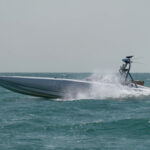
Corporate News. Autonomous vessel developer and manufacturer Saronic Technologies last week said it has produced its 300th Corsair, a 24-foot speed boat unveiled in the fall of 2024 that entered prototyping a year ago and is now in serial production. Corsair has a range of 1,000 nautical miles and a top speed exceeding 35 knots and can deliver kinetic and non-kinetic effects. Kratos Defense & Security Solutions has selected Odon, Ind., for the future home of its arc jet and laser facility for hypersonic materials development. The site selection follows a potential $68 million award last fall through the Pentagon’s Industrial Base Analysis and Sustainment program to design and build a moder mid-tier arc jet and coupled fiber laser facility for hypersonic materials evaluation, an effort Kratos calls Project Helios. Radio frequency technology company Hidden Level last week unveiled a new anechoic chamber at its manufacturing campus in Syracuse, N.Y., to allow it to accelerate development and production of solutions for airspace security and countering drones.
People News. Gabe Camarillo, under secretary of the Army during the Biden administration, has been appointed by Peraton as president of its Defense sector. Prior to joining Peraton, Camarillo was senior vice president of KBR’s Defense Technology Solutions business unit. Drone interceptor developer Powerus last wee named Rear Adm. Milton Sands III to its advisory board. Sands is a former commander of the Naval Special Warfare Command.