By Jay A. Stout, Defense Opinion Writer.
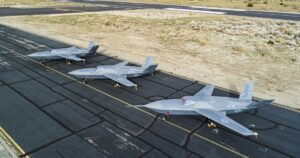
The Collaborative Combat Aircraft (CCA) is the defense aviation fixation of the decade. A small, low-cost, unmanned adjunct to manned fighters, the Air Force intends to field it in large numbers to offset China’s numerical advantage in fighters.
Advocates argue that the United States lacks the capacity to field enough traditional aircraft and that the solution is to produce a thousand or more CCAs.
The logic is appealing. And flawed.
The primary issue is cost versus capability. Physics does not offer discounts. An unmanned aircraft with capabilities comparable to a manned fighter must be similar in size and weight to carry comparable fuel, sensors and weapons. The assumption that savings come simply from removing the pilot and shrinking the aircraft ignores this reality.
To be fair, pricing a loosely defined system is difficult. Smaller aircraft are in fact cheaper. Former Air Force Secretary Frank Kendall estimated that a combat-capable CCA might cost $25 million to $30 million per unit. Current leadership, however, does not commit to a firm figure. But capability tracks with cost. Smaller aircraft carry fewer weapons shorter distances. These limitations directly reduce effectiveness—the reason the system exists.
More expensive than it looks
The cost problem extends beyond the airframe. CCA depends on advanced autonomy, resilient communications and a digital architecture to coordinate large formations. It also demands a unique logistics system and enough personnel to operate and maintain it. Each adds complexity and expense.
How is this supposed to cost less?
There are also vulnerabilities. A tightly networked formation depends on reliable connectivity. That dependence presents opportunities for disruption. Sophisticated adversaries will leverage those opportunities to neutralize the system.
Together, these cost drivers and operational risks threaten to consume resources at a scale that will unnerve even the most jaded defense careerists.
Transformative potential
Nevertheless, unmanned aviation does offer transformative potential—just not as envisioned for CCA. A different approach leverages “unmannedness” not to miniaturize capability but expand it.
Consider a larger unmanned aircraft. For the sake of discussion—because there is no official program—let’s name it the Deep Penetration Autonomous Strike System, or DPASS. Unconstrained by human endurance, this as-yet-undeveloped program can remain airborne for days. A stealthy design supported by aerial refueling and carrying sufficient fuel, sensors and weapons, it delivers persistent combat power deep into enemy territory.
An aircraft like DPASS could maintain continuous surveillance over vast regions. Armed appropriately, it also strikes air, sea and ground targets. This persistent, long-range capability not only destroys enemy forces, but also compels them into a reactive posture. DPASS’s stealth enhances survivability and creates the powerful friction of uncertainty. Countering it requires outsized levels of resources.
DPASS would not be small or cheap. Persistently performing meaningful missions at long range requires an aircraft large enough to carry substantial fuel, weapons and sensors. It is likely comparable in size to a large fighter and could cost as much or more.
A much better alternative
But cost without context is meaningless. A small number of DPASS, each capable of staying aloft for days, holds enormous areas at risk. Replicating that capability with manned aircraft would require far more airframes flying far more sorties with a consequently increased demand on scarce and expensive aerial refuelers.
This is a capability CCA simply cannot provide. Its limited range, endurance and payload prevent it from operating effectively at the distances that matter. Even in large numbers, it cannot deliver equivalent operational value.
Therefore, there cannot be a meaningful cost comparison between DPASS, CCA and manned aircraft. CCA cannot achieve the needed effects at any scale. And while DPASS has a similar unit cost as manned aircraft, it delivers capabilities that manned systems can only approximate with far greater numbers at greater total expense.
DPASS is fundamentally different. It requires fewer platforms. But each offers strategic capabilities. It is not a disposable, low-cost, robotic sidekick. It is a theater-level asset—persistent, effective, unpredictable and difficult to counter.
And it is not a new idea. In the 1990s, the services explored long-range, stealthy, unmanned strike systems. But they were abandoned due to shifting priorities and technical hurdles. The Navy came closest. Its X-47B demonstrated carrier-based unmanned operations in 2013 and aerial refueling in 2015. Its intended successor, UCLASS, initially pursued a concept similar to DPASS but was canceled in 2016.
Real capability against China
Like CCA, any aircraft like DPASS still carries risk. The difference is that DPASS provides real capability at useful ranges. If the nation is serious about countering China, CCA isn’t the answer. It cannot contribute meaningfully to that fight.
This is not a debate about manned versus unmanned, nor about exquisite versus cheap. It is about operational effectiveness. Certainly, mass has value—but only when it can reach the fight, survive it and accomplish the mission.
The real question is not whether the nation can afford to develop a concept like DPASS. It is whether it can afford to ignore a concept that offers decisive capability in favor of a flawed one that offers nothing but a chimeric comfort in numbers.
Retired Marine Corps Lt. Col. Jay A. Stout flew fighters for 20 years before embarking on a long career in the defense industry as an unmanned aviation expert. His latest book is, “Savage Skies, Emerald Hell: The U.S., Australia, Japan and the Ferocious Air Battle for New Guinea in World War II.”

Are you a Defense Daily reader with a thought-provoking opinion on a defense issue? We want to hear from you.
- We welcome submissions of opinion articles on national security, defense spending, weapons systems and related areas.
- We welcome submissions from lawmakers, administration officials, industry representatives, military officials, academics, think tank experts, congressional candidates, international experts and others on issues important to the national defense community.
- We welcome a diverse range of opinions all along the political spectrum.
- Email: editor@DefenseOpinion.com