 By
By 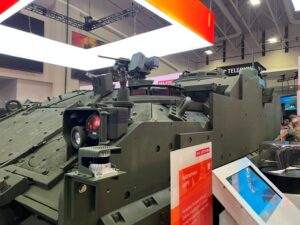
BAE Systems on Monday rolled out its new Autonomous Armored Multi-Purpose Vehicle for the first time, with an aim to conduct an initial demonstration of the platform in February.
Bill Sheehy, BAE Systems’ vice president of ground maneuver futures, told Defense Daily the company partnered with Forterra for the autonomy capability and RENK America for the drive-by-wire technology on the project, noting a goal to eventually provide the capability to an Army unit to gather feedback.
“We are on schedule with that. So we aren’t at full autonomy yet, we are still going through and learning. We have the autonomy stack built and we have the drive-by-wire built. That’s all inside the vehicle, and we are working through how it works,” Sheehy said in an interview at the Association of the U.S. Army’s annual conference, where BAE Systems is showcasing the autonomous platform.
BAE Systems’ AMPV is the Army’s replacement for its legacy M113 armored personnel carriers, with the company receiving a full-rate production contract in 2023 (Defense Daily, Sept. 1, 2023).
Sheehy said work on the Autonomous AMPV began earlier this year at BAE Systems’ Sterling Heights, Michigan facility to get the drive-by-wire tech in place, before shipping the vehicle for continued development at Forterra’s headquarters in Maryland.
“On a wheeled vehicle, when you go to turn your car in a turn, you slow down, you apply some weight. On a heavy track vehicle, you actually apply power because it’s got to turn, and one track goes backwards, so you can pivot. And autonomous software didn’t realize that. So those are the kinds of things we’re learning, right? The blocking and tackling for how an [autonomous] tracked combat vehicle literally moves,” Sheehy said.
“I had envisioned having to designate waypoints and doing this all laborious [work]. [Forterra was] showing me the concept, and they literally just touch the screen, and the vehicle knows it, and then turns it. So it is that quick, and so that’s the intent”
Sheehy detailed the potential benefits an autonomy capability could bring to the Army’s AMPV, with BAE Systems aiming to highlight the solution as a potential future kit to upgrade some of the vehicle fleet.
“When an armored unit moves, it moves from a place of relative security to a last covering concealed spot. If you can do that autonomously and allow your crew to rest, then when you get to that last pitch before they launch into combat, they’re better rested,” Sheehy said. “I think once we get it out there, and the Army starts messing with it and using it and developing it, they’re going to see things that none of us see.”
“If you want to have it on certain vehicles, you install it forward. It doesn’t have to be all or nothing, right? So the ability to [make it] an autonomous vehicle really would rely on the commander’s discretion to make these resupply vehicles autonomous, so [they] can reallocate [their] soldiers to this task over here and allow this vehicle to go back and forth doing resupply,” Sheehy added.
BAE Systems, Forterra and RENK have collectively invested a total of around $8 million into the project so far.
“When the [Secretary of Defense] and [Secretary of the] Army gave us the challenge, us being all of industry, bring me your solutions, self-invest, go fast, that really is the motivation behind any of the capabilities you’re putting on there. So, our ability to come together, self-organize [with industry], look at what we see going on in Ukraine, around the world, in different conflicts. Then, how do we position this vehicle for the Army as an option to what they want to do? So that’s what we really are doing across any of the capabilities,” Sheehy said.
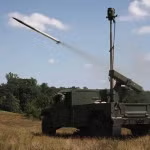
BAE Systems over the last few years has showcased several versions of the AMPV outfitted with different payloads using its new External Mission Equipment Package (ExMEP) top plate designed for rapid integration, to include a turreted mortar capability, an unmanned turret version and a counter-drone platform, with Sheehy adding the autonomous version aligns with the company’s intent to highlight potential options for the Army.
An Army unit also received a pair of AMPVs earlier this year equipped with a remote turret weapon system capable of countering drone threats, called AMPV-30, with BAE Systems previously noting the concept demonstrators were developed in six months with $17 million in internal funding (Defense Daily, Sept. 22).
Sheehy said the Army unit will retain the AMPV-30s for now, with plans to take them to a National Training Center rotation in March.
“I would love for them to go with AMPV-30. But even if they don’t, I think it’s an inflection point for how the Army develops capability. Getting it to the soldier, let the soldier feedback on it and then have industry move and change,” Sheehy said. “The vehicle is highly lethal. It has brought them capability they haven’t had, like the airburst round. So now they can engage troops in trenches behind walls. They can engage aerial targets, all that.”
Sheehy noted that discussions are still to be had with the Army on potentially bringing in the AMPV-30 capability to the vehicle fleet or cutting the ExMEP into the AMPV production line.
“The AMPV-30 has the capability, because of the [Integrated Combat System], for you to control the turret on another vehicle. So imagine if we had an autonomous vehicle that you could drive out there with the other vehicle. Now, you’ve reduced the exposure of soldiers in a direct kinetic fight, and you keep the same number of turrets in the fight because now your vehicle can control too, right? So there is a natural confluence of all these capabilities coming forward on that piece, and it’s just a matter of time and CONOPS and how you want to run it,” Sheehy said.
BAE Systems is also aiming to get an Autonomous AMPV provided to an Army unit as part of the Transforming in Contact initiative or another experiment opportunity, to gather feedback from soldiers.
“We’ll learn a ton. We learned a ton with the AMPV-30s that have been with soldiers for six months. We’ve learned a ton from them on how they engage. So it’s great,” Sheehy said.