 By
By 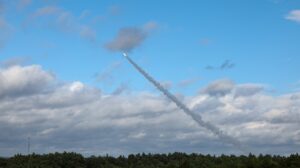
Poland has conducted a successful operational demonstration with the Northrop Grumman [NOC]-developed Integrated Battle Command System (IBCS).
The U.S. Army said the test was a “significant milestone” toward Poland achieving full operational capability with IBCS, a core component of Warsaw’s WISŁA medium range air defense modernization effort.
“Poland’s success is NATO’s success. U.S. commitment ensures Poland has an IBCS-enabled Patriot force by the end of 2025,” Maj. Gen. Frank Lozano, the U.S. Army’s program executive officer for missiles and space, said in a statement. “Together, we are demonstrating the future of integrated air and missile defense for all coalition partners.”
IBCS is the U.S. Army’s future air and missile defense command platform, designed to integrate and connect a wide swath of “sensor to shooter” capabilities, with the service to date having integrated a range of capabilities with the system to include the Sentinel A3 radar, Patriot radar, the new RTX [RTX]-built LTAMDS radar and the Indirect Fire Protection Capacity effector.
Poland signed on to become the first international IBCS operator after agreeing to a $4.75 billion deal with the U.S. in March 2018 to purchase the Patriot missile defense system along with the new Northrop Grumman-built battle command system in support of the first phase of its WISŁA program (Defense Daily, March 28, 2018).
The Army said the recent operational demo involved a live fire flight test conducted by Poland’s 37th Air and Missile Defense Squadron, with Northrop Grumman noting that the event was the first international operational exercise for IBCS and that the system assisted in taking out surrogate air-breathing targets.
“The demonstration showcased Poland’s ability to employ IBCS in concert with adapted Patriot components, underscoring the nation’s growing operational capacity to integrate and command advanced air and missile defense forces,” the U.S. Army said in a statement.
The U.S. Army called Poland’s WISŁA modernization effort the “largest and most significant Foreign Military Sales program” in its current portfolio.
“Enabled by IBCS, Poland’s WISŁA batteries can link multiple diverse sensors and shooters across a single fire control network, making the system fully plug-and-fight capable with U.S. and NATO assets,” the Army said.
Poland previously declared Basic Operational Capability with IBCS in 2023 and achieved Initial Operational Capability in 2024.
Last March, Poland and the U.S. signed a separate agreement worth approximately $2.5 billion for additional future deliveries of IBCS for the NAREW short-range air defense modernization program and the second phase of WISLA air and missile defense upgrade effort (Defense Daily, March 1, 2024).
Poland has recently faced provocations from Russian aircraft crossing into its borders, to include an incursion of 21 drones, with Warsaw having stated an intent to take out future encroachments from Moscow.
“Poland’s success is operationally critical and carries political and military implications—reinforcing NATO deterrence, coalition interoperability, and defense industry credibility. U.S. support remains unwavering. Poland’s achievement demonstrates the strength of an open-systems approach to coalition-ready integrated fires, bolsters NATO’s eastern flank, and enhances combined plug-and-fight capability,” the U.S. Army said in its statement on the IBCS operational demo.
The Army in December 2021 awarded Northrop Grumman a potential $1.4 billion deal for IBCS low-rate and production and the program was then approved for full rate production in April 2023 (Defense Daily, April 12, 2023).
Northrop Grumman announced in late July it had completed LRIP deliveries to the U.S. Army (Defense Daily, July 30).