 By
By 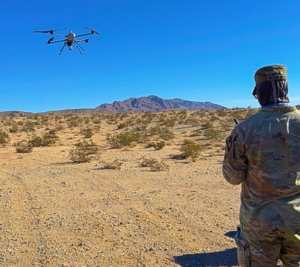
As it delivers and supports “Transforming in Contact” (TiC) units’ employment of its C100 drone, a Performance Drone Works (PDW) official told Defense Daily the company is eyeing the Army potentially moving into the Medium Range Reconnaissance (MRR) effort later this year.
Jonathan Lowe, vice president of sales for Pentagon programs, detailed the company’s recent participation with Army TiC units at the National Training Center (NTC) at Fort Irwin, Calif., noting soldiers are “pushing the envelope” with the C100s delivered under the company-level small unmanned aircraft system (sUAS) program directed requirement informing MRR.
“That Company Direct Requirement is really laying the groundwork for the Medium Range Reconnaissance program of record, which we’ll start to see at the end of this fiscal year into 2027,” Lowe said.
The Army in September 2024 selected PDW’s C100 and Anduril Industries’ Ghost-X UAS for its Company-Level Directed Requirement sUAS program to inform the future MRR requirement, with each firm tapped to provide 48 drones for the first tranche of the initiative (Defense Daily, Sept. 12 2024).
Both systems have been rapidly delivered to TiC units, with the Army having said is intended to enable “maneuver companies to conduct multiple tasks with rapidly reconfigurable, attritable, modular payload capabilities to execute reconnaissance, surveillance, and target acquisition missions.”
The Army’s TiC effort, spearheaded by Gen. Randy George, the service’s chief of staff, has focused on testing new operating concepts with select Army units and providing troops with new technology, such as drones, to inform rapid fielding decisions.
PDW has been awarded three contracts to date from the Army for C100 deliveries under the directed requirement program, mostly recently a $20.9 million award last September that also included Multi-Mission Payloads (Defense Daily, Sept. 18 2025).
“We’re gathering different feedback. They’re [going] to different areas of responsibility, different domains, INDOPACOM, EUCOM, CENTCOM, you name it, NORTHCOM. So all of those operating environments present their own challenges,” Lowe said. “If a unit is going to a certain location and they’re working on integrating different types of fire maneuvering capabilities, those commanders are going to want to see a capability like the C100 do different things.”
On the 21-pound C100, Lowe noted the system can fly for 74 minutes and carry 10 pounds in its intelligence, surveillance and reconnaissance configuration, while the system fits in a rucksack and is operated by a single user that can deploy the system in about five minutes.
“There was nothing else like that when the Company [Level] Direct Requirement came out. Those requirements were largely generated off a system like the C100,” Lowe said. “Where it really stands out is in the modularity, is in the payload capacity, the endurance and the fact that our ground control station runs on the [Tactical Assault Kit].”
Lowe noted the eventual MRR requirement is intended to address “a gap at the company and battalion level.”
“Now, where the system gets employed within a brigade, whether it’s a platoon or a company or battalion, that’s up to them. That’s kind of shooter’s choice. But there was a huge gap. And so the Army said, ‘We need a capability to fit this.’ They’ve got the Short Range Reconnaissance. They’ve got the larger Long Range Reconnaissance for Group 3s or Group 4s. But there was nothing really in this Group 2 space, and that’s where the C100 fit in,” Lowe said.
PDW visited the NTC twice in early November, with the first iteration focused on working with a unit out of the Army’s 1st Infantry Division that had been recently fielded C100s and then returning for a second phase to collaborate with the Program Management Office Small UAS.
“We wanted to make sure that they feel fully confident in the equipment that they’ve received and they’re able to conduct all the objectives that their commanders and, really, the Army is asking them to do in that sort of realistic type of operating environment,” Lowe said. “So the first phase was really [about] let’s make sure these guys are fully proficient. The second phase was really let’s see how they’re going to use the systems during the different missions that they had.”
To date, Lowe said PDW has also worked with TiC units at the Joint Readiness Training Center at Fort Polk, La., and the Joint Multinational Readiness Center in Hohenfels , Germany.
“And most of those we’ve actually done on our own accord, coordinating with Army leadership but also with those end users, again…to make sure that they’re fully confident. And then we’re able to transfer those lessons learned back immediately to our product engineering team to see if there’s anything that we need to work out or if there’s something else that we need to add from a capability standpoint,” Lowe said.
The TiC units are “pushing the envelope” with the C100’s employment, Lowe added, which has also included seeing how the system plugs into the Army’s Integrated Tactical Network and integrates with ground systems such as Bradley and Stryker vehicles as well as fixed wing and rotary wing assets.
“This is [about] extending those capabilities and, again, it’s going to present new challenges. Is it going to work with other systems? Is it going to work on the network? What [happens] when they actually plug it in?…And how do we think about it, not just from the PDW standpoint, but from the Army and from the joint [perspective]. And then the other vendors who have our capabilities out there as well, how do we work with them and plug everything together,” Lowe said.
Feedback gathered from the TiC unit’s rapid experimentation with the C100 has been directly implemented into PDW’s planning processes, Lowe said.
“We take the feedback at the tactical level [and] where those friction points are and then at the programmatic level say, ‘Hey, we think we want this payload next. We want this capability.’ We rapidly say, ‘Ok if this is something that we’re going to do, where’s the supply chain,’” Lowe said.
“That’s really best captured in our Multi-Mission Payloads, where the Army said, ‘We want electronic warfare, we want a [mobile ad hoc network] and we also want visual based navigation for totally GPS-denied [environments].’ We leaned in and in a matter of five months, we were able to integrate those very high [Technology Readiness Level] payloads from other vendors that were integrated then onto the C100. So that’s really where we take all that feedback and we roll out, whether it’s our [own research and development funding] or whether it’s a funded program, we’re going to do it if that’s what the warfighter wants,” Lowe added.
PDW this past August opened its new 90,000 square foot Drone Factory 01 in Huntsville, Ala., that aims to build 60,000 systems annually, to include 350 C100s a month (Defense Daily, Aug. 21)