 By
By 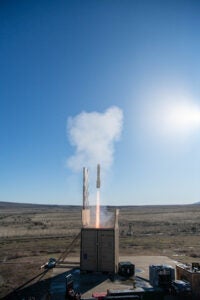
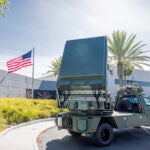
Lockheed Martin [LMT] on Tuesday unveiled its new Grizzly low-cost containerized launcher that can fire Hellfire missiles from a 10-foot shipping container, having recently completed its first live-fire tests.
The company’s announcement pitched the launcher as offering a “cost-efficient, rapid-mobility and low-observable distributed expeditionary weapon delivery capability” for a purpose-built asymmetric capability to augment artillery and missile launch systems.
“It’s a fairly small containerized launcher. The idea is to provide a bit of an asymmetric capability to our warfighters…you might think of a depth of magazine as being a really large magazine. Another way to achieve depth of magazine is to have several launchers,” Chris Murphy, who leads business development at Lockheed Martin’s Advanced Programs area under its integrated air and missile defense program, told reporters Monday ahead of the AUSA Global Force Symposium.
He noted the company pushed Grizzly as a quick development project that took nine months from starting consideration and six months from development to the first live fire tests.
In the tests, the Grizzly demonstrated the ability to load and launch a missile from a 10-foot Tricon container, with the test validating Grizzly’s capability of launching missiles vertically and at an angle. An official confirmed this has been funded through internal company investments.
“Our first live fire tests come just six months after the program began research and development, through internal Lockheed Martin investment, demonstrating our focus on quickly delivering a mobile and versatile launcher capability to defeat evolving threats,” Randy Crites, vice president of Lockheed Martin Advanced Programs, said in a statement.
“Grizzly provides the customer versatility and flexibility for their needs, as well as an element of mobility and discreteness for offensive and defensive fires,” Crites added.
Murphy said Grizzly’s strength is being a highly transportable launcher based out of the relatively small container that is focused on lower cost and flexibility. It uses launcher architectures like the fielded M299 system and commercial-off-the-shelf materials that reduce the logistics footprint and acquisition cost.
“What we’ve tried to do is take a lot of the cost out of those launchers and use containers where possible…the idea is that you can leave these somewhat unattended. Obviously they would be in proximity to some support, but as opposed to having a full on launcher sitting out in some place or moving around someplace, the idea is to have some containers available, and they protect the system from weather, but they also then allow rapid access and also rapid reload when the time comes,” Murphy said.
Murphy added Lockheed Martin’s concept of operations is that a military customer can stash the launchers in multiple locations and “make the enemy uncertain of what is where, by using commercial materials and commercial launchers, it’s not obvious where you have protection capability, and it allows you to spread the protection out geographically.”
The company highlighted other features of Grizzly include that it is agnostic to both command and control and sensor options, can be remotely operated, can easily integrate new missiles that fit into the capability, and can either come with an included power source or connected to a separate power system.
“It gives our customers a lot of options for how to address either maybe a short term need or maybe a longer term need someplace without having a long spin up period for what you think of as a classic launcher,” Murphy said.
However, he emphasized Grizzly is not meant to replace the service’s existing purpose-built launchers that are designed to survive for long times.
“This approach, if you had to, you could launch everything out of it, and if it was necessary, you could probably just leave it, because it’s a fairly low price approach,” Murphy said.
Murphy confirmed one scenario they designed Grizzly to be useful for is Marine Corps units deployed on Pacific islands that are being resupplied with missiles from the Autonomous Low-Profile Vessels (ALPVs) that are currently being tested to hold two Naval Strike Missiles.
“I think that they address some of the needs. I’m not going to speak directly for [government customers], but we believe it’s an offering that they will find appealing and certainly want to work with them on all sorts of applications. Something like that is right where we were thinking, though, when we developed this,” he said.
Otherwise, Murphy said Grizzly could help almost every military service solve some similar problems they have, “if they’re able to adjust their needs a little bit, adjust their requirements a little bit.”
Murphy acknowledged Grizzly could even be adapted to Navy shipboard use, although the maritime environment would “pose some challenges that you might have to rethink a couple of things, but the general concept is valid, and we are speaking with essentially all branches of the military.”