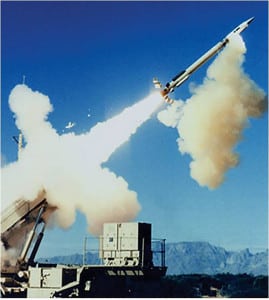
PAC-3 MSE Award. A Lockheed Martin spokesperson has confirmed to Defense Daily that the Army on March 6 awarded the company a deal covering the final year of its previously awarded multi-year contract for Patriot Advanced Capability–3 Missile Segment Enhancement (PAC-3 MSE) interceptors. The update follows comments from Army acquisition executive Brent Ingraham on March 12 alluding to a recent PAC-3 MSE award. “We awarded it. Would we love to scale it higher? Absolutely. That’s been sort of loud and clear all the way from the White House that we need to produce more,” Ingraham said at an Association of the U.S. Army discussion. The Army in early September 2025 awarded Lockheed Martin a $9.8 billion multi-year contract to produce 1,970 PAC-3 MSE interceptors, and in January signed a seven-year framework with the Pentagon to triple its production capacity. Details have not been disclosed yet on the value or quantities for the final year award under the multi-year deal.
Wedgetail Oversight. As the Air Force faces a May 4 deadline to brief Congress on how the service plans to reduce future requirements and control costs on the Boeing E-7 Wedgetail air moving target indication (AMTI) aircraft, the Defense Department last week awarded the company more than $2.4 billion in contracts for Wedgetail work in Seattle, Oklahoma City, and Huntsville, Ala. The awards bring the total value of Air Force Wedgetail awards thus far to $5 billion. The Air Force has wanted to cancel the E-7 in favor of moving AMTI to space, but Congress denied that push and funded the E-7 at $1.1 billion in fiscal 2026 for rapid prototyping and a transition to engineering and manufacturing development .
Common C-UAS Standards. The U.S. Defense Department and the United Kingdom’s Ministry of Defence have agreed to establish common data standards for counter-unmanned aircraft system (C-UAS) technologies, a step on the path to ensuring that different systems used by the military forces of each country “share data seamlessly, improve sensor fusion and accelerate the deployment of new technologies to the warfighter,” the task force coordinating C-UAS efforts for the DoD said last week. Work on the Joint Declaration of Intent between the DoD and MoD was led by Joint Interagency Task Force (JIATF)-401, which said it will require the data standard compliance for systems entering its marketplace, an online catalog of more than 1,600 C-UAS items and growing. “Vendors who adopt these standards will find a more direct path to getting their capabilities into the hands of our warfighters,” JIATF-401 Director Brig. Gen. Matt Ross said in a statement.
HII Union Agreements. HII on March 12 announced all five collective bargaining union units at its Ingalls Shipbuilding division in Pascagoula, Miss., ratified new collective bargaining agreements running through March 2031. The agreements include an immediate 18 percent or higher base wage increase for unionized shipbuilders, which it called the largest single wage increase in the shipyard’s history. Beyond the immediate wage hikes, the agreement also provides 35 to 47 percent wage growth overall through 2031, with company leadership expecting this to improve shipyard recruitment and attrittion. Negotiations between company leadership and union representative concluded on Feb. 12, leading to the vote and ratification by the union memberships. The five bargaining units include members of the Pascagoula Metal Trades Council, International Brotherhood of Electrical Workers, Office and Professional Employees International Union, International Association of Machinists, and the United Federation of Special Police and Security Officers.
Kudos To Hegseth. Sen. Tim Kaine (D-Va.) on March 12 said he has complimented Secretary of Defense Pete Hegseth and the Pentagon leadership’s work for “blowing cobwebs out in some of the ways we’re looking at acquisition.” Speaking during the Ronald Reagan Institute’s National Security Innovation Base Summit, Kaine said he welcomes how they are looking at a broader set of actors, “bringing in the innovators, bringing in the disruptors, not overlooking the the main players that have been with us forever, but broadening the net.” While focused on naval issues as ranking member of the Senate Armed Services’ Seapower subcommittee, Kaine specifically cited the reforms being implemented by Deputy Secretary of Defense Steve Feinberg and Secretary of the Navy John Phelan on shipbuilding. “We’ve got some innovative thinkers, and that’s what’s needed. And I’ve heard both Feinberg and Phelan say just incremental improvement is not going to get us to where we need to get. So innovation and the way we look at acquisition and who’s included in the ecosystem, very important,’ Kaine said. Kaine also complemented similar reforms being led by Secretary of the Army Dan Driscoll.
GE Investment. GE Aerospace on March 9 announced plans for another $1 billion investment this year into its U.S. manufacturing sites and supplier base “to help accelerate engine deliveries, ramp production of parts that safely extend time between maintenance shop visits and strengthen defense production to keep pace with military demand.” More than $275 million of the total investment will go toward improvements at sites that work on defense engines and components, according to the company, including over $40 million to its Lynn, Massachusetts site “to refresh machinery, expand test cell capacity and flexibility to meet delivery pace and make building upgrades” and $10 million for its Madisonville, Kentucky facility “to invest in new machines increasing part production, inspection equipment, tooling, and facility upgrades.”
Swarm Aero A Round. Swarm Aero last week said it raised $35 million in a Series A round to accelerate development and deployment of its large, long-range unmanned aircraft system and the “swarm software that enables drones to be controlled at scale.” The California-based startup aims to shakeup the drone market by enabling large numbers of drones to operate through its Legion command and control software that it says requires minimal human involvement. The financing was led by Two Sigma Ventures and Silent Ventures.
Battery Investment. Solid state battery developer Factorial Inc. has received strategic investments from IQT, Philenergy and POSCO Future to accelerate the Boston-based company’s expansion into drones and mobile robotics. The values of the investments were not disclosed. Factorial says its batteries deliver high-power in low temperature environments. “Energy performance is becoming a major limiting factor in mobility and intelligent systems,” Siyu Huang, Factorial’s CEO, said in a statement. “From unmanned aerial vehicles to robotics, incremental improvements are no longer sufficient.” She said the investments will accelerate “our growth, particularly in the strategic drone segment.”
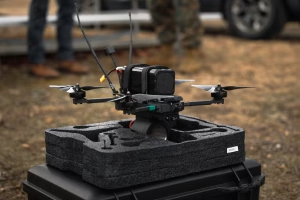
Euro Drone Investment. Black Forest Systems, an Estonian-based drone company, has received a $400,000 investment from Swedish investment company Front Ventures to refine the engineering, begin production readiness and deliver its SHADOX first-person view drone, the company said last week. Black Forest bills itself as a vertically integrated Ukrainian-Estonian technology company. SHADOX features a compact, protected-propeller design for operations inside buildings and trenches, self-stabilization to minimize piloting skills, ease of learning, and encrypted, low-profile communications for operations in electronic warfare-contested environments.
Golf, Trumps, and Defense. Aureus Greenway Holdings, a Nevada holding company that owns two public golf country clubs in Florida, is merging with Autonomous Power Corporation, which does business as Powerus and has developed autonomous drones for air and maritime use. Investors in the new company, which will operate as Powerus Corp. and expects to trade on the Nasdaq using the ticker symbol “PUSA,” include President Donald Trump’s sons Donald Trump Jr. and Eric Trump.
CACI Closes ARKA. CACI International last week said it completed its $2.6 billion cash acquisition of ARKA Group, adding high-end electro-optical and infrared and hyperspectral imaging capabilities used on classified satellite programs (Defense Daily, Dec. 22, 2025). ARKA also brings with it agentic artificial intelligence-based software. “ARKA purposefully accelerates our space market strategy while adding technologies that strengthen and expand our position in this rapidly growing domain, which is traditionally defined by high technical barriers to entry,” John Mengucci, CACI president and CEO, said in a statement.
New GD Surveillance Towers. General Dynamics Information Technology last week unveiled new autonomous surveillance towers (ASTs) for border security, becoming what it said is “one of the few companies in the country” with artificial intelligence-based ASTs. Anduril Industries already supplies U.S. Border Patrol with ASTs. GDIT previously provided the Remote Video Surveillance System that is operated by Border Patrol. GDIT said its AITs feature commercial technology, edge artificial intelligence and machine learning, patented video analytics, and advanced 5G and satellite communications to detect, identify, classify and track items of interest.
GD Hikes Dividend. General Dynamics last week said its board has agreed to increased the company’s quarterly dividend by 6 percent to $1.59 per share from the current $1.50 to shareholders of record on April 10.
Escorts. Chairman of the Joint Chiefs of Staff Gen. Dan Caine during a March 10 press conference said the military will look at the “range of options to set the military conditions” if tasked to escort oil and gas tankers though the Persian Gulf and Strait of Hormuz amid hostilities with Iran. Caine said like every potential mission, Pentagon officials will go to the Secretary of Defense and president with the resources required, command and control needed, risk and how to mitigate risks. “So, we’re looking at a range of options there, and we’ll figure out how to solve problems as they come to us,” he added. Secretary of Defense Pete Hegseth quoted President Donald Trump that if Iran does anything to stop the flow of oil through the strait “they will be hit by the United States of America 20 times harder than they have been hit thus far.” Hegseth also said Trump takes the condition of the strait seriously and that the administration is working with energy partners “to control for that. That’s part of that scoping of this.”
KC-135 Crash. U.S. Central Command on March 13 confirmed that all six crew members aboard a U.S. KC-135 Stratotanker refueling aircraft that went down in western Iraq were killed in the crash. “The aircraft was lost while flying over friendly airspace March 12 during Operation Epic Fury. The circumstances of the incident are under investigation. However, the loss of the aircraft was not due to hostile fire or friendly fire,” USCENTCOM said in a statement. There have now been a total of 13 U.S. servicemember fatalities since the outbreak of the operation against Iran. “War is hell. War is chaos. And as we saw yesterday with the tragic crash of our KC135 tanker, bad things can happen,” Defense Secretary Pete Hegseth said during a briefing on March 13.
Iran School Strike. A group of 46 Senate Democrats, led by Sens. Jeanne Shaheen (D-N.H.), Chris Van Hollen (D-Md.), Tim Kaine (D-Va.), Elizabeth Warren (D-Mass.) and Brian Schatz (D-Hawaii), sent a letter on March 11 pressing the Pentagon to provide details on airstrikes on a school in Minab, Iran. They note their “grave concern” with the Feb. 28 strike, which resulted in killing at least 168 Iranians including children, and called for a “swift investigation.” “The results of this school attack are horrific. The majority of those killed in the strikes were girls between the ages of 7 and 12 years old. Neither the United States nor the Israeli government has yet taken responsibility for this attack,” the lawmakers wrote in their letter. “There have also been reports of airstrikes that have hit multiple hospitals, cultural heritage sites, and other critical civilian infrastructure. This includes the use of explosive weapons in major Iranian cities and populated areas, including the capital, Tehran, which is home to approximately nine million people.”
…Investigation Underway. Hegseth during his March 13 briefing alongside Gen. Dan Caine, chairman of the Joint Chiefs of Staff, said U.S. CENTCOM has designated an investigating officer to lead an investigation into the strike that hit the school. “The command investigation will take as long as necessary to address all the matters surrounding this incident and the investigating officer is from outside CENTCOM and is a general officer,” Hegseth said. “We will investigate and we’ll get to the truth and we’ll share it when we have it, absolutely.”
Aussie USVs. The Australian government on March 11 announced a $125 million contract with Ocius to deliver another 40 new Bluebottle uncrewed surface vessels (USVs) over five years. This contract increases the Royal Australian Navy’s (RAN) Bluebottle fleet to 55 vessels to perform long-range intelligence, surveillance and reconnaissance missions. The Bluebottle USV was developed with the RAN and first funded through their Defense Innovation Hub. The vessel is powered via solar, wind and wave energy to provide persistent surface and sub-surface surveillance.
C-Band, L-Band, and Hyperspectral Maritime Surveillance. U.S. commercial space companies are looking to plug a shortfall in C-band, L-band, and hyperspectral imaging for maritime surveillance, according to a commercial space analyst. Detecting shadow fleets, such as surreptitious Russian oilers, and drug vessels are of concern. Foreign expertise includes the RADARSAT C-band constellation by Canada’s MDA Ltd. and the Firefly constellation of hyperspectral imaging satellites by India’s government-funded Pixxel.
New Hand Grenade. The Army on March 10 said it has cleared its new M111 Offensive Hand Grenade for “full material release,” making it the first hand grenade to achieve that designation since 1968. The M111 was developed by the Army’s Capabilities Program Executive Ammunition and Energetics, in partnership with Army Combat Capabilities Development Command’s Armaments Center. “The Mk3A2 is restricted for use due to its asbestos body unlike the M111 which utilizes a plastic body that is fully consumed during detonation,” the Army said. “The M111 will provide increased training and operational readiness while providing the soldier with a safer option. It also offers Soldiers the ability to fight more effectively in closed quarter urban environments by leveraging blast overpressure instead of fragmentation to deliver lethality.”
Hydrogen-Powered UAS. Heven AeroTech said on March 12 the Army has awarded it a “Basic Ordering Agreement” (BOA) for its Z1 hydrogen-powered, long-endurance unmanned aircraft system (UAS). The company described the BOA as a contracting vehicle the Army can use to procure Z1s “through a streamlined acquisition pathway.” “This agreement represents an important step in reducing procurement friction for Army units seeking advanced UAS capabilities,” Michael Buscher, Heven AeroTech’s president of U.S. operations, said in a statement. “Hydrogen-powered systems offer extended endurance, logistical flexibility, and reduced dependency on traditional fuel and battery supply chains. Through this BOA, we are positioned to provide Army units with a pre-negotiated acquisition pathway to Heven’s systems, enabling faster procurement and accelerating our ability to support evolving mission requirements with resilient, domestically aligned technology.” Heven told Defense Daily that there is no direct value tied to the BOA as it’s an open contract vehicle and that there’s no limit to the number of Z1s that could be ordered.