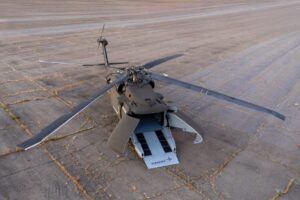
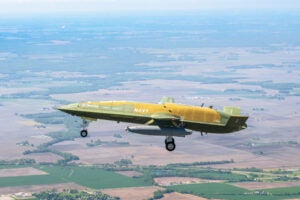
MQ-25 Engine. Rolls-Royce is awaiting word from the U.S. Navy on when the company’s AE 3007N engine for the Boeing MQ-25 Stingray refueling drone will see its first carrier landing test, says Tiffany Bowman, Rolls-Royce’s senior vice president for the AE 1107 and AE 3007 engines. The Air Force RQ-4 Global Hawk by Northrop Grumman also uses an AE 3007 as does the Navy’s MQ-4C Triton, also by Northrop Grumman.
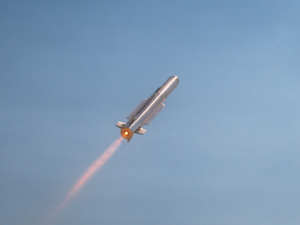
NGI Concerns. The Government Accountability Office on Aug. 20 said a restricted report was completed expressing concern the Next Generation Interceptor (NGI) program could be late and cost more than estimated. The report is titled “Missile Defense: Actions Needed to Improve the Likelihood That Next Generation Interceptor Will Be Delivered On Time and On Budget” but it is restricted, meaning it contains classified or controlled unclassified information by executive branch agencies so it cannot be publicly released. In April, Missile Defense Agency (MDA) Director Lt. Gen. Heath Collins told senators the Critical Design Review for the All-up Round was on track for the end of 2026. However, due to the NGI downselect occurring in 2024 rather than at least through CDR, MDA previously reported it was going to be delivered 18-plus months later than planned, largely due to solid rocket motor issues.
Valkyrie BLOS. Kratos Defense & Security Solutions this month announced a missionized version of the Marine Corps Valkyrie Collaborative Combat Aircraft successfully demonstrated electronic warfare (EW) capabilities and beyond line-of-sight (BLOS) command and control data link in an April 2026 test. In this Southern California test, the Valkyrie launched from a zero-length launcher, validated and characterized the BLOS system, and “transitioned seamlessly from the Kratos ground control station to an Autonomy Government Reference Architecture (A-GRA)-compliant human machine interface (HMI), developed by Autonodyne, LLC, which allowed a USMC operator to control the vehicle over BLOS,” the company said in a statement. The Valkyrie then flew with multiple Marine Corps F-35s and an F/A-18 and met coordinated EW test objectives before an autonomous return to the recovery point. Steve Fendley, president of Kratos Unmanned Systems Division, noted this was the fourth new mission system configuration flown on the service’s Valkyrie platform in under three years, demonstrating its open systems architecture and vendor-agnostic autonomy.
ESB-8. The Navy accepted delivery of the USNS Hector A. Cafferata Jr., (ESB-8), the final Lewis B. Puller-class expeditionary sea base ship from General Dynamics NASSCO in San Diego on Aug. 25 following integrated sea trials earlier in the summer. These ships are based on a crude oil carrier design to support maritime missions including Special Operations Forces and Airborne Mine Counter Measures. ESBs have a four-spot flight deck, mission deck, and hangar. They are designed around four primary capabilities in aviation facilities, berthing, equipment staging support and command and control assets. “Our ESBs are critical to maritime operations, providing logistics support from sea to shore for a broad range of military operations,” Jon Thomas, acting program manager for Strategic and Theater Sealift, said in a statement.
NSMV-4. TOTE Services LLC and the Hanwha Philly Shipyard completed the fourth of five National Security Multi-Mission Vessels (NSMV), the Lone Star State, and delivered it to the U.S. Department of Transportation’s Maritime Administration on Aug. 21. The vessel is due to be homeported at the Texas A&M Maritime Academy. The new vessel will serve as the academy’s primary training ship while also aiding humanitarian and disaster response missions. The vessel will be repositioned to Galveston, Texas, in November and cadets and faculty members are expected to embark on the Lone Star State for its first sea term in April 2027. TOTE serves as Vessel Construction Manager for the NSMV program.
Another OPC in Build. Austal USA last week said it has begun construction of its third Offshore Patrol Cutter (OPC), the future USCGC Ingham, for the Coast Guard. The 360-foot OPC is scheduled for delivery in fiscal year 2030. Austal’s first OPC in production, USCGC Pickering, is more than 50 percent complete and slated to deliver in late 2027, Icarus, the second OPC, is 15 percent complete and scheduled for delivery in the first quarter of 2029. Austal is under contract for 11 OPCs. Eastern Shipbuilding Group is building the first two OPCs in the Coast Guard’s program of record that calls for 25 of the medium endurance vessels.
PSNS Dry Dock. The Navy on Aug. 26 announced the completion of a seismic retrofit of Dry Dock 4 at Puget Sound Naval Shipyard & Intermediate Maintenance Facility. This is the result of a $378 million modernization project contract to reinforce the structural integrity of dry docks against potential future seismic events, falling under the Navy’s Shipyard Infrastructure Optimization Program. The Navy noted the original work scope was tracing five months ahead of schedule, so Naval Facilities Engineering Systems Command used funds from the July 2025 reconciliation bill to add additional upgrades at a total contract value of $517 million. Upgrades included structural anchors consisting of 12 cables drilled through dry dock walls, past the drainage layer and deep into the native soil. The new anchors are meant to ensure the dry dock can withstand large seismic events with less than six inches of lateral movement, so any ships in the dry dock would not come in contact with the walls. Reconciliation funds added upgrades to reinforce quay walls on either side of the caisson and additional anchors to the dry dock around the pump well and reinforce the pump well. Funds also funded removal of 500 decommissioned keel blocks.
Aussie USV Sonar. Ocius Technology on Aug. 25 announced it signed agreements to integrate sonar systems from maritime technology company ThayerMahan and Thales Australia across its fleet of Australian-made Bluebottle uncrewed surface vessels (USVs). This includes 40 Outpost acoustic intelligence payloads with TransparenSea processing software that consists of sensing payloads and processing software to help in anti-submarine warfare. The companies said this is a “practical application of AUKUS Pillar II,” that combined Australian autonomous technology with U.S. acoustic sensing and processing capabilities. Ocius also selected Thales Australia’s BlueSentry thin line arrays and BlueSentry acoustic processing to integrate onto Bluebottle USVs to help support maritime surveillance. The Bluebottle vessels are produced and equipped with acoustic arrays at Ocius’ production facility in Sydney, Australia. Ocius said these contracts are the largest fielded deployments of persistent above and below water surveillance undersea warfare missions in the world so far.
Autonomous Logistics. Stratom last week said it has received a four-year Small Business Innovation Research Phase III contract to mature the autonomy of its Autonomous Pallet Loader (APL)—and its safe use around aircraft—and advance the system toward operational use in support of military logistics. The APL award was sponsored by U.S. Transportation Command and extends joint development with U.S. Central Command, the Marine Corps and the Air Force. The Colorado-based company current material handling equipment requires “skilled operators and large manned platforms that are logistically intensive to deploy and sustain, increasing manpower demands and risk to personnel.” The APL is air-transportable and configured o support the CH-53K helicopter and C-130 aircraft.
GNSS-Independent Navigation. TrustPoint, which is developing a commercial Global Navigation Satellite System (GNSS), has successfully demonstrated operation of its C-band signals through interference on a receiver developed by Hexagon’s NovAtel, “accelerating the path to commercial resilient” positioning, navigation and timing, the company said last week. The work was under a contract with Naval Air Systems Command. “The demonstration confirms that TrustPoint’s C-band signals can be acquired, tracked and used to generate precise positioning data in environments where GPS is degraded or denied by modern electronic warfare,” TrustPoint said.
Space Force Award. Software company Integrate last week said it has received another Space Force contract for its program management software, this time for the Space Systems Integration Office (SSIO). The value of the award was not disclosed. Last year, the Seattle-based company received a $25 million award to help the Mission Manifest Office support launch operations. Integrate’s platform will allow SSIO to integrate and manage across programs, stakeholders and organizations, including government and commercial, with more timely data to improve decision-making. “Integrate’s project management platform strengthens our capacity to visualize the minute details and track broader objectives within the Space Force’s programs,” Helen Ying, system of systems engineering lead at the Space Force, said in a statement.
AI for NRO. The National Reconnaissance Office (NRO) wants to boost its use of artificial intelligence significantly, a top official said on Aug. 27. “We have considerable capability, but it’s not infinite,” Bill Adkins, principal deputy director of the NRO, said at the AFCEA Intelligence and National Security Summit. “We’re trying to find more needles in bigger haystacks, and we don’t have enough humans to go through all this so we have to figure out how to leverage tools like AI to be able to get through that data at speed and at scale to support our customers.”
Counter-Drone Partnership. NextNav and Tiami Networks have partnered to test long-range megahertz-based sensing capabilities for detecting drones and maintaining airspace awareness while also providing three-dimensional positioning, navigation and timing (PNT) information. The partnership leverages NextNav’s terrestrial 5G PNT network and Tiami’s expertise in integrated sensing and communications. “The need for longer range situational awareness has never been more urgent as drones continue to threaten large-scale events, critical infrastructure, and government and military facilities including airports,” David Gell, NextNav’s vice president of business development, said in a statement.
Tetra Tech Settlement. Tetra Tech Inc. paid the government $57 million to resolve allegations under the False Claims Act that it fabricated work and data that the Navy relied on to determine if the former Hunters Point Naval Shipyard in San Francisco Bay was free of harmful radiation, the Justice Department announced Aug. 24. In a lawsuit, the government alleged that pursuant to contracts issued between 2003 and 2014, Tetra Tech was required to investigate the soil and buildings at the former shipyard to remediate any areas that had excessive radiation so it could be transferred to the City of San Francisco for redevelopment, but it told field technicians to discard soil samples from potentially contaminated occasions and replace it with clean soil known to satisfy release criteria as well as intentionally manipulating scan results. The government alleged through this conduct, Tetra Tech benefited by receiving additional unearned contract award fees and avoided obligations to perform further remediation work, ultimately decreasing costs and increasing profits. Due to the settlement, the claims resolved by it are only allegations with no determination of liability. The government also recovered $40 million in a separate settlement in 2025 under the Comprehensive Environmental Response, Compensation, and Liability Act, also known as Superfund.