By Steven Wills, Ph.D., Defense Opinion Writer.
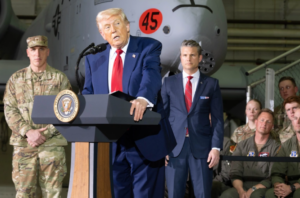
While not specifically saying so, President Trump’s new National Security Strategy (NSS) released on Dec.4 is in fact a clarion call for a larger and more capable Navy.
The document’s focus on protection of sea lines of communication, key choke points and an overall more robust U.S. presence in the Western Hemisphere together point to the need for increasing the size and capability of the Navy.
The Navy currently is composed of approximately 290 ships centered around 11 nuclear aircraft carriers. The responsibilities outlined in the NSS suggest a larger Navy of approximately 350 manned ships and 12 flattops.
A focus on Western Hemisphere
The increased military presence in the Western Hemisphere required by the NSS is fundamentally underpinned by a powerful Navy. Current operations in the Caribbean Sea are enabled by naval forces that provide the president multiple options for kinetic and non-kinetic action.
Warships are an inherent component of U.S. national statecraft, from the 19th century when U.S. naval forces achieved the trade opening of Japan under the leadership of Commodore Matthew Perry, to more recent operations in the 1980’s to liberate Grenada and Panama from coercive Marxist and militarist governments.
Grey-hulled Navy and white-hulled U.S. Coast Guard ships are the vanguard of U.S. diplomacy, and a grim harbinger of what happens when nations oppose U.S. efforts. So-called “gunboat” or “big stick” diplomacy does not work absent a large and capable Navy.
Expeditionary forces essential
The need for expeditionary forces is also a key component in the NSS requirements for protection of sea lines of communication and maritime choke points in the Middle East and Indo-Pacific. As seen in Red Sea combat in the last two years, this effort usually requires persistent, high-end naval forces that can remain on station for weeks and deliver consistent lethal force.
The Navy’s carrier air wing is well-suited to provide persistent striking capacity but is currently hobbled by short-range aircraft. A recent report on accidents during the Red Sea campaign indicated that F/A-18 E/F aircraft are still being used as “buddy tankers” to support longer ranged operations. This is poor use of a strike airplane and highlights the need to get the M/A-25A unmanned tanker into service immediately.
The other element of naval needs highlighted by the Red Sea campaign is that even lower end adversaries like the Houthi rebels in Yemen are capable and require significant ordnance capacity to combat. This means more ships that can rotate into and join the fight, when necessary, in addition to having more weapons.
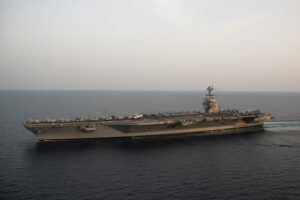
A minimum of 12 flattops
The Navy needs a minimum of 12 carriers to cover the deployed locations the president’s strategy identifies: the Indo-Pacific, the Middle East and the Western Hemisphere. Defense of Israel and a showdown with Russia could drive that demand signal to four deployed carriers, which translates into a minimum of 12 flattops. The Navy currently has 11 number of carriers, and could drop to 10 next year due to delays in delivery the next flattop USS John F. Kennedy, and the pending retirement of the oldest carrier USS Nimitz in 2026.
Additional warships will be required to escort carriers, launch offensive missiles and escort combat logistics forces that support deployed ships and protect key maritime choke points and trade lines as the president’s strategy commands.
The president’s deal for new icebreakers means that the Arctic is another potential location for deployed naval forces where land-based air and ground units are more limited in movement and action. These new missions mean more amphibious warfare vessels and perhaps modern equivalents of the battleship, probably armed by hypersonic missiles in large numbers.
President Trump’s new National Security Strategy stakes out many new missions, as well as emphasizing previous ones. Taken together, they demand a much larger and more capable Navy. The administration should strengthen the new security document by calling for American command of the seas, as President Reagan did in the 1980’s, to compel Congress to provide the necessary budgets
A strategy of “America First” must begin with combat-capable naval forces forward deployed to guard U.S. interests and if necessary, launch prompt, lethal and sustained combat action to defend them.
Dr. Steven Wills is the navalist at the Center for Maritime Strategy. His research and analysis centers on U.S. Navy strategy and policy, surface warfare programs and platforms and military history.

Are you a Defense Daily reader with a thought-provoking opinion on a defense issue? We want to hear from you.
- We welcome submissions of opinion articles on national security, defense spending, weapons systems and related areas.
- We welcome submissions from lawmakers, administration officials, industry representatives, military officials, academics, think tank experts, congressional candidates, international experts and others on issues important to the national defense community.
- We welcome a diverse range of opinions all along the political spectrum.
- Email: editor@DefenseOpinion.com