By Bill Milroy, Defense Opinion Writer.
Space-based communications are now as fundamental to military operations as fuel and logistics. Warfighters expect assured connectivity for command and control, intelligence and real-time situational awareness, all while facing growing cyber, electronic and physical threats.
That reality is forcing the Department of Defense (DoD) to rethink satellites and the ground systems that connect missions to space. In this new era, “resilience” means designing ground systems that can survive a contested environment, adapt to rapidly changing commercial offerings and still deliver reliable communications. That requires moving beyond legacy parabolic dishes to a new class of phased array technology.
Older systems with many limitations
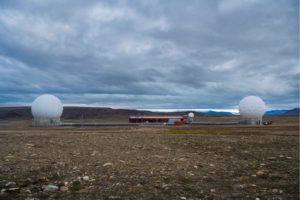
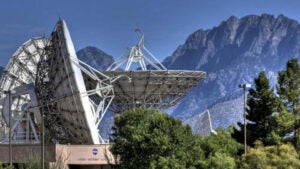
Traditional ground stations use large parabolic dishes locked at a geostationary (GEO) satellite. For decades, those systems were “good enough.” The satellite appears fixed in the sky, the dish stares at a single point, and as long as the motors and mechanics keep working the link holds.
But this legacy model has serious limitations. Each dish is strictly one beam. If you need more simultaneous links, you need more dishes, which is unsustainable in terms of cost, complexity, and footprint.
Large dishes require heavy mounts, concrete pads, cranes to install and significant operations and maintenance dollars. Replacement parts can take weeks or months to arrive. What’s more, a cluster of dishes is a clear indicator of a high-value node using satellite imagery.
Lastly, unlike GEO satellites, low earth orbit (LEO) and medium earth orbit (MEO) satellites move quickly across the sky, requiring continuous tracking and repointing.
A better solution
Keeping pace with advancements, phased array antennas offer a fundamentally different approach, using multiple radiating elements to passively steer beams. In practical terms, a relatively flat, multi-subarray panel can form and reconfigure multiple beams, track multiple satellites across the sky and switch between satellite constellations and frequency bands in software.
The defense community has extensively researched and talked about replacing dishes with phased arrays. Until recently, the technology simply wasn’t practical. Arrays were too big, consumed too much power and cost far more than alternatives, keeping them confined to niche use cases.
The equation is now changing.
New and novel advances in phased array techniques and hardware reduce size, power and cost while increasing performance. As a result, phased arrays are re-emerging as viable replacements to traditional dishes for ground infrastructure.
SATCOM design priorities
For defense decision-makers, this shift aligns with three key design priorities for resilient satellite communications (SATCOM) architectures: architectural diversity, interoperability and security.
Security: Surviving in a contested domain. Ground systems are targets, and adversaries have options ranging from cyber intrusion to electronic and physical attacks. Resilient satellite communications must address several dimensions – they must be harder to find, target, or intercept; they must be harder to jam; they must be aligned with cyber and air-gapped needs.
Architectural diversity: More paths to space. Resilient SATCOM depends on having multiple ways to move data securely. That means they must have multiple orbits, leveraging GEO, HEO, MEO and LEO constellations; they must use diverse frequency bands; and, they must combine government and commercial capacity and hybrid models.
A single, mechanically steered dish is typically tied to a specific band, orbit and network. If that network is unavailable, due to a technical issue, market exit or adversary action, then options are limited. In contrast, phased-array terminals are designed to support multiple bands and constellations from the outset, with software defining the constellation or waveform.
Interoperability: Stitching systems into a resilient whole. Interoperability — across constellations, vendors, and ground infrastructure — is critical. With dishes, the usual answer to more capacity or more networks is, “Just add another dish.” Each new network then involves new hardware, new integration work and another point of failure. That drives up costs and complexity.
Electronically steered arrays enable a different approach. One terminal can support multiple simultaneous beams, talking to different satellites and networks at once. Software-defined interfaces allow the same hardware to interoperate with different modem racks, mission networks and management systems. Ground operators can dynamically allocate beams to missions, rather than dedicating hardware to a single use case
From a budget standpoint, it’s not enough for a phased array to be technically impressive. It must also be competitive on total cost of ownership. But because a single array can replace several large dishes and their costly maintenance, the business case becomes far more compelling.
Today’s operational environment — marked by aging dishes, expanding constellations and a more contested space domain — is pushing legacy ground systems to their limits. Modern phased-array terminals, built for diversity, interoperability and security, provide the resilient SATCOM solution the DoD demands.
Bill Milroy is chief technical officer and co-founder of ThinKom, a satellite communications company based in Hawthorne, California.

Are you a Defense Daily reader with a thought-provoking opinion on a defense issue? We want to hear from you.
- We welcome submissions of opinion articles on national security, defense spending, weapons systems and related areas.
- We welcome submissions from lawmakers, administration officials, industry representatives, military officials, academics, think tank experts, congressional candidates, international experts and others on issues important to the national defense community.
- We welcome a diverse range of opinions all along the political spectrum.
- Email: editor@DefenseOpinion.com