 By
By 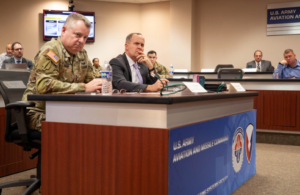
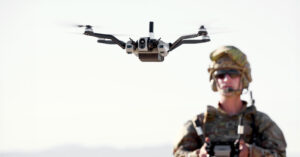
HUNTSVILLE, Ala. – The Army’s SkyFoundry initiative to manufacture thousands of its own cheap drones on a monthly basis has recently “evolved,” with an official telling Defense Daily the program is “100 percent a commercial partnership.”
“We’re still innovating and testing and trying new things, but SkyFoundry is still progressing. The Drone Dominance effort is still there. The way that the Army is adapting its approach to it has evolved a little bit over the last couple months,” Rich Martin, Army Material Command’s (AMC) director of supply chain management, said in an interview at the Association of the U.S. Army’s Global Force Symposium here.
“The idea that the Army would be singularly producing the breadth and depth of the drones that our nation needs was probably a bad narrative. We have been from the beginning, 100 percent committed to being partnered with commercial partners. The Army can’t make [drones at] that level though. Hell, today, our country can’t make [drones at] that level, if I’m really being honest. But it is 100 percent a commercial partnership,” Martin added.
The Army first detailed the SkyFoundry initiative last October stating a goal to reach capacity to build 10,000 cheap drones within a year of receiving funding, with the aim to use the low-cost systems to help train soldiers in drone warfare (Defense Daily, Oct. 17 2025).
Col. James Crocker, the military deputy for AMC’s Supply Chain Management Directorate, told reporters at the time the service would need to acquire the appropriate machinery and train the workforce of the Army’s organic industrial base in order to achieve that manufacturing capacity.
To enable SkyFoundry, the Joint Manufacturing & Technology Training Center (JMTC) at the Army’s Rock Island Arsenal in Illinois would manufacture drone frames, Tobyhanna Army Depot in Pennsylvania would focus on electronics and propulsion, to include manufacturing brushless motors, Red River Army Depot in Texas would manufacture injection molded propellers and Blue Grass Army Depot in Kentucky would serve as a drone innovation hub to prototype designs based on soldier feedback, according to Crocker.
On the brushless motors, Martin said the Army is “on the verge of being able to produce those at scale, which is another source of supply to meet the national requirement.”
Martin noted that industry’s built-in scale for production drones could assist in the SkyFoundry initiative, while he did not comment specifically on how commercial partners will now be factored into the new approach or how the program’s objectives have potentially be restructured.
“There are companies out there, whether it’s a small [business], whether it’s a large [business], that are innovating in a space and at a pace that we can’t necessarily do. But when they innovate, and they try to do that at scale, now they’ve got to have a way to produce it. We have production capacity, so thus we have a natural partnership that I think is advantageous to everybody,” Martin said.
Martin also said a new Commercial Solutions Opening to bolster organic industrial base (OIB) modernization efforts, which resulted in a recent award to Hadrian Automation to establish an advanced manufacturing facility at Red River Depot, is “somewhat tied” into SkyFoundry (Defense Daily, March 18).
The Army earlier this month also announced the new Strategic Capital Initiative to bring in private capital to fund efforts ranging from technology modernization to bolstering OIB efforts, adding with the service looking to use the initiative to make progress on its $150 billion backlog of infrastructure projects (Defense Daily, March 5).
“If you’re going to make that [product], make it here, invest here, keep this thing viable and use your capital wisely here. And as we meet the requirements and the demands we need, then you still have that extra capacity. And it’s a win for both ends,” Martin said.