The Eagle Passive/Active Warning Survivability System (EPAWSS), which is intended to improve the ability of U.S. Air Force F-15 fighter jets to detect and counter air and ground threats, is on track to begin flight tests in the fourth quarter of this year, according to EPAWSS prime contractor Boeing [BA].Developmental testing will occur through the second quarter of 2020 and be followed by an independent operational test and evaluation phase that will last about a year, Boeing said in written…
Upgrades to the GPS ground system–the Architecture Evolution Plan (AEP)–is an option under consideration by the Defense Department’s space acquisition chief, as problems continue in fielding the GPS Next Generation […]
Senate Budget Committee Chair Lindsey Graham (R-S.C.) said Wednesday, with the White House’s backing, his panel will move “expeditiously” on crafting a second reconciliation bill, citing priorities for defense and […]
Defense Secretary Pete Hegseth on Thursday acknowledged the Pentagon could potentially ask Congress for $200 billion in supplemental funding to support the ongoing operation against Iran and replenish munitions used […]
U.S. Northern Command (NORTHCOM) used a counter small unmanned aircraft system (sUAS) flyaway kit (FAK) in the early hours of the strikes against Iran on Feb. 28, according to Air […]
The Eagle Passive/Active Warning Survivability System (EPAWSS), which is intended to improve the ability of U.S. Air Force F-15 fighter jets to detect and counter air and ground threats, is on track to begin flight tests in the fourth quarter of this year, according to EPAWSS prime contractor Boeing [BA].
Developmental testing will occur through the second quarter of 2020 and be followed by an independent operational test and evaluation phase that will last about a year, Boeing said in written responses to questions. Tests will take place at Eglin Air Force Base in Florida and Nellis Air Force Base in Nevada.
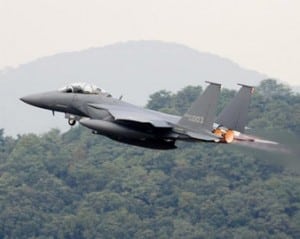
Boeing’s F-15. Photo: Boeing.
If the program is fully funded, the Air Force will start fielding EPAWSS on the F-15E Strike Eagle in September 2022 and the F-15C Eagle in September 2023, Boeing said. A total of more than 400 F-15s — 217 F-15Es and 196 F-15Cs – could get the upgrade.
Although the Air Force has so far requested EPAWSS procurement funding only for the F-15E, the fiscal year 2019 defense authorization bill recently passed by the House would add $67 million to begin buying EPAWSS kits for the F-15C as well. The F-15E is designed to perform both air-to-air and air-to-ground missions, while the F-15C focuses on gaining and maintaining air superiority.
The all-digital EPAWSS will enhance the F-15’s ability to detect and identify air and ground threats, use countermeasures and jam enemy radar. It will replace the F-15’s original self-defense system, the 1970s-era Tactical Electronic Warfare System (TEWS), whose analog technology has limited capability against modern threats. TEWS is also becoming more difficult and expensive to maintain.
“The proliferation of fourth-generation enemy aircraft, sophisticated ‘double-digit’ anti-aircraft missile systems and other enemy systems pose a significant threat to F-15 survivability,” the Air Force wrote in its FY 2019 budget request. EPAWSS “will replace the F-15’s functionally obsolete self-defense … TEWS to enhance weapon system situational awareness and survivability against enemy threats.”
Under the program, which is expected to cost more than $4 billion, Boeing will integrate EPAWSS onto the F-15 and modify the jet to support the system. Subcontractor BAE Systems is developing EPAWSS hardware and software.
The Air Force says that EPAWSS will allow the Boeing-built F-15 to operate in contested environments through 2040. The service tapped Boeing as the EPAWSS prime contractor in 2015, and the program completed a critical design review in 2017.
After lawmakers decided against including major “right to repair” reforms in the latest defense policy bill, a senior Army official has said the service is continuing its push for authorities […]

 By
By