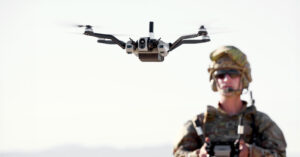
Representatives of Ukrainian drone, counter-drone, and defense tech companies said this week that they are reducing their dependence on Chinese components significantly, as Ukraine builds its domestic supplier base.
Some elements of the low-cost Chinese supply chain have been particularly difficult to reduce, particularly lower-tier components for printed circuit boards, flight controllers, and motors–the latter due in part to the Chinese control of manganese used for drones’ lithium-ion batteries–but Ukraine is stepping up purchases of domestically-built components to reap economies of scale and reduce component unit costs.
Officials from Ukrainian companies and BRAVE1, a Ukrainian defense tech group focused on accelerating the fielding of innovative systems for Ukraine, spoke with reporters at the Ukrainian Embassy in Washington, D.C. on March 9, as BRAVE1 embarks upon a nationwide investment roadshow in the U.S.
In the year after the Russian invasion in February 2022, as the Ukrainian military drone industry was ramping up, “most of the components of those drones came from China,” said Yaroslav Azhniuk, the CEO of Kyiv’s The Fourth Law, which develops drone autonomy systems.
“As of today, there are some drones for which 100 percent of their components were produced in Ukraine, and, if we talk about averages, I would say 80 percent to 90 percent of the first-level components are being produced in Ukraine so we’re talking about motors, propellers, frames, radios, cameras, etc.,” Azhniuk said. “However, there are second-level components–for example, sensors for drone cameras and battery cells, and they come from China. It’s the same case for companies in the U.S. which depend on Chinese components.”
“To fight that, we are localizing component production deeper and deeper,” he said. “At my company, we’re beginning to build a semiconductor fab to produce those drone camera sensors in Ukraine, and we’ve received significant interest from parties in the United States. Now we’re considering building a semiconductor plant here in the United States capable of manufacturing the needed quantities of those thermal sensors.”
“For some of these components, the whole of Europe produces only enough components for Ukraine to consume in two to three months, and for some of these components in the United States, the situation is not much better so it’s crucial for the defense of the free world to build this internal capability for the whole supply chain,” Azhniuk said.
Restrictions on using critical minerals and materials from China and a ban on using Chinese-made semiconductors is set to take effect for the U.S. government on Jan. 1, 2027 and Dec. 23, 2027, respectively. Section 5949 of the fiscal 2023 National Defense Authorization Act began the move toward such U.S. “on-shoring.”
More Ukrainian companies are viewing local components “as a must have in their portfolio, and I’m not only speaking of drones,” said Taras Bublyk, the head of strategy for the Ukrainian electronic warfare company Unwave. “If you think of electronic warfare solutions–jammers, amplifiers, etc.–that were originally in China, right now it is 100 percent local production.”
Iryna Zabolotna, the chief operating officer of Brave1, said that the Ukrainian military drone industry faces two challenges.
“We need to create our Ukrainian component base, but we need to understand that we need to scale our amount of production because the plan for 2026 is to produce more than 7 million drones in Ukraine,” she said.
China’s low cost production also poses a hurdle–one that Ukrainian and allied capital expenditures may help solve.
“In Ukraine, we produced 5 million drones in 2025, so if it’s a quadrocopter, there’s a need for 20 million motors, something like 70,000 per day,” said Sergiy Orlov, director of international cooperation and government relations for General Cherry, which develops drone and counter-drone systems that it says are used by more than 120 Ukrainian military units.
“We do prefer to use Ukrainian components, even if it’s somehow dozens of percent more expensive,” he said. “We are absolutely ready to produce 100 percent ‘No China’ components for all the requests. It will require more money.”