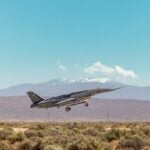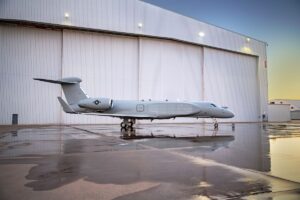
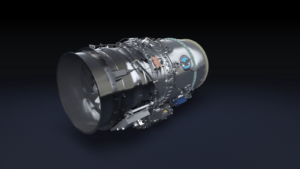
CCA Engine. RTX’s Pratt & Whitney said that one of its PW500 engines is installed on a Northrop Grumman YFQ-48A Talon Blue drone, which may be an entrant for Increment 2 of the Air Force’s Collaborative Combat Aircraft (CCA) competition. P&W on April 17 said that the engine “is integrated into the aircraft and is ready to power flight tests.” For Talon Blue, the company said that it worked “to expand the commercial limits” of the more than 24.5 million flight hour PW500. “The PW500 engine family is one of several in-production commercial engines available to address the broad spectrum of CCA aircraft in development today,” P&W said. “In addition to domestic pursuits, Pratt & Whitney is also on contract with an international customer and discussing additional opportunities with airframers.” The General Atomics YFQ-42A is competing against the Anduril Industries YFQ-44A for CCA Increment 1, and the Air Force has said it plans to award a contract for the latter this year, in addition to starting development of CCA Increment 2.
…Autonomy Handoff. Northrop Grumman said it flew the Talon IQ testbed—an autonomous Model 437 aircraft by Northrop Grumman’s Scaled Composites, and moved controls mid-flight from Northrop Grumman’s Prism mission autonomy software “to Applied Intuition’s and Accelint’s mission autonomy skills, demonstrating Talon IQ’s ability to dynamically switch partner autonomy at the individual skill level within the testbed.” Northrop Grumman said that its “strategic investment in risk-mitigated flight tests” provides “confidence that autonomy software is ready for the next-generation Talon Blue platform.”
Thousands of Missiles. While the Strait of Hormuz may soon fully open to commercial shipping following a ceasefire between Israel and Hezbollah in Lebanon, Iran may still have a formidable military force to contend with, Pentagon disavowals to the contrary. In prepared testimony to the House Armed Services Committee’s intelligence and special operations forces panel last Thursday, Marine Lt. Gen. James Adams, the director of the Defense Intelligence Agency, said that “Iran retains thousands of missiles and one-way attack UAVs that can threaten U.S. and partner forces throughout the region, despite degradations to its capabilities from both attrition and expenditure.” On March 11, the Handala hacking group, linked to Iran, launched a cyberattack on the Michigan-based medical device company, Stryker. That March 11 hack was Iran’s “first destructive cyberattack against a U.S. company since 2014,” according to Adams.
LTAMDS Order. The Army on April 16 awarded RTX a $904.6 million order for production of five Lower Tier Air and Missile Defense System (LTAMDS) and six spares. The cumulative value of RTX’s low-rate initial production contract with the Army now totals $5.4 billion, according to the Pentagon. LTAMDS, the Army’s new radar for the Patriot air defense system, is a 360-degree Active Electronically Scanned Array radar using Gallium Nitride that is billed as providing improved performance over the legacy capability against manned and unmanned aircraft, cruise missile, ballistic missiles and hypersonic missiles. “With demand surging for this high-impact 360-degree radar, we are investing in advanced facilities to scale production and accelerate delivery, ensuring service members receive this critical capability without delay. This latest contract demonstrates the critical need for LTAMDS amid increasingly complex and large raid threat tactics,” Tom Laliberty, president of land and air defense systems at RTX’s Raytheon business, said in a statement.
DDG-102. The Navy awarded Vigor Marine LLC a $253 million contract on April 16 for the maintenance, modernization, and repair of the Arleigh Burke-class USS Sampson (DDG-102) destroyer during its fiscal year 2026 Depot Modernization Period. The work encompasses all labor, supervision, equipment, production, testing, facilities, and quality assurance necessary to prepare for and accomplish the maintenance and repair period. Work will occur in Seattle, Wash., and is expected to be finished by March 2028. This award was not competitively procured.
…DDG-103. Naval Sea Systems Command awarded General Dynamics NASSCO-Norfolk a $183 million contract action to conduct maintenance, modernization, and repair of USS Truxtun (DDG 103) during a planned Fiscal year 2026 Depot Modernization Period. The work will occur in Norfolk, Va. and is expected to be finished by April 2028. The Defense Department noted the contract was competitively procured, with only one other offer.
…DDG-124. The Navy conducted a commissioning ceremony of the Arleigh Burke-class destroyer USS Harvey C. Barnum Jr. (DDG-124) on April 11 at Naval Station Norfolk, Va. Navy Secretary John Phelan served as the ceremony’s principal speaker, where he noted this is the first vessel to bear the name of a Vietnam War Medal of Honor recipient.
…LCS-31. The Navy plans to commission the future USS Cleveland (LCS 31) Freedom-variant Littoral Combat Ship (LCS) on May 16, 2026, in Cleveland, Ohio. The commissioning will mark the completion of the last Freedom-variant LCS construction phase. The Freedom-variant prime contractor is Lockheed Martin and Fincantieri Marinette Marine as the shipbuilding partner. After the commissioning, LCS-31 will be homeported in Mayport, Fla., with its sister ships.
UH-60 and Launched Effects. The Army in the next three months plans to conduct more work with the Black Hawk helicopter and launched effects, according to Col. Ryan Nesrsta, project manager for the Army’s Utility Helicopters Project Office. Nesrsta told reporters on April 16 at the Army Aviation Association of America’s annual conference in Nashville that the aim is to “qualify that capability on the aircraft.” Launched effects is the Army’s program to field new autonomous air vehicles that can be launched from aircraft or ground platforms with a variety of payloads and mission system applications for reconnaissance, extended communications links and eventually lethal capabilities. Nesrsta said the focus with the upcoming Black Hawk work is medium-range launched effects and will “subsequently explore additional space to launch both lethal and non lethal effects off of the aircraft.”
UAS Amphib. The Marine Corps on April 15 announced it recently conducted two weeks of shipboard testing with the TRV-150C Tactical Resupply Unmanned Aircraft System (TRUAS) aboard a San Antonio-class amphibious transport dock ship. This dynamic interface testing was conducted by the Portfolio Acquisition Executive for Robotics and Autonomous Systems Aircraft Management Program Office and Air Test and Evaluation Squadron 24. This test focused on evaluating how the system operates in a complex shipboard environment. The Navy added that during the testing, the TRUAS vehicle completed multiple launches and recoveries, showing the feasibility of unmanned maritime cargo delivery.
Stalker Orders. Redwire Corp. on April 14 announced it received over $20 million worth of purchase order awards in the first quarter of fiscal year 2026 for the Navy and Marine Corps’ Small Tactical Unmanned Aircraft Systems Program Office Family of Small UAS Team. This award includes the Marine Corps’ first acquisition of Redwire’s Advanced Navigation version of the Stalker Block 30 autonomous Vertical Take Off and Landing uncrewed aerial system. This adds to over 250 Stalker aircraft the Marine Corps already fields. The Advanced Navigation Stalker systems include air vehicles, ISR camera payloads, varying distance range ground control station and associated support kits. Procurement occurred via a Defense Logistics Agency Tailored Logistics Support contract, with Atlantic Diving Supply serving as prime contractor for the award.
UAS Order. Quantum Systems said on April 15 it has received a $15.3 million to deliver its Vector AI drones in support of the Army’s second iteration of its Company-Level sUAS Directed Requirement effort. The program is intended to rapidly field UAS capabilities to support maneuver units while also informing the future Medium Range Reconnaissance Requirement, with the Army having worked with Performance Drone Work’s C-100 and Anduril Industries’ Ghost X UAS to date. “The Vector platform has logged more than 20,000 operational flight hours in Ukraine alone where operational use has helped refine its autonomy and mission adaptability in contested environments. Its modular architecture and open integration approach align directly with the Army’s push toward interoperable, rapidly evolving capabilities,” Dave Sharpin, CEO of Quantum Systems, said in a statement.
C-UAS Marketplace Buys. So far, Defense Department customers have purchased $13 million worth of counter-drone systems off a two-month-old marketplace intended to make it easier, and faster for commands, warfighters and interagency partners to acquire validated capabilities. The Joint Interagency Task Force (JIATF)-401 said four purchases have been made using the Counter-UAS Marketplace to get capabilities—consisting of low-collateral defeat effectors, sensor systems, radars and electronic warfare systems—to U.S. Central Command, individual services with homeland defense missions, and the Joint Task Force Southern Border. “Through the platform, customers can review performance data, compare systems and make informed decisions based on real-world test results and verified capabilities,” Army Maj. Matt Mellor, lead acquisitions specialist for JIATF-401, said in a statement.
…D.C.-Area C-UAS Exercise. Separately, the task force said is working with the Joint Task Force-National Capital Region at Fort Belvoir, Va., in a training exercise to improve counter-drone capabilities in the greater Washington, D.C. area. JIATF-401 last week said that soldiers from the 3rd U.S. Infantry Regiment are training with the Bumblebee V1 C-UAS system to practice detecting, tracking, identifying and defeating drones with minimal risk to nearby personnel and facilities. The Perennial Autonomy Bumblebee is a small operator-controlled drone that slams into other drones during flight. “Bumblebee’s improved air-to-air capability will enhance our layered defenses by enabling warfighters to follow drones back to their launch point to identify the operator, or by destroying them in the air with minimal risk to people or property on the ground,” task force spokesperson Lt. Col. Adam Scher said in a statement.
Autohook. Fairbanks Morse Defense (FMD) on April 14 unveiled its Autohook fully autonomous vessel recovery interface ahead of the Navy League’s 2026 Sea Air Space expo. FMD said Autohook was developed by its Vestdavit Norway-based business and called the system a “cornerstone capability in establishing a new standard for fully autonomous Launch and Recovery System” supporting unmanned surface vehicles and other assets that do not require any human intervention. The company noted Autohook achieved operational acceptance at Sea State 4 conditions and it aligns with NATO operational standards and is geared air working for allies’ militaries.
Australian GMLRS. Australia has successfully test-fired its first domestically-produced GMLRS rocket, the country’s defense ministry said on April 12. The update follows Australia’s announcement last December it was set to start manufacturing GMLRS under its co-production arrangement with the U.S. and Lockheed Martin. “Making missiles in Australia is central to Australia’s national defense resilience. Australia is now the only country outside the United States to make the GMLRS missile, providing opportunities for Australian industry to enter into global supply chains,” Australian Minister for Defense Industry Pat Conroy, said in a statement. “This successful test-firing is a major milestone for Australia’s sovereign guided weapons capability, demonstrating concrete progress in strengthening our national self reliance and delivering a defense future made in Australia.” The GMLRS work is part of a multi-billion dollar Guided Weapons and Explosive Ordnance plan to bolster Australia’s domestic weapons manufacturing capability.
Rheinmetall-Destinus JV. Germany’s Rheinmetall and Netherlands-based defense tech firm Destinus announced on April 13 they have agreed to establish a joint venture focused on building advanced missile systems, to include cruise missiles and ballistic rocket artillery. Rheinmetall will hold a 51 percent stake, while Destinus will hold the remaining 49 percent, with the firms noting the arrangement is still subject to regulatory approvals. The new Rheinmetall Destinus Strike Systems venture said it will offer capabilities to “a broad international market in Europe, as well as selected partner countries within the NATO alliance.” “We must expand the industrial base for modern defense systems in Europe. This joint venture reflects this necessity. We are combining Rheinmetall’s production capacities and experience in managing large-scale programs with Destinus’s specific technology and system design. By doing so, we are laying the foundations for scalable, operational missiles that are tailored to the current requirements of the European and allied armed forces,” Rheinmetall CEO Armin Papperger said in a statement.
PNT Prototyping. The Army on April 13 announced two Other Transaction Authority agreements with IS4S and GPS source to work on its NorthStar mounted precision, navigation and timing effort, focused on prototyping modular, upgradable capabilities for ground-based platforms. The two deals are worth up to $41 million and cover a 36-month period of performance. “We’re confident that with our vendor partners, we’ll introduce an affordable, MOSA-compliant product with next-generation capability into our family of open solutions and continue to bring upgradable and scalable APNT products to soldiers in the field,” Chris Jais, project manager for PNT, said in a statement.
Stinger Replacement. Lockheed Martin said on April 17 it recently hosted the Army to showcase a full-scale, final assembly demonstration of its offering for the Next-Generation Short-Range Interceptor (NGSRI) competition, the service’s effort to develop a Stinger missile replacement. Lockheed Martin is currently competing against RTX for NGSRI. On the recent demo at its Advanced Manufacturing Technology Center in Grand Prairie, Texas, Lockheed Martin said the event was “more than a technical showcase” and was intended to show the Army progress on its “ready-to-field solution now, while the permanent production line comes online.” “The successful demonstration reinforced Army confidence, positioning the NGSRI program strongly for the next procurement phase,” Lockheed Martin said in a statement. Lockheed Martin said in January it had recently conducted a successful first flight test of its NGSRI offering.
Bell in UKR. Textron’s Bell aircraft company last Friday said it has formed a subsidiary in Ukraine and will open a “dedicated office” there as it eyes industrial cooperation with the country. Bell Textron Ukraine will focus on “helicopter assembly, maintenance, and repair,” the company said. “This is a meaningful step toward building a practical, mutually beneficial cooperation with the Ukraine defense and industrial base,” Jeffrey Schloesser, senior vice president of Strategic Pursuits, said in a statement.
Security Detection JV. Leidos and privately held Analogic have agreed to form a joint venture serving the global security detection market, with the partnership operating under the Analogic brand and Leidos maintaining a significant minority ownership, the companies said last week. Leidos brings about 1,500 employees and $625 million in projected 2026 sales to the JV, which expected to be approved in the second half of this year. Analogic will provide standalone and integrated screening and detection solutions to the aviation, ports and borders, and critical infrastructure markets. The JV will be led by current Analogic CEO Tom Ripp. Analogic is a portfolio company of the investment firm Altaris.
AI Pilot Assistant. Beacon AI, an aviation software company, last week said it received a four-year $49.5 million Other Transaction Authority prototype award from U.S. Special Operations Command to work with certain customers on its artificial intelligence technology that assists in activities onboard aircraft. Beacon said its partners for the work include several operational units and research partners, including the Air Force Human Performance Wing, around “safety, endurance and mission effectiveness for long-duration and high-workload aviation operations.” Beacon said its software goes beyond autopilot functions to include “open and closed loop pilot assistance autonomy systems that act as context-aware advisory assistants that help crews manage complexity.”
Maritime Intel Partnership. Maritime intelligence company Windward is integrating geospatial intelligence company Vantor’s Sentry persistent satellite-based data collection and analysis system into its maritime domain awareness platform. The companies said last week their partnership eliminates a gap in maritime domain awareness stemming from fragmented sensors and separate detection, identify verification and behavioral analysis workflows. Windward earlier this month acquired Prominent Edge, giving it experienced mission specialists around geospatial and maritime intelligence that work in high-security organizations.
HARQ for Quantum. The Defense Advanced Research Projects Agency (DARPA) last week launched the Heterogeneous Architectures for Quantum (HARQ) program with the goal of shedding the limitations of current homogenous approaches to quantum computing that are limited to being designed around a single quantum bit, known as a qubit, the basic unit of quantum information. The agency notes that classical computing is based on integrating disparate specialized processors. “Qubit technologies each have their own distinct advantages, but no single approach can deliver everything needed for large-scale, high-performance quantum systems,” Justin Cohen, a DARPA program manager, said in a statement. The agency has selected 19 teams to work on separate workstreams.
New Rocket Lab Product. Launch vehicle and satellite provider Rocket Lab last week introduced an electric thruster to propel satellites in orbit, adding a new product to the company’s portfolio. Rocket Lab said that Gauss, the name given the thruster, features a Hall Thruster, power processing unit and a propellant management assembly, and is designed for high production volume—more than 200 per year. “Electric propulsion thrusters have historically proven extremely difficult to produce in high volumes, causing supply chain fragility for national security and commercial constellation operators alike,” the company said in announcing its in-house designed thruster.