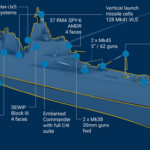
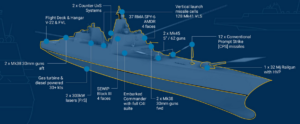
Railgun Redux. The Navy’s White Sands Detachment (WSD) began testing a Navy railgun again in February at White Sands Missile Range in New Mexico. The testing was revealed in a NAVSEA Port Hueneme warfare center 2025 year of review report. The short acknowledgement said “WSD tested a railgun to collect critical information about high-velocity firing during a three-day campaign at White Sands Missile Range in New Mexico.” The testing was a joint effort between WSD and the Virginia-based Naval Surface Warfare Center Dahlgren Division and was “conducted for Naval Sea Systems Command Joint Hypersonics Transition Office.” The Navy previously shelved railgun testing in 2021. In June 2021, then-Chief of Naval Operations Adm. Mike Gilday told lawmakers the service has been chasing the technology for almost 30 years and “we just have not been able to develop a system that can easily get aboard a ship that would provide the kind of probability to kill” that they want. Gilday at the time noted the Navy found utility in a high velocity projectile used in the railgun tests and other advancements in standoff range and hypersonic weapons technology would likely “make the railgun a less attractive option just with respect to range.” More recently, the Navy listed railguns as a technology it seeks to put on the future Trump-class battleships.
DOGE. The Department of Government Efficiency (DOGE) team assigned to the Pentagon is “still alive and well,” according to Jay Hurst III, the department’s acting comptroller. Defense Secretary Pete Hegseth had previously provided regular updates on where DOGE was advising cuts at the Pentagon, to include announcing $5 billion in savings last June from slashing consulting contracts, while the team’s work has largely gone unremarked upon so far in 2026. “They’ve been able to kind of look into things at a level that’s really hard to do when you’re building the budget. And we benefited from that for the FY ‘27 budget,” Hurst said at the McAleese Conference on March 17. Owen West, who previously served as DOGE’s team lead at the Pentagon, has since taken over as director of the department’s Defense Innovation Unit.
NATO 2035. Air Force Gen. Alexus Grynkewich, commander of U.S. European Command, told lawmakers on March 18 he believes European partners will be able to assume most of NATO’s responsibilities by 2035. “The way I think about it is they’ll be a lot better by 2035 than they are in 2030. And by 2035, I think they can assume most of the responsibilities. And every day between now and then, they get better and better and take on more of that burden,” Grynkewich said during a House Armed Services Committee hearing. Top Pentagon policy official Elbridge Colby has called for a “NATO 3.0” model based around European nations taking on increased responsibilities and defense expenditures and a U.S. role of “partnership rather than dependency.” “For the first time in a long time, money is not the problem in Europe. European allies are spending more and more of their budgets [ on defense]. We have five or six allies who, this year, are going to exceed five percent [of GDP] on core defense spending. So that’s a good news story. And several other economies are on their way through three to 3.5 percent,” Grynkewich said.
FAMM Engines. Georgia’s PBS Aerospace, a subsidiary of the Czech Republic’s PBS Group, said on Friday that it has received a $3 million Other Transaction Authority contract from the U.S. Air Force for engines for the service’s Family of Affordable Mass Munitions (FAMM). “The award represents PBS Aerospace’s first publicly disclosed prime contract with the U.S. government – a meaningful distinction that positions the company as a direct industrial partner to the U.S. Air Force, not simply a component provider in a larger supply chain,” the company said. “As a prime contractor, PBS Aerospace holds contractual accountability for delivery and performance at the program level. PBS Aerospace’s small turbojet engines power unmanned, attritable systems where scalability, affordability, and reliability are critical operational requirements. The company’s Roswell, Ga., facility is actively scaling production to fulfill this contract and existing commitments, reflecting a real and growing contribution to the U.S. defense industrial base.” PBS Aerospace said that it stood up the Roswell plant in less than a year “to move at the speed required by today’s defense environment.”
FMS Reform Vs. Production. Assistant Secretary of Defense for Industrial Base Policy Michael Cadenazzi last week said reforming the Foreign Military Sales (FMS) process to accelerate U.S. arms transfers does not matter as much as increasing the production capacity of the defense industrial base. “The gap is, I could go ahead and go much faster in FMS, I’d still be waiting in line to get my weapons from the prime,” he said at the McAleese Defense Programs Conference. “The issue has been there is not enough production capacity. By driving them all together and recognizing that the FMS DCS (Direct Commercial Sales) problem is a production problem, we wouldn’t be squabbling over process issues if we had more production on the factory floor.”
…Supply Chain Visibility. Asked during the event what large companies can do to support their suppliers production capacity increases, Cadenazzi replied that the Defense Department needs help from the prime contractors with visibility into their supply chains. “I think the first thing would be assist us in getting additional visibility,” he said. “A lot of times we go to companies and we ask for transparency on who their suppliers are, and the answer is ‘no.’ And so that’s not helpful where we’re trying to go ahead and buy your weapons and invest and de-risk your production.” The more transparency DoD has into the supplier base the better it can invest and co-invest with the primes, he said.
…Supplier Lock In. It is not enough any longer for the department to just worry about getting the prime contractors on contract without enduring they “lock in their supply chains,” Cadenazzi said. DoD needs to engage directly with suppliers, ensure that “we’re locking in suppliers with transparent pricing agreements” and “flowing down the cash wherever we can” to get the necessary “stability at the lower levels that we want,” he said. “So, we’re really excited about creating structures through contracting mechanisms, etcetera, to actually make that feasible going forward.”
More P550s. The Army on March 20 awarded AeroVironment a $117.3 million deal to deliver more P550 Group 2 drones in support of the Long Range Reconnaissance (LRR) program. In August 2024, AV announced the Army had picked the company to provide its new P550 UAS to select units in support of the Transforming in Contact rapid fielding initiative and to inform the LRR program. The new contract follows a $42 million deal from December 2025 to provide additional P550s. The Army has described the LRR as its program to provide a Group 2 UAS to organic maneuver battalions to support reconnaissance, surveillance and target acquisition operations, with an interest in solutions that weigh less than 55 pounds, have a range of 40 to 60 kilometers and an endurance of five to 10 hours.
Polar Communications. Nearly two years after launch, the Enhanced Polar System-Recapitalization (EPS-R) has achieved operational acceptance, according to Space Force’s Space Systems Command (SSC). Northrop Grumman’s EPS-R is a follow on to the company’s two EPS extremely high frequency payloads, which became operational in November 2019. The systems are to provide military satellite communications above 65 degrees North latitude. EPS-R launched in August 2024 from Vandenberg Space Force Base, Calif., aboard Space Norway’s Arctic Satellite Broadband Mission satellites. “EPS-R will extend the EPS capability into the early to mid-2030s to prevent a polar coverage gap until the Evolved Strategic SATCOM (ESS) polar variants are available,” according to SSC, which awarded Boeing a $2.8 billion contract last year for the first two ESS satellites.
Drone Autonomy IPO. Swarmer’s initial public offering on the Nasdaq last week netted the small multinational drone autonomy company about $14.7 million after discounts, commissions and offering expenses, the Texas-based company said. All told, Swarmer closed on the sale of nearly 3.5 million shares for $5 a piece in a fund raising to add employees, expand the capabilities of its autonomy platform and its integration with more hardware companies (Defense Daily, March 17).
Lockheed Drone Protection. Fortem Technologies last week said that Lockheed Martin has contracted with the company to provide its TrueView radar sensors and DroneHunter non-lethal interceptor drones to protect critical infrastructure. Fortem’s technology will be integrated with Lockheed Martin’s Sanctum counter-unmanned aircraft system mission management software. “Fortem has spent years proving our counter-drone technology in conflict zones and at some of the highest-profile events in the world,” Jon Gruen, the Utah-based company’s CEO, said in a statement. “This contract puts that same capability to work protecting critical infrastructure.”
Apex in Japan. Productized satellite bus manufacturer Apex last week announced its first contract with a Japanese company, NEC Corp., in support of a technology demonstration mission launching in 2027. NEC has acquired an Aries satellite bus that the Japanese company will to demonstrate “high-throughput” optical communications in a 1,000 kilometer low Earth orbit. Apex has previous foreign sales and the NEC purchase adds to the company’s international footprint.
C-UAS News. Hidden Level last week said it successfully detected and tracked Group 1 drones at low altitudes during a live capabilities demonstration on Santa Rosa Island, Fla., in collaboration with the Air Force’s 96th Test Wing Plans and Programs innovation Office and 46th Test Squadron, validating the startup’s radio frequency-based drone detection technology for airspace monitoring. Hidden Level said the test marked the end of a two-year effort with the Air Force test community and showcased the Syracuse, N.Y.-based company’s ability to “seamlessly integrate and share critical sensor data with other mission applications” used by the Air Force.
…New Interceptor. Powerus last week introduced Guardian-1, what it says is a low-cost, high-speed interceptor designed to defeat drones and one-way attack drones and other unmanned aircraft systems such as Iran’s Shahed-136. The company, whose investors include President Donald Trump’s sons Donald Jr. and Eric, said Guardian-1 recently conducted flight demonstrations with U.S. servicemembers “alongside war-game exercises at the National Training Center.”
More Square Footage. Counter-drone company MyDefence last week said it opened a 25,000 square foot manufacturing and innovation facility in Oklahoma City, Okla. The company makes wearable, mobile and fixed-site counter-unmanned aircraft system technology. Unmanned surface vessel developer and manufacturer Saronic said it is opening a nearly 15,000 square foot office in New Orleans as an engineering and technical hub in support of its shipbuilding operations in Louisiana. Hardware and marine engineers, naval architects and systems testers will support the design and development of Saronic’s 180-foot autonomous ship, Marauder, which is being built in Franklin, La.
PIPIR Meeting. The Partnership for Indo-Pacific Industrial Resilience (PIPIR) held its second meeting on March 18, with the 16 member nations stating they convened to “reaffirm our commitment to accelerating defense industrial cooperation.” The United Kingdom and Thailand were endorsed as the 15th and 16th partners of PIPIR at the meeting, joining the U.S., Australia, Canada, Germany, Italy, Japan, Lithuania, Netherlands, New Zealand, Norway, Philippines, South Korea, Singapore and Sweden. “Collectively, we are committed to strengthening defense industrial resilience to promote the continued regional security, economic security, and prosperity of the Indo-Pacific,” the PIPIR nations said in a joint statement. The group said it discussed current capacity shortfalls, momentum made in addressing “barriers to increased armaments cooperation,” and efforts to “de-risk supply chains, expand forward sustainment capacity, remove policy and regulatory impediments to cooperation and accelerate production of key systems and components.”
…New Initiatives. At its recent virtual meeting, the PIPIR nations said they also agreed to expand the scope of a regional sustainment hub in Australia to support operators of P-8 Poseidon maritime patrol and reconnaissance aircraft and endorsed plans to cooperate on development of batteries and motors for small drones. The group said it also committed to a new project to explore establishing a forward-deployed F100/F110 engine repair hub in Japan to support regional sustainment of F-15s and F-16s and discussed progress standing up a CH-47 Chinook T-55 engine repair hub in South Korea, a new solid rocket motor initiative between the U.S. and Japan, a new load, assemble, and pack line effort for 30mm-by-173mm ammunition with the Philippines and regional co-production opportunities for modular unmanned aerial vehicle projects.