
Dems Want Iran Hearing. Democrats on the House Armed Services Committee have called on Chair Mike Rogers (R-Ala.) to immediately convene a public hearing with Pentagon officials on the Trump administration’s ongoing military campaign against Iran, pressuring for answers on the costs of the operation to date, details on munitions expenditures and more clarity on the department’s plans to ask Congress for a potential $200 billion supplemental. “We are deeply troubled by the lack of transparency from the Trump Administration and the Department of Defense and its failure to keep the Congress and the American people informed. We remain concerned by the ever-shifting strategic and operational objectives of the conflict and lack of clarity regarding the possible use of U.S. ground forces in the region,” HASC Ranking Member Adam Smith (D-Wash.) wrote March 27 in a letter signed by all Democrats on the committee.
GMTI Launch in 2028? Space Force Lt. Gen. Douglas Schiess, the deputy chief of space operations for operations, says the service and the National Reconnaissance Office continue developing the space-based ground moving target indication (GMTI) radar satellites and that first launch is “expected as soon as 2028.” The Space Force requested more than $1 billion in research and development for space GMTI in fiscal 2026, but congressional appropriators reduced that to $719 million and redirected $154.5 million in classified spending to GMTI procurement and $35 million to GMTI advanced procurement.
Challenges Ahead. Space acquisition chief Thomas Ainsworth notes that programs facing challenges include the long-delayed GPS Next Generation Operational Control System by RTX’s Raytheon and the Satellite Communication Augmentation Resource (SCAR). This month, the Space Force terminated AeroVironment’s contract for SCAR after the parties failed to agree on a firm-fixed-price contract that provides the service with a cheaper solution. SCAR is to be a future network of satellite control antennae to replace the 19 in the Satellite Control Network. “SCAR continues to be a necessary and important enabler of national security space operations, and the Department of the Air Force is committed to its success to support the Joint Force,” Ainsworth says.
Moody To SASC. Sen. Ashley Moody (R-Fla.) has been named as the newest member of the Senate Armed Services Committee (SASC), replacing Sen. Markwayne Mullin (R-Okla.) following his confirmation to lead the Department of Homeland Security. Moody was appointed by Florida Governor Ron DeSantis in January 2025 to fill the vacant Florida Senate seat after Marco Rubio was named Secretary of State. “Sen. Moody brings a wealth of experience to this body’s critical work, and her addition comes at a consequential moment for our national defense. I look forward to working alongside her as we address a pivotal year for military budgeting, modernization and industrial base expansion,” SASC Chair Rogers (R-Miss.) said in a statement.
CH-47F Block IIs. The Army on March 26 awarded Boeing a $326 million deal for the next six CH-47F Block II heavy-lift helicopters. The new production awards follow the Army’s rapid fielding decision last October for the Block II program, which included affirming plans to outfit two Combat Aviation Brigades with the upgraded heavy-lift helicopter. The upgrades associated with the CH-47F Block II include an improved drivetrain, increased range, a redesigned fuel system and an ability to lift an additional 4,000 pounds.
M48 USV. Magnet Defense LLC on March 26 announced it began production on its first deliverable M48 medium-sized unmanned surface vessel (USV), moving past the initial “validated prototype program.” The M48 has a range of 17,000 nautical miles and the company said it can self-deploy from San Diego to the Persian Gulf without assist or refueling. The M48 is based on the same hull, mechanical and electrical systems as the Magnet Research Vessel prototype that accumulated over 1,000 days at sea and over 40,000 nautical miles since 2020, Magnet Defense said. The unmanned vessel comes with the company’s proprietary DriveAI navigational autonomy suite and is capable of supporting various combat missions like integrated air and missile defense, contested logistics, anti-surface and anti-submarine warfare, and electronic warfare. Magnet said the first production M48 is scheduled to be delivered in the second quarter of 2027.
Sub AUV. L3Harris Technologies on March 25 announced it won an Other Transaction Authority contract from the Defense Innovation Unit to deliver its Torpedo Tube Launch and Recovery system that deploys and retrieves the company’s Iver4 900 autonomous underwater vehicles (AUVs) via submarine torpedo tubes. The company noted both U.S. and allied navies have already validated the system to conduct intelligence, surveillance, reconnaissance, mine detection and seabed warfare missions without surfacing. Nino DiCosmo, L3Harris president for the Maritime, Space & Mission Systems business, boasted theirs is the first system to successfully launch and recover AUVs from a submarine. “The Torpedo Tube Launch and Recovery system is not a future capability, it’s answering combatant commander needs today,” he said in a statement.
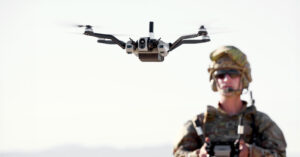
sUAS Order. Skydio said on March 23 it has received a new order from the Army worth over $52 million to deliver more than 2,500 of its X10D drones. The company said the deal is the “largest small unmanned aircraft system (sUAS) procurement from a single manufacturer in the Army’s history.” The Army previously selected both Skydio’s X10D and Red Cat’s Black Widow for fielding in support of the Short Range Reconnaissance program. “This order reflects the decisive role small autonomous systems now play in modern conflict and the Army’s commitment to putting those capabilities in soldiers’ hands,” Mark Valentine, Skydio’s global head of national security strategy, said in a statement. “It also shows that the United States can deliver world-class drone capability at the scale and speed required by today’s operational environment.”
USSF Cyber Squadrons. The Space Force’s Space Systems Command last week said it has formed two new defensive cyber squadrons to defense its launch ranges from adversary cyber-attacks during launch operations. The 630 Cyberspace Squadron (CYS) is aligned under Space Launch Delta 30 at Vandenberg Space Force Base, Calif., and Space Launch Delta (SLD) 30 and 645 CYS was reassigned from Delta 6 to SLD 45 at Patrick Space Force Base, Fla. “Our new Defensive Cyber Operations Squadrons are just one of the ways the U.S. Space Force is staying ahead of the threat,” Maj. Torius Davis, commander of 630 CYS, said in a statement.
Striveworks Investment. Striveworks last week said that Washington Harbour Partners has made a capital investment in the company that will be put toward improving its product offerings—including deepening its Chariot platform to support agentic AI use cases across defense and national security customers—expanding its engineering, research and development teams, and scaling to meet increasing demand for artificial intelligence-powered data analytics and intelligence fusion across U.S. and allied governments. The Austin, Texas-based company has about 80 employees. The value of the investment was not disclosed.
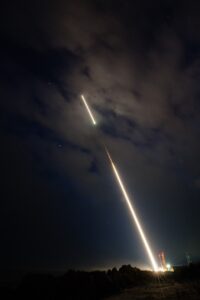
Quantum Sensor Launch. Canada’s SBQuantum last Friday said its quantum diamond magnetometer-based sensor that can provide GPS-independent navigation is slated to launch on Sunday, March 29, as part of the final phase of the National Geospatial-Intelligence Agency’s MagQuest Challenge. SBQuantum is teamed with Spire Global in the final phase of the challenge, a competition supporting new ways to collect data in support of the World Magnetic Model that is the standard for navigation and heading (Defense Daily, Sept. 28, 2023). “Applications for this sensor go far beyond the WMM itself, from defense and navigation to resource exploration and public safety,” David Roy-Guay, SBQuantum’s founder, said in a statement.
Minot Visit. Air Force Gen. Dale White, the direct reporting portfolio manager for critical major weapon systems, visited the 91st Missile Wing at Minot AFB, N.D., on March 19-20 to gain insights on requirements and modernization involved with the Northrop Grumman LGM-35A Sentinel future ICBM, the Air Force said. This year, the Pentagon may re-certify Sentinel for engineering and manufacturing development (EMD) after rescinding EMD in 2024 after a Nunn-McCurdy breach.
Data Centers. The Army announced on March 26 it will enter into negotiations with investment firm Carlyle and portfolio company CyrusOne to work on building and operating commercial hyper-scaled data centers on two Army installations. The service noted the deals are not yet finalized, while Carlyle was picked for a project at Fort Bliss, Texas, and the KKR and BlackRock-managed CyrusOne was selected for work at Dugway Proving Ground in Utah. “The companies were chosen through a rigorous and competitive process and will be responsible for financing, building, operating, maintaining and decommissioning the data centers on underutilized but non-excess Army land at no upfront cost to taxpayers,” the Army said in a statement.
Japan HVGP FMS. The State Department last week approved a potential $340 million Foreign Military Sale (FMS) to Japan for equipment and services in support of the country’s upgraded Hyper Velocity Gliding Projectiles (HVGP) capability. Th equipment and services include test preparation, test support, transportation support, range surveillance and safety, test data and more that will be provided by the U.S. government.
…Radios for South Korea. The department also approved a potential $200 million FMS to South Korea for ARC-210 RT-2036(C) secure radios for F-1K and KC-330 aircraft, and KY-100M communication security devices for a number of aircraft. RTX’s Collins Aerospace segment is the principal contractor for the sale.
…And for Belgium. A proposed $156.1 million FMS for Belgium includes AN/PRC-163, AN/PRC-167 and AN/PRC-160 radios and related equipment supplied by L3Harris Technologies. The State Department said the sale will allow the Belgium army to “communicate across moderate to extended distances using encryption that prevents interception.”