Back to USPACOM. The Defense Department last week changed the name of U.S. Indo-Pacific Command (INDOPACOM) to U.S. Pacific Command (USPACOM), reversing a name change the first Trump administration made in 2018. USPACOM was established by the Truman administration in 1947. The name change to USINDOPACOM was meant to reflect the command’s expanding area of operations across the Indian and Pacific Oceans. “Restoring the legacy USPACOM designation honors the command’s deep historical roots, fostering a sense of price and collective spirit among all who serve in the Pacific,” USPACOM said in a June 16 statement. The command’s area of responsibility is unchanged. The name change comes at a time of heightened tension between the U.S. and India, including a U.S. air strike on June 10th on the oil tanker MT Settebello in the Gulf of Oman. The strike disabled the tanker and killed three Indian sailors on the ship, which U.S. Central Command (CENTCOM) said was carrying Iranian oil at a time of the U.S. blockade.
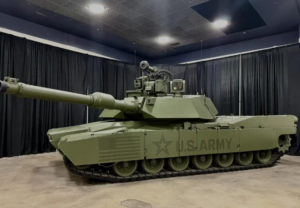
M1E3 On Track. A senior Army acquisition official told lawmakers on June 16 the Army remains on track with its accelerated timeline for the new M1E3 Abrams tank. “We’re very excited about this program. Everything is moving forward. We have the funding behind it. So right now we’re it’s just a matter of getting the vehicles delivered and then just fielded it to that division, and so we can start capturing feedback and then moving forward with a very aggressive schedule for the M1E3,” Jesse Tolleson, principal deputy assistant secretary of the Army for acquisition, logistics and technology, said at a Senate Armed Services Airland Subcommittee hearing. Tolleson was referring to the Army’s plans to have four M1E3 prototypes this year that are set to be delivered to the 1st Cavalry Division for testing soon. The Army has said its intent is to then shift into production in 2027. “The M1E3 represents a reset. It’s lighter, it’s more mobile, it has a vehicle protection system built in, it’s more protected and it’s a lot more lethal. And we can use it as a base kit, because it’ll have drive-by wire technology in it, so I could make it autonomous or semi-autonomous,” Lt. Gen. Miles Brown, acting head of Army Transformation and Training Command, said at the hearing.
SSN-788. The Virginia-class submarine USS Colorado (SSN-788) completed its scheduled maintenance period at the Pearl Harbor Naval Shipyard and Intermediate Maintenance Facility (PHNSY & IMF) on June 10, 29 days ahead of schedule. The Navy said the early completion was due to a close partnership and clear communication between the shipyard and ship’s crew. “Colorado’s success was largely due to the continual hard work, communication, and coordination between our Sailors and the shipyard team. Ending the availability early allows us to get back out to sea and prepare the crew for operations,” U.S. Navy Cmdr. Justin Reeves, Colorado commanding officer, said in a statement.
Gateway to Sentinel. The Air Force and Army Corps of Engineers broke ground on May 28th at Malmstrom AFB, Mont., on a construction project for a $26 million Commercial Entrance Control Facility (CECF)–the so-called “Gateway to Sentinel”–which, once built in 2028, is to allow direct access for contractors and machinery to sites related to the future Northrop Grumman [NOC] LGM-35A Sentinel ICBM. Malmstrom is the home of the 341st Missile Wing. CECF will support “nearly $1 billion in future project work by providing a modern, secure and efficient gateway for the influx of personnel, equipment and materials required to upgrade and revitalize the nation’s ICBM arsenal from the aging Minuteman III to Sentinel ICBMs,” according to the Corps of Engineers. “The Sentinel program will bring a steady stream of contractors, materials and construction traffic to Malmstrom over the next decade – this could overwhelm the installation’s existing gates that were not designed to handle such a sustained, high-volume construction traffic…The new CECF is being built on a separate, dedicated campus, allowing Sentinel-related traffic to no longer impact the daily flow of service members, families and civilians who live and work on base.”
Arctic Connectivity. The Senate Armed Services Committee (SASC) wants a report from Defense Secretary Pete Hegseth, in consultation with U.S. Space Force and U.S. Northern Command leaders, on “a strategy to enhance secure, high-speed downlink capabilities and persistent connectivity in high-longitudinal and polar regions,” according to SASC’s fiscal 2027 defense authorization bill. Northrop Grumman builds the Enhanced Polar System-Recapitalization (EPS-R), which is to augment the communications capacity of the company’s Enhanced Polar System (EPS) until the mid-2030s when Northrop Grumman polar variants of Protected Tactical SATCOM and Evolved Strategic SATCOM are to field. EPS fielded in 2019, and the Space Force said in March that EPS-R was operational. Among the items SASC wants in Hegseth’s report are “a plan to winterize and protect existing and future ground-based downlink stations against extreme thermal variance and permafrost degradation; an assessment of integrating commercial and military low-Earth orbit and highly elliptical orbit satellite constellations to ensure continuous broadband coverage above 65 degrees North latitude; provisions for redundant terrestrial fiber-optic or microwave back haul links to prevent single-point-of-failure scenarios in remote Arctic installations of the Department of Defense; and a framework for data-sharing and downlink hand-offs between the Department of Defense, the Coast Guard, and allied countries in the Arctic region, including North Atlantic Treaty Organization partners.”
More M109A7s. The Army has awarded BAE Systems a $535 million contract to produce more M109A7 Paladin Self-Propelled Howitzers and M992A3 Ammunition Carriers, the company said on June 16. “As a key capability in the Army’s Armored Brigade Combat Team formation, the M109A7 Paladin provides advanced firepower and maneuverability, enabling artillery units to rapidly deploy and engage targets with precision,” BAE Systems said in a statement.
ERAP. General Atomics Electromagnetic Systems (GA‑EMS) said on June 12 it has received a contract from the Army to demonstrate a long-range maneuvering 155mm projectile in support of the Extended Range Artillery Projectile (ERAP) program. GA-EMS said the deal supports flight demonstrations to validate its ERAP offering is capable of achieving “significantly greater ranges than current rounds while maintaining precision in GPS‑degraded or denied environments.” “Our projectile is engineered to provide extended range without rocket assist and remains compatible with legacy cannons and loaders. Its features include deployable wings and advanced redundant guidance systems. These capabilities provide agility and mission flexibility, supporting strike and intelligence, surveillance and reconnaissance missions,” Michael Rucker, vice president of GA-EMS Weapons Programs, said in a statement. The Army has previously detailed an aim to begin production on an ERAP solution by fiscal year 2029 and a goal to achieve initial operational capability with a new munition by FY ‘30.
…GA-EMS/Rheinmetall. GA-EMS and Rheinmetall on June 16 signed a memorandum of understanding at the Eurosatory defense trade show in Paris to explore co-production opportunities for the former’s Vektrex maneuvering 155mm precision-guided munition. “Vektrex extends the range and effectiveness of coalition artillery forces and addresses growing requirements for modernisation, long-range strike capability and munitions replenishment. Driven by increasing international demand for industrial-scale manufacturing as governments rebuild depleted munition inventories, expand defense industrial capacity and modernize artillery forces for high-intensity operations, the companies entered into the agreement to assess Vektrex as a cost-effective standoff capability,” the two firms said in a statement. “Rheinmetall’s expertise in munitions and production, combined with its NATO-compliant infrastructure, positions Vektrex for large-scale series production to meet the requirements of alliance and partner nations.”
New York Customer. York Space Systems last week said it received a contract with a new U.S. government customers to deploy its M-CLASS satellite platform ins support of “critical national security priorities.” The value of the award and mission details were not disclosed. The M-CLASS is York’s most powerful satellite and can host more than 2,200 pounds of payload mass and provide eight-plus kilowatts of power. The award has the potential for “much larger follow-on opportunities to provide critical national defense needs,” Dirk Wallinger, York’s CEO, said in a statement.
Gauntlet II Underway. The Pentagon’s Drone Dominance Program’s (DDP) Gauntlet second phase qualifying round was completed earlier this month at Camp Grayling, Mich., the Defense Innovation Unit (DIU) said last week. The qualifying round included 49 vendors that brought 79 unique drones to compete in two mission areas, long range strike and tactical assault in close quarters (Defense Daily, May 26). DIU and its partners next will select the top performers in each mission area to compete in the operational scenarios beginning in late August with the chance to win production orders valued at $300 million combined. The Gauntlet II competition will include night operations. Some of the winners of the earlier Gauntlet I have begun shipping their drones to DoD, with the department having accepted unmanned systems supplied by Neros Technologies, according to the DDP’s website. The DDP is an effort to bolster the domestic drone industrial base.
C-UAS Cooperation. Army Secretary Dan Driscoll called for “faster acquisition, stronger interoperability and closer cooperation with allies and partners” during a statement of intent signing with several countries on June 16 at the Eurosatory defense trade show in Paris to streamline counter-drone acquisition. The ceremony included U.S. Army leaders and representatives from Sweden, Denmark, Norway, France, Poland, the United Kingdom, the Netherlands, Italy and Lithuania, and comes as the service has worked on bringing in additional nations to participate in its new UAS and C-UAS marketplaces. “What we’re fundamentally trying to do here is bring in the same market portals that have made so many companies successful in our country and yours, and just get our government and other governments’ regulation out of the way,” Driscoll said in a statement. “What we think will work is to allow everyone here to offer their products to Soldiers around the world and us to just listen to Soldiers, get their feedback, and then scale the things that work.”
C-UAS Partnership. L3Harris Technologies and Turkey’s Skydagger Technologies last week agreed to collaborate on drone interceptor technology, specifically integrating drone interceptors aboard L3Harris’ VAMPIRE counter-drone platform. The new capability would be manufacture in the U.S. for allied operations, L3Harris said. “This MoU brings together Skydagger’s new and affordable C-UxS drone technology with L3Harris’ proven capabilities in drone detection and defeat,” Tom Kirkland, president, targeting and sensor systems in L3Harris’ Communications & Spectrum Dominance segment, said in a statement.
UGV Partnership. All-domain domain autonomy software company Havoc and unmanned ground vehicle (UGV) company AZAK have partners to produce small autonomous ground systems, the companies said last week. The partnership was solidified at the Army’s recent Operational Jailbreak in Colorado where the companies built a small autonomous ground platform in less than two days to defeat drone swarms. The platform consists of AZAK’s self-propelled wheel chassis that is autonomously operated by Havoc’s collaborative autonomy software. At the Jailbreak event, Havoc and AZAK worked with Allen Control Systems and some other companies to create and demonstrate the counter-drone platform.
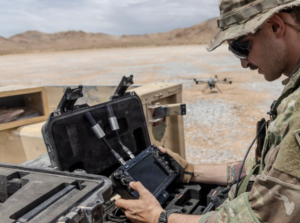
Black Recon Micro-Drone. Teledyne FLIR Defense on June 15 announced at the Eurosatory defense industry conference in Paris the launch of its new Black Recon micro-drone capability designed to offer “continuous, untethered reconnaissance from military vehicles and fixed installations.” “Designed for vehicle integration, Black Recon allows crews to launch, operate, recover and recharge up to three unmanned aerial systems without leaving their platform, reducing risk and accelerating decision-making,” the company said in a statement. “Each UAV launches autonomously, performs reconnaissance, surveillance, and target acquisition missions, then returns to the launcher for capture, docking and recharging. The result is uninterrupted ISR coverage day or night while keeping personnel protected inside the platform.” Black Recon has a flight time of 50 to 60 minutes, can operate at speeds of 25 meters per second and weighs less than 450 grams, according to Teledyne FLIR Defense, noting the capability is available for order now and deliveries are expected to begin in 2027.
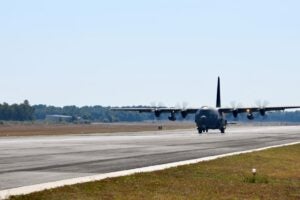
Kuwait/KC-130J Support. The State Department on June 15 said it has approved a potential $235.9 million Foreign Military Sale (FMS) with Kuwait covering follow-on sustainment support for the country’s fleet of three KC-130J aircraft. Under the deal, Kuwait would receive maintenance support for the Lockheed Martin-built KC-130J extended-range tankers as well as U.S. government and contractor engineering, technical and logistics support services and five years of spare and repair parts. “The proposed sale will improve Kuwait’s Air Force (KAF) capability to meet current and future threats by contributing to shared security objectives, promote regional stability and build interoperability with the United States. The KAF utilizes these aircraft to deter threats and protect national resources. This sale will support ongoing sustainment efforts, maintenance, repair and provide the U.S. Navy program office with the flexibility to perform the necessary sustainment actions based on KAF priorities,” the State Department said in a statement. The prime contractors for the work are V2X, Aviation Training Consulting, CAE USA, Dowty and Rolls-Royce, according to the department.
…Singapore/HIMARS Upgrades. The department on June 15 also said it has approved a potential $73 million FMS case with Singapore for 18 Common Fire Control System upgrade kits for the country’s Lockheed Martin-built M142 High Mobility Artillery Rocket System. Singapore would also receive support equipment, spare parts, training and U.S. government and contractor technical support and engineering and logistics support services. “The proposed sale will improve Singapore’s capability to meet current and future threats by enhancing and extending its Army’s ability to conduct operations and enable effective training,” the State Department said in a statement.
PAE SSP. The Navy held a retirement and change of command ceremony on June 12 when leadership of the Portfolio Acquisition Executive (PAE) Strategic Systems Programs (SSP) recognized the transfer of leadership from Vice Adm. Johnny Wolfe to Vice Adm. Douglas Williams as the 15th director of PAE SSP. The event was presided over by William Mahan, performing the duties of the assistant secretary of the Navy for research, development, and acquisition. Williams previously served as the director for test at the Missile Defense Agency and has over 30 years of active-duty experience. In this new role, Williams will oversee the Navy’s strategic weapon system on the nuclear-armed ballistic missile submarines and regional strike capabilities like Conventional Prompt Strike and Nuclear-Armed Sea-Launched Cruise Missile programs. Wolfe had been SSP director since 2018.
New QBI Selectee. Quandela last week said it has been selected by the Defense Advanced Research Projects Agency to participate in Stage A of the Quantum Benchmarking Initiative (QBI), allowing the company to showcase a detailed concept for a “utility-scale, fault-tolerant quantum computer, along with technical evidence supporting its near-term feasibility.” Quandela is developing a spin-photon quantum computing hybrid architecture. DARPA last fall transitioned 11 companies from Stage A to B in the QBI, which is assessing the possibility of developing a cost-effective quantum computer by 2033 (Defense Daily, Nov. 7, 2025).
FLEETEX 250. The U.S. 2nd Fleet hosted the start of Fleet Exercise (FLEETEX) 250 on June 16, which has ships from 17 allied and partner countries participating in various naval warfare exercises out of Naval Station Norfolk, Va. in June. Other participating countries include Belgium, Brazil, Canada, Cameroon, Côte d’Ivoire, Cyprus, Denmark, France, Germany, Mexico, Morocco, Netherlands, Norway, Peru, Senegal, Spain, Turkey, and the U.K. The Navy described this large-scale exercise as designed to enhance interoperability and test the integrated forces in a dynamic, multi-domain training environment. It includes 31 warships, several nation’s aircraft and crews to conduct a series of structured training events at-sea. The exercise will focus on including anti-air, anti-submarine, and amphibious warfare operations, culminating in a “scenario-driven free-play event against a dynamic adversary,” the Navy said. The main goal of the event is building cohesiveness, validate tactical procedures and strengthen collective capabilities. The harbor phase lasts through June 21 before the event moves to at-sea execution from June 22-29.
Editor’s Note. In observance of Juneteenth, Defense Daily will not publish on Friday, June 19.