By Col. Wes Spaid (USMC, ret.), Defense Opinion Writer.
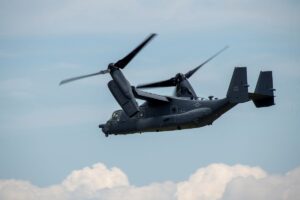
As global threats intensify—from China’s coercion in the Indo-Pacific to instability across the Southern Hemisphere—the United States must safeguard a capability no aircraft in the current inventory can replicate: the long-range vertical lift, speed, survivability and operational flexibility of the V-22 Osprey.
Recent reports from the Government Accountability Office (GAO) and Naval Air Systems Command (NAVAIR) have raised concerns related to the oversight of the Osprey program from a safety and maintenance standpoint. Addressing these concerns is a necessity. But so is preserving a platform unlike any other in the U.S. inventory.
The imperative is to do both: Improve safety oversight rigorously while maintaining operational reach for our service members. Thankfully, the U.S. military has expressed its commitment to doing so.
A central combat capability
The MV-22B remains central to the Marine Air–Ground Task Force’s ability to maneuver across contested areas near the sea. Under the U.S. Marine Corps’ ongoing restructuring initiative “Force Design 2030,” distributed formations depend on rapid displacement across significant distances.
No conventional rotary-wing platform can self-deploy, sustain airplane-like speed over range, or execute contested logistics in the way V-22 squadrons do today. Without the Osprey, the Marine Corps would lose the mobility advantage essential to complicating an adversary’s targeting cycle.
Nowhere is this advantage more decisive than in the Indo-Pacific.
Forward-deployed MV-22Bs in Japan and Hawaii routinely conduct crisis response missions, reinforce allies and reposition forces across the first and second island chains in hours, not days. In a theater defined by scale and limited warning timelines, this speed matters.
During operations in Iraq, battlefield circulation using legacy rotary-wing aircraft often occurred only weekly due to range, speed and staging limitations. When the first operational MV-22 units entered the theater, tilt-rotor speed and self-deployment flexibility enabled daily movement of commanders, units, critical parts and time-critical niche detachments across the entire country.
What had previously demanded significant planning and fuel coordination became a routine mission set, reducing dependence on ground convoys, extending commanders’ operational reach and accelerating decision-making across a distributed battlespace ashore and afloat.
Reshaping operations
Tilt-rotor aviation fundamentally reshaped operations. It provided a level of maneuver—rapid, unpredictable and scalable—that traditional helicopters could not sustain. The V-22 demonstrated the core tenets of distributed operations—spreading small, highly effective units across vast areas of operations–well before the concept was codified in tactical doctrine.
In the Indo-Pacific, the V-22 is not a luxury—it is a requirement for survival. The distances between operational nodes—Okinawa and the Philippines, Guam and the first island chain—underscore a simple reality: conventional rotary-wing aviation cannot close the distances required for contested logistics or dynamic force employment.
The Marine Corps MV-22, Air Force CV-22 and the Navy’s CMV-22 deliver attributes that emerging programs such as Next-Generation Vertical Lift and Future Vertical Lift aspire to achieve — airplane-like speed with vertical-lift flexibility, long-range reach, profile adaptability for survivability and the ability to operate from austere or improvised locations.
Across multiple theaters, the operational value of tilt-rotor mobility is clear. Air Force Special Operations Command’s CV-22 fleet enables geographic combatant commands to insert, extract, and sustain forces in denied or geographically complex environments.
These missions span the United States Indo-Pacific Command (INDOPACOM), the United States European Command (EUCOM) and global task forces, including operations in the Southern Hemisphere, where distance and terrain require unconventional aviation solutions. Similarly, the Navy’s CMV-22B is replacing the legacy C-2 fixed-wing aircraft not simply as a logistics aircraft, but because it delivers the range, flexibility and deck-handling characteristics necessary for modern carrier strike group operations.
Mobility has strategic consequences. The ability to move across an entire region in a single sortie—reaching dispersed units, repositioning capabilities or reinforcing deterrence—creates agility that adversaries must account for. It compresses timelines, expands opportunities and imposes uncertainty on opponents who depend on predicting our patterns of movement.
Continued investment needed
As Congress and the Department of Defense evaluate budgets and force design priorities, continued investment in the V-22 program is essential. Sustaining its modernization pipeline preserves a strategic mobility asset that provides deterrence, enables campaigning and ensures the joint force can respond across multiple theaters.
Preserving the V-22 maintains the operational reach and flexibility required in a world where adversaries are moving faster, fields of fire are expanding and distance itself has become a contested space. Reducing this capability—even incrementally—would introduce operational risk that competitors would be eager to exploit.
Tilt-rotor aviation has transformed how the United States projects power and maintains presence. In an era of distributed operations, the V-22 is not optional. It is indispensable.
Retired Marine Corps Col. Wes Spaid is a former aviator with operational experience in both rotary-wing and tilt-rotor aircraft, including participation in the MV-22’s first combat deployment and its first deployment in an Amphibious Readiness Group and Marine Expeditionary Unit. The views expressed are his own and do not reflect those of any current or former employer.

Are you a Defense Daily reader with a thought-provoking opinion on a defense issue? We want to hear from you.
- We welcome submissions of opinion articles on national security, defense spending, weapons systems and related areas.
- We welcome submissions from lawmakers, administration officials, industry representatives, military officials, academics, think tank experts, congressional candidates, international experts and others on issues important to the national defense community.
- We welcome a diverse range of opinions all along the political spectrum.
- Email: editor@DefenseOpinion.com