 By
By 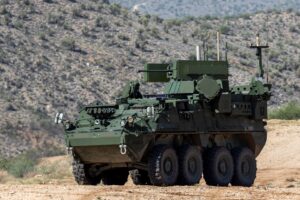
The Army wants to move away from single vehicle configurations for its on-the-move short-range air defense platform to a palletized approach that can plug-and-play different sensors and effectors and be put on multiple vehicle types, and Army official said on Monday.
With the “sled” concept, best-of-breed capabilities would be used that would address Maneuver-Short Range Air Defense (M-SHORAD) needs from Group 1 drones, which are those that weigh up to 21 pounds, to fixed-wing aircraft, Col. Marc Pelini, military deputy for fires at the Future Capabilities Directorate for the Army Transformation and Training Command.
Army Chief of Staff Gen. Randy George recently approved the Capabilities Development Document for M-SHORAD Increment 4, which moves away from a fully integrated vehicle to the sled concept, Pelini said during a counter-small unmanned aircraft system (C-sUAS) panel at the Association of U.S. Army Conference.
Pelini mentioned General Dynamics’ [GD] SGT Stout, which is the M-SHORAD Inc. 1 based on the Stryker wheeled vehicle, and the Leonardo DRS [DRS] Mobile-Low, Slow, Small Unmanned Aircraft System Integrated Defense System, referred to as M-LIDS, as providing the lessons learned for the M-SHORAD Inc. 4 requirements spanning the range of drone and larger short-range threats. Leonardo DRS provides the mission equipment package for SGT Stout.
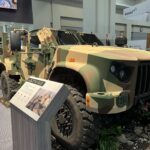
The vendor-agnostic sled with interchangeable sensors and effectors could go on an Infantry Squad Vehicle, a Humvee, a Joint Light Tactical Vehicle, or even a commercial truck like a Toyota truck, he said.
The sled would not be a simple flat sheet of steel but rather a more sophisticated platform with an open hardware and software systems approach to enable the plug-and-play of the different equipment options a commander would want, Pelini said. This open systems approach is meant to save time and money, and future proof as new technologies emerge and threats evolve, he said.
“And I can have that self-contained capability that allows the maneuver commander to have a menu of options,” he said. “And when I talk about menu of options, I’m talking about being able to pull off a radar, like an X-band radar, and put a Ku-band radar on, or pull a Coyote pod off and put a Stinger pod on. And the system itself, or the palette itself, recognizes that and automatically changes the user interface for the operator to engage those threats.”
The Army’s intent is to have a prototype of Increment 4 in the spring of 2026 for the U.S. and United Kingdom Flytrap 5.0 exercise, Pelini said. There is enough existing technology that can be integrated so Gen. George has “challenged us to go fast on this,” he said.
Flytrap will provide the lessons for the program to provide the air defense community with an initial capability within a year of the exercise, Col. Guy Yelverton, deputy for acquisition and systems management and the C-sUAS Project Lead, for the Army Program Executive Office Missiles and Space, told audience.
“Speed” is the goal, Yelverton said.
With M-SHORAD Inc. 4, there will be a convergence of short-range air defense capabilities, Brig. Gen. Glenn Henke, commandant of the Army Air Defense Artillery School and deputy commander of the Army Fires Center of Excellence, said on the panel. This mean that “every existing SHORAD batter can be a counter-UAS battery, and vice versa,” he said.