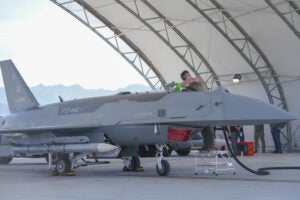
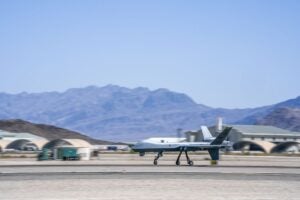
Drone Commonality. As the Air Force embarks on an “MQ Next” program to replace the General Atomics Aeronautical Systems, Inc., MQ-9A Reaper for a loitering, long endurance intelligence, surveillance, and reconnaissance (ISR) drone, there may be some opportunities for savings through leveraging investments the service is making on Collaborative Combat Aircraft air-to-air drones. “I think we’ll absolutely expand autonomous systems to leverage the technology,” says Air Force Col. John “KC” Cummings, the autonomous collaborative platforms division chief at Air Combat Command (ACC). “I’m focused on all the ACC core functions, ISR and strike among them, but we also have folks at Air Force Futures who are thinking about other ways to use collaborative autonomy across different platforms, including tanker and mobility aircraft. I think there are a lot of programs that would benefit from the autonomy architecture we’ve developed and the command and control architecture that comes with that.” Cummings told Defense Daily that ACC’s CCA staffers are “definitely sharing our notes” with ACC’s ISR and strike requirements personnel on MQ Next and that CCA and MQ Next “have some of the same requirements and share some of the same aspirations for being interoperable and using autonomy to reduce the number of humans on the loop for our systems.”
DOT&E Reports. Sen. Elizabeth Warren (D-Mass.) and Rep. Donald Norcross (D-N.J.), two members of their respective defense authorization committees, are asking Defense Secretary Pete Hegseth for a justification on his steep cuts to the directorate of operational test and evaluation (DOT&E) and his classification of the formerly unclassified, DOT&E weapons reports. “The DOT&E office serves a critical role in ensuring weapon systems are safe and effective for combat use. Congress established this office in 1983 after a bipartisan 91-5 vote in the Senate after horrifying scandals exposed longstanding deficiencies in operational testing of weapons systems, including the M-16 malfunctions during the Vietnam War and test failures of the Sergeant York Divisional Air Defense (DIVAD) gun,” Warren and Norcross wrote in their Aug. 12 letter. “Congress created this office to be a statutorily independent authority that reports directly to the Secretary of Defense and Congress.”
Australia-Japan Laser. The Australian defence ministry on Aug. 18 announced the first co-development project between the Australian and Japanese defense industries resulted in successful field trials of a laser, dubbed Project Boobook, after an Australian owl species. The effort involved Australia’s Defense Science and Technology Group (DSTG), Mitsubishi Electric Australia (MEA) and Mitsubishi Electric Corporation. Australia said it resulted in the testing of a “world-first prototype laser system,” but the government did not disclose the laser’s power output or its specific application. The Boobook trials occurred at the Cultana Training Area and DSTG Edinburgh, which the ministry said “provided valuable insights into the system’s design and technical requirements, informing the next phases of development and commercialization.” The ministry also said this demonstrated the ability for both countries to jointly develop advanced technologies and paves the way for future defense industrial collaboration between the two countries. MEA is also establishing $50 million in new investment at facilities at New South Wales in advance of what the ministry calls large-scale manufacturing, to become the home of a new MEA Defense Division that will support future manufacturing opportunities.
Muon Raise. Spacecraft system developer and manufacturer Muon Space last week closed an oversubscribed $250 million Series C round it will use to expand production, accelerate development of new spacecraft platforms, invest in payloads and other mission-enabling capabilities, and scale its Mission Foundry model that “delivers complete, mission-ready constellations” integrated by the company. The Silicon Valley-based startup has launched seven satellites in the first half of 2026, bringing to 11 the number of spacecraft it has deployed to date. The company recently opened a manufacturing plant in San Jose capable of building 500 satellites annually by 2027. The funding was led by Eclipse Capital.
Navy CIO. Acting Secretary of the Navy Hung Cao on Aug. 18 appointed M. Barry Tanner as the permanent Chief Information Officer (CIO) for the Department of the Navy (DoN). Tanner had already been serving as the acting CIO since former DoN CIO Jane Rathbun announced her retirement from the federal government in August 2025 and left the role in December 2025. In this position, Tanner serves as the principal advisor to the secretary and oversees the department’s over $12 billion information technology portfolio. “Information is a critical weapon system, and Mr. Tanner’s unparalleled experience, both as a veteran naval officer and a cutting-edge digital leader, makes him the ideal choice to spearhead our digital modernization. He will ensure our Fleet has the lethal, secure, and resilient cyber capabilities needed to defeat any adversary,” Cao said in a statement. Tanner will be tasked with driving the implementation of the Navy’s Information Superiority Vision 2.0 and the DoN Strategy to Weaponize Data and AI. The Navy said Tanner’s primary focus areas will include establishing robust Artificial Intelligence Infrastructure, executing Zero Trust Architecture, securing Cryptographic Modernization, and driving Cyber Readiness. Tanner previously served as Deputy CIO and Director of Operations for the Navy’s Program Executive Office for Digital and Enterprise Services.
…Navy Legislative. Cao on Aug. 14 appointed Kahlil “KD” Warner as the Senior Advisor to the Secretary of the Navy for Legislative Affairs, serving within the Office of Legislative Affairs. In this role, Warner serves as the “principal civilian advisor responsible for reviewing and coordinating timely, accurate responses to official correspondence, resolving constituent issues, and clarifying Department of the Navy policy on items of congressional interest,” the Navy said in an announcement. Previously, Warner served in the Office of the Assistant Secretary of Defense for Legislative Affairs as the senior legislative advisor to both the Under Secretary of Defense for Policy and the Under Secretary of Defense for Personnel & Readiness.
SSN-798. The Navy on Aug. 17 reported it completed shakedown trials on the USS Massachusetts (SSN-798) and that the submarine is ready for fleet tasking after the service waived the boat’s post-shakedown availability due to its “superb material condition and combat readiness.” The Navy said waiving the period was made possible due to the operational quality of the ship during trials “and the urgency to deliver warfighting capability to the Fleet.” Chief of Naval Operations Adm. Daryl Caudle in a statement said the waiver “ reflects the exceptional condition of the ship and our determination to deliver combat-ready capability faster. It also allows our shipbuilding workforce to focus its talent and capacity where we need it most, building the next generation of submarines our nation requires.” Vice Adm. Rob Gaucher, director of Submarine Programs admitted waiving this period is a calculated risk as they seek to drive efficiency, innovation and shipbuilding speed. HII’s Newport News Shipbuilding first delivered SSN-798 in November 2025 and the sub was commissioned in March. This is the seventh Block VI Virginia-class submarine.
UGV Evaluation. HDT Robotics, now known as BLADE, said on August 17 the Army’s 82nd Airborne Division is evaluating its Hunter WOLF unmanned ground vehicle (UGV) as part of a Transforming in Contact event at Fort Polk in Louisiana. The training event is the latest evaluation opportunity following similar engagements with the Army’s 3rd Brigade, 10th Mountain Division and 101st Airborne Division earlier this year. “The value of these evaluations is seeing how the Hunter WOLF supports different mission sets, environments, and operational priorities. Every event helps validate the flexibility of the platform and identify new ways it can reduce workload and help keep soldiers out of harm’s way,” Tom Van Doren, BLADE’s president of robotics, said in a statement. The company describes Hunter WOLF as a “robotic multi-mission ground vehicle…with a payload capacity of up to 2,800 lbs.” that can support logistics and casualty evacuation missions. The Army recently picked HDT as one of several firms for its Project Sustainment and Infantry Last Tactical Mile programs to deliver UGV prototypes.
Flight Record. The Army said on August 20 that a battery-powered small drone it developed, that was powered by two brushless direct current motors assembled at its Tobyhanna Army Depot in Pennsylvania, “shattered a world endurance record, flying for more than eight hours in the desert heat.” The Group 1 small UAS flew for 8 hours, 41 minutes and 43 seconds. The aircraft flew for approximately 300 miles before safely landing, surpassing the previous record by 50 minutes during a demonstration at Edwards Air Force Base in California, with the service noting it was in the air for “approximately 300 miles before safely landing, surpassing the previous record by 50 minutes.” “This is a huge milestone for [Army Materiel Command] and Tobyhanna, considering the fact that we just cut the ribbon on the new brushless motor line on June 30,” said Jon Strzelec, AMC’s advanced manufacturing lead for sUAS.
Two More SSCs. The Navy awarded Textron Systems Corp. another $231 million contract modification to construct two more Ship-to-Shore Connector (SSC) Landing Craft Air Cushion (LCAC-100)-class craft. Work will be split between facilities in New Orleans, La. (62 percent); Camden, N.J. (eight percent and Cincinnati, Ohio (six percent) and is expected to be finished by May 2032.
LCU-1710. Austal USA’ Mobile, Ala., shipyard delivered the first-in-class LCU-1710 landing craft utility vessel to the Navy on Aug. 14, marking the first LCU-1700-class vessel delivered to the service. LCU 1710 is designed to transport equipment and personnel from ship to shore as support of expeditionary operations, providing more enhanced capability, endurance, and survivability compared to legacy LCUs. Before delivery, LCU-1710 completed acceptance trials, including comprehensive testing of the ship’s major systems and equipment to demonstrate operational performance, reliability and compliance for the Navy’s requirements. Testing also demonstrated the vessels’ ability to get underway without assistance of tugs or pilots, validating limited crew operating capability. Austal noted this was the first steel ship it has delivered to the Navy.
Army and FedEx. The Army on August 21 announced a “landmark collaboration” with a team led by FedEx Dataworks “to undertake a sweeping modernization of its domestic non-tactical logistics networks, supply chain procedures and Organic Industrial Base (OIB) sites.” The project is part of the Army’s Strategic Capital Initiative, which aims to bring in private capital to fund efforts ranging from technology modernization to bolstering OIB efforts. “In collaboration with the FedEx-led team, the Army aims to create a predictive, intelligent logistics network to optimize materiel management and improve transportation routing, as well as modernize its physical logistics infrastructure,” the Army said. “FedEx will apply its expertise in large-scale orchestration to Army materiel management, optimizing stock levels and demand forecasting.” The Army expects to have a finalized implementation for U.S.-based sites by November. “A soldier can order brake pads for his pickup and they’re on his porch the next day. There is no reason the Army can’t achieve that same level of speed and reliability for the warfighter. Logistics win wars. Through the Strategic Capital Initiative, we’re pairing the Army’s depots and demand with FedEx’s logistics expertise and Google’s secure cloud to build a supply chain that moves as fast as the fight demands,” Army Secretary Dan Driscoll said in a statement.
Maritime Autonomy Partners. Unmanned surface vessel (USV) developer Blue Ops and Havoc, which is developing collaborative autonomy software for all domains, have partnered to integrate Havoc’s software and command-and-control capabilities across Blue Ops’ USV portfolio. Blue Ops, part of Red Cat Holdings, has developed the Variant 7 USV and is planning more. Blue Ops said last week that its modular open systems architecture approach is designed to enable rapid integration of autonomy, sensors, communications, payloads and other mission technologies. Havoc’s software is in use by the Defense Department, the companies said. Operational fleets are planned at each company’s headquarters in Rhode Island and Florida to give potential customers access to live demonstrations, testing and operational evaluation, including of single-vessel and multi-vessel autonomy.
Antin Acquires Vigor. The private equity firm Antin Infrastructure Partners last week completed its acquisition of Vigor Marine Group from the investment firm Lone Star. Deal terms were not disclosed. Vigor is based in Portland, Ore., has 2,700 employees at shipyard and fabrication facilities in the Pacific Northwest, Virginia and California, and provides maintenance, repair and overhaul services, and fabrication to the Navy, Army, Military Sealift Command, Coast Guard and commercial customers. Vigor’s leadership and management team will continue to lead the company.
Battery Plant. Lithium-ion battery manufacturer Forge Nano last week broke ground in Morrisville, N.C., to expand an existing 100,000 square foot production facility to 315,000 square feet to scale annual manufacturing capacity to up to 3 gigawatt hours, which refers to total energy output. The Denver-based company is increasing domestic production to meet rising military demand for the small cylindrical batteries. Forge Nano has about 140 employees and expects to have more than 400 when the expanded factory is operating in two years. The company also makes advanced coatings for computer chips, batteries and defense and aerospace applications.
One-Way Attack Deal. AEVEX Corp. last week said it received a $41 million contract to provide one-way attack systems to support U.S. government customers. Neither the specific systems nor the customers were disclosed. AEVEX said the contract “expands the company’s role across priority operations.”
New ULA Chief. United Launch Alliance (ULA) last week named Mark Peller as its new president and CEO effective immediately. Peller had been ULA’s chief operating officer, responsible for engineering, supply chain, production, launch, quality assurance, information systems, and overall program management and integration of the Atlas and Vulcan launch vehicle programs. Peller succeeds Tory Bruno, who departed ULA last December to run the national security division of launch provider Blue Origin (Defense Daily, Dec. 26, 2025). ULA is a joint venture of Boeing and Lockheed Martin.