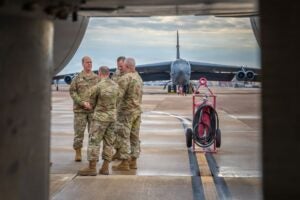
If We Don’t Fund It, You Will. Top U.S. Air Force officials have said that they want to move quickly to space-based air moving target indication to replace the service’s 1970s-era Boeing E-3 Airborne Warning and Control System (AWACS) planes. Yet, Congress appropriated $1.1 billion in fiscal 2026 to buy two Boeing E-7A Wedgetail planes to begin replacing the Air Force’s AWACS through rapid prototyping and engineering and manufacturing development (EMD) of the Wedgetail. Since 2023, the Air Force has retired 15 of its 31 AWACS. Legislators forbade the Air Force from killing the Wedgetail program. “We will, of course, follow congressional direction and we will do the rapid prototypes,” Air Force Secretary Troy Meink says. “We will fund those rapid prototypes, and they told us to deliver a plan to transition to EMD aircraft…Deliver a plan does not mean we’re going to put it into the budget.”
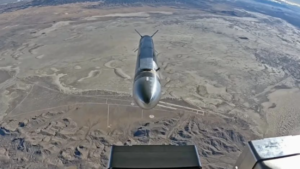
USAF AGM-190A. The U.S. Air Force has designated the Leidos Black Arrow small cruise missile (SCM) as the AGM-190A–a marking that Leidos said acknowledges “the SCM’s role in addressing the Department of War’s critical need for affordable, adaptable stand-off strike capabilities.” In tests from a C-130 transport, the 200-pound class weapon demonstrated a range of more than 400 nautical miles, the company said. SCM’s “modular hardware design and open system software enable the AGM-190A to rapidly evolve for changing mission requirements,” according to Leidos. “The AGM-190A’s mission versatility and affordability reflect Leidos’ NorthStar 2030 strategic focus on innovative, scalable solutions designed to meet evolving customer requirements.”
Blackbeard Transitioning. The Navy last week awarded Castelion $50 million to transition the company’s Blackbeard missile from prototype to an early operational capability. The latest award follows contracts the California-based startup received from the Army and Navy last fall to integrate Blackbeard with ground and aircraft platforms for flight testing this year and early operational capabilities in 2027 (Defense Daily, Oct. 24, 2025). The Navy’s Feb. 25 contract announcement said the award “provides full-scale prototypes, flight testing, and operational fielding to continue to expedite the Blackbeard Hypersonic Weapons development, integration, testing, and early operational capability in support” of the Small Business Innovation Research Phase III project entitled “Low Cost Highly Manufacturable Long Range Strike Weapon Production.” Castelion says Blackbeard is designed for mass production and rapid fielding.
More Switchblades. AeroVironment has received a new $186 million order from the Army to deliver its Switchblade 600 Block 2 and Switchblade 300 Block 20 loitering munitions, the company said on Feb. 26. The deal was placed under the five-year, potentially $990 million contract the Army originally awarded to AV in August 2024. AV said the order will cover the first delivery of the new Explosively Formed Penetrator to the Army. “For the first time, the Army has procured the system with an Explosively Formed Penetrator payload, delivering enhanced lethality against armored threats while retaining the speed, portability, and ease of use that have made Switchblade 300 a trusted solution at the small-unit level,” the company said in a statement.
T-ATS 12. Austal USA launched its second of five Navajo-class towing, salvage and rescue ship, the future USNS Solomon Atkinson (T-ATS 12) on Feb. 23. T-ATS 12 is one of three ships currently under construction at Austal’s Mobile, Ala. shipyard and the first of two set to be launched within a week of each other. The ship was over 75 percent complete at the time of launch and the company is now preparing for its next major milestone, engine light off leading into sea trials. The Navy’s FY 2026 budget request listed T-ATS 12 as having a planned delivery date of Feb. 2027, 65 months after the awarding of the contract. Previously, Austal delivered T-ATS 11 in June 2025.
…And EPF-16. Then on Feb. 27, the company launched the future Spearhead-class USNS Lansing (EPF-16) expeditionary fast transport ship. The ship was previously christened in January and is docked pierside at the yard for final outfitting and system activation before sea trials occur later in 2026. EPF-16 was the 26th ships launched at the shipyard into the river via dry dock. Notably, the future Lansing will be the Navy’s third EPF Flight II medical variant ship, featuring enhanced medical capabilities.
Jordan FMS. The State Department on Feb. 26 said it has approved a potential $280 million Foreign Military Sale (FMS) with Jordan for Ku band multi-function radio frequency system (KuMRFS) radars. Along with the RTX-built KuMRFS radars and command and control system, the deal also includes generators, GPS receivers, spare and repair parts, test equipment and training devices. “The proposed sale will improve Jordan’s capability to meet current and future threats by sustaining a credible force that can deter adversaries and participate in CENTCOM operations,” the State Department said in a statement.
Marines Not Considering CTT. A Marine Corps official on Feb. 25 said the service is not currently considering the Army’s Common Tactical Truck (CTT) program as a potential replacement for its Logistic Vehicle System Replacement truck (LVSR), built by Oshkosh Defense. “Right now, the Marine Corps does not have an interest in the CTT level of effort. We are monitoring it. We are continuing to observe. But at this time, we are focused on sustaining our fleet of LVSRs now and into the future,” Jennifer Moore, the Marine Corps’ program manager for motor transport said at the National Defense Industrial Association’s Tactical Wheeled Vehicles Conference in Pittsburgh. After evaluating several industry prototypes, the Army will soon issue a Commercial Solutions Opening for CTT procurement as it seeks a replacement for its Family of Heavy Tactical Vehicle trucks, also built by Oshkosh Defense. Simone Walton, a lead heavy tactical vehicles officials with the Marine Corps’ PM Transport noted the service previously approved a 20-year service life extension for the LVSR. “So a replacement might not be around the corner anytime soon,” Walston said.
SM-3 IIA Audit Reverse. The Defense Department’s Office of Inspector General on Feb. 23 announced it was terminating an audit of the Missile Defense Agency’s management and acquisition strategy for the Standard Missile-3 Block IIA program. First announced in January, the OIG did not explain why the audit was canceled, only stating “we are terminating the audit at this time. We plan to reassess the necessity of this audit at a later date.”
Farsighted Identification. The Defense Advanced Research Projects Agency has contracted with RTX business unit BBN Technologies to develop X-Ray imaging algorithms leveraging mathematical modeling and image analysis to identify man-made objects a kilometer away, improving situational awareness. “We are developing algorithms that turn a small number of grainy snapshots into enough detail for decision-makers to act, whether the mission is assessing potential threats or supporting emergency response operations,” Joshua Fasching, BBN principal investigator for the XENA program, said in a statement. BBN is partnered with the Georgia Institute of Technology on the effort.
Army DroneHunter. Fortem Technologies last week said it received a three-year, $18 million contract from the Army to provide its DroneHunter F700 counter-drone system to protect Army sites worldwide. The F700 is a multi-rotor drone equipped with a net capture system to safely intercept small unmanned aircraft systems without collateral damage. Fortem already received an initial $4 million order under the contract. The F700 previously was selected by a Defense Department task force under the Replicator 2 initiative, which will allow DoD and the military services to assess the system for potential use in protecting installations and bases.
C-UAS Partnership. Epirus and Digital Force Technologies (DFT) have partnered to integrate the former’s Leonidas high-power microwave system with the latter’s command-and-control and multi-domain sensor fusion software to create an integrated non-kinetic counter-ubmanned aircraft system (C-UAS) kil chain, the companies said last week. DFT brins its scalable Seraphim operating system and hardware solutions for autonomous tracking and identification of drone threats. “This collaboration marries our systems integration and swarm defeat expertise with DFT’s edge processing and automation knowhow to deliver exactly what our customers are asking for, a flexible, adaptable and fully integrated counter-UAS kill chain for critical point defense missions,” Andy Lowery, Epirus’ CEO, said in a statement.
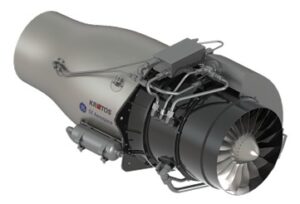
New Propulsion Offerings. JetCat Defense last week introduced three new small engines designed for use in affordable mass applications. The 150-pound thrust-class P650, the 200-pound thrust-class P900 and the 200-pound thrust class P1350, which leverages 3D printing to reduce part count and lower cost. The Ohio-based company also said it recently added 30,000 square feet of assembly space to support output of up to 15,000 engines annually on a single shift.
Canadian Defence Alliance. Nearly two dozen Canadian-owned and controlled defense companies have launched a new trade association to strengthen the country’s sovereign defense industrial base. The Alliance of Canadian Defence Companies (ACDC) last week said it “is focused on strengthening coordination among Canadian defence firms and providing a unified Canadian industry voice on policy, procurement reform and industrial development.” Co-Chairs Eliot Pence, founder and CEO of Dominion Dynamics, and Paul Ziade, co-founder and CEO of North Vector Dynamics, said “Canada has exceptional defense builders, but they have not always had a unified mechanism to coordinate and advocate collectively.” ACDC says Canada has more than 500 defense companies employing more than 50,000 people nationwide.
Business Expansion. Allen Control Systems (ACS), which manufactures the Bullfrog autonomous counter-drone robotic gun system, last week said it has tripled its Austin, Texas, operations to more than 57,000 square feet to meet demand for the system and enable scaling to low rate initial production, and research, development, testing and evaluation capabilities to support deliveries to U.S. and allied customers. ACS said it plans to add more engineering and technical talent to accelerate development, testing and deployment of Bullfrog.
New San Fran Hub. Mach Industries has opened a new hub in San Francisco to take advantage of the engineering talent in the area, the startup weapons system developer said last week. “We expand where great engineers are solving the hardest problems,” Ethan Thornton, founder and CEO of Mach, said in a statement. “San Francisco helps us move faster within the broader technology ecosystem while strengthening the engineering, prototyping and manufacturing work already underway across Mach.”
T-AGS 67. The Navy plans to christen the future USNS Robert Ballard (T-AGS 67) oceanographic survey ship during a ceremony at Bollinger Mississippi Shipbuilding in Pascagoula, Miss., on Saturday, Feb. 28. The ship is named after a retired U.S. Navy commander and professor of Oceanography at the University of Rhode Island’s Graduate School of Oceanography. Bollard is widely known for discovering the final resting place of the Titanic.
Fifth JEDI. The Commander of Task Force 67 (CTF-67) hosted the fifth iteration of the Joint Exploration and Discussion of Initiatives (JEDI) symposium at Naval Air Station (NAS) Sigonella on Feb. 9-12 where they convened maritime patrol and reconnaissance aircraft crews from the U.S, United Kingdom, Norway, Canada and Germany. The Navy said this event aimed to “synchronize the operations of the multi-national P-8A Poseidon fleet, effectively forging a single, cohesive force across the European theater.” U.S. Navy Capt. Brian Schneider, commodore, CTF-67, said the JEDI Symposium has become the gold standard for iterating capabilities of the U.S. Navy’s P-8A Poseidon multi-mission maritime aircraft partners along those that operate it. This year featured a capstone flying event with a cross-decked mission crew where operators from the U.K., Norway, Germany, and Canada manned the controls of a U.S. P-8A to track an Expendable Mobile ASW Training Target.