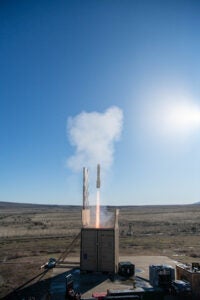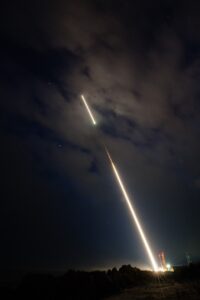
SRM Timelines. A partnership between Lockheed Martin and General Dynamics to add a new manufacturing source for solid rocket motors (SRMs) will result in first article testing in 2025, followed by more testing in 2026 by the military services to get certifications, and hopefully production at rate will begin in 2027, Lockheed Martin CEO Jim Taiclet said on his company’s third quarter earnings call Oct. 22. The SRM design will be based on Lockheed Martin intellectual property and GD will do the manufacturing, he said. The companies in August announced the SRM partnership, which initially is aimed at making motors for the Guided Multiple Launch Rocket System (GMLRS). Northrop Grumman is current SRM supplier for GMLRS.
Air Force C-sUAS. The Air Force Counter-small Unmanned Aircraft Systems (CsUAS) branch last week issued a Request for Information for air vehicle-based Low Collateral Effects Interceptor (LCEI) technology to combat Group 1 and 2 drone threats, which are those weighing up to 55 pounds. The CsUAS branch, which is within the Air Force Life Cycle Management Center, wants to know if an LCEI can be equipped with multiple effectors simultaneously and if the LCEI’s effector has a range of five nautical miles from launch point.
Rocket Ship. Bollinger Shipyards officially laid the keel for the future ship meant to transport Vulcan rockets from the factory in Decatur, Ala., to launch sites at Cape Canaveral Space Force Station, Fla. and Vandenberg Space Force Base, Calif. The new RS SpaceShip will be the second transport vessel to be used in the United Launch Alliance’s (ULA) maritime fleet. ULA first awarded the contract to build this second roll-on/roll-off vessel qualified for both ocean-going and river service in late 2023. Construction is underway at Bollinger’s Marine Fabricators facility in Amelia, La. Delivery is expected in early 2026. The ULA Vulcan rocket is already contracted for 38 launches to support Amazon’s Project Kuiper satellite constellation that seeks to provide “affordable broadband service to unserved and underserved communities around the world,” the company said.
BAE/Aerospike. BAE Systems said on Oct. 22 that software firm Aerospike has joined its Mission Advantage technology partnership program, aimed at developing “future data-driven capabilities” for the Army and other DoD customers. The partnership will leverage Aerospike’s “massively scalable, millisecond-latency database solutions,” according to BAE Systems, to help advance development of solutions that enable “access [to] precise, actionable data in real time.” “Aerospike’s multi-model database offers the lowest-latency, highest-throughput system to enable accurate, real-time decision-making even in contested environments,” Cuong Nguyen, Aerospike’s vice president for public sector, said in a statement. “As a vital component of the [Unified Network Operations] technology stack, we’re proud to partner with BAE Systems to help them optimize and demonstrate the effectiveness of their data solutions.”
Navy Nuke Power. A Navy Oct. 7 Request For Information (RFI) is investigating information and market interest to develop non-excess, under-utilized Department of the Navy (DoN) lands to build “commercial scale, grid facing clean energy generation to achieve full base energy resilience,” including shore-based nuclear technologies or other advanced reactor technology. These power plants would be on or adjacent to DoN installations including Naval Air Station (NAS) Oceana, Va.; Naval Weapons Station (NWS) Yorktown, Va.; Marine Corps Base (MCB) Quantico, Va.; NAS Patuxent River, Md.; Marine Corps Air Station (MCAS) Cherry Point, N.C. and Marine Corps Base Camp Lejeune, N.C.
…For Resiliency. The RFI specifically seeks to identify industry capabilities and solutions to solve the department’s resiliency and carbon free energy goals while improving the cost, timeline and risk profile of industry projects of mutual interest with the Navy Department. The notice said the service wants to improve energy security and reliability for installation and surrounding communities. It said the push for enhanced resiliency is spurred by increasing frequency and severity of extreme weather, the rise in cyber events, potential for physical attacks and routine power outages from current sources that are critical infrastructure but privately owned and operated off-installation. The advanced nuclear or other kind of power station could provide “stable and reliable energy for extended periods” to ensure the government installations remain operational even in adverse conditions.
…Scalable Too. This RFI specifically said nuclear technologies are becoming “more attractive potential options” because they may provide scalable and flexible solutions tailored to the energy needs of a particular region. The Navy said in this scenario the commercial electric grid would take any generating energy in normal times, but a grid disturbance would allow the installation to provide power locally. Responses are due by Nov. 7.
Austal Facility. Austal USA marked the start of construction of its new submarine module manufacturing facility in Mobile, Ala., MMF3, on Oct. 23. The building will include 369,600 square feet of indoor manufacturing space the company said is purpose-built to manufacture submarine modules. The facility is scheduled to be fully operational by late 2026. This will be a major part of increasing Austal’s contribution to help increase production rates of Virginia-class and Columbia-class submarines. The company said when this and other new buildings under construction are complete,d Austal USA’s Mobile facility will include 117,000 square-foot steel panel line, and seven assembly bays with over 400,000 square feet of indoor erection space and two submarine module manufacturing facilities with over one million square feet of covered manufacturing space “optimized for serial production.”
TACAMO E-130J. The Navy Airborne Strategic Command, Control and Communications Program Office (PMA-271) and Strategic Communications Wing 1 (SCW-1) announced the Navy’s new Take Charge and Move Out (TACAMO) mission aircraft will be named the E-130J. This aircraft used to be called the E-XX and will relieve the E-6B Mercury fleet for the TACAMO mission to provide airborne Nuclear Command, Control, and Communications (NC3) for the president, secretary of defense and U.S. Strategic Command to connect with the nuclear-armed ballistic missile forces. The Navy said the name comes from E standing for special electronic installation, 130 as the design number and reflecting its origin as the EC-130, and J is the series because it will be a modified C-130J-30 Super Hercules airframe. MPA-271 is procuring the E-130J via a TACAMO Recapitalization program, with the solicitation closing in April. The Navy said the contract award is set for January.
LCS-29. The U.S. Navy plans to commission the future Freedom-variant Littoral Combat Ship USS Beloit (LCS-29) during a ceremony in Milwaukee, Wis., on Nov. 23. This will be the first ship in the Navy bearing the name of the city in Wisconsin. The Navy noted the name honors contributions from residents of Beloit, including those at the Fairbanks Morse plant that builds engines to power Navy ships and submarines. Following the ceremony, LCS-29 will head to its homeport assignment of Naval Station Mayport in Jacksonville, Fla.
Tier 2. More funding needs to go to Tier 2 suppliers for DoD systems–suppliers critical to getting a final Original Equipment Manufacturer product out the door through supplying material to larger Tier 1 suppliers, said Tom Gillespie, managing partner at In-Q-Tel. “I do think more money needs to go to Tier 2, in general,” he says. “The dual-use aspect is important where it’s not just a completely government solution. It’s building off things that are supposed to be commercial as well. I think that creates efficiencies that are helpful to the government as well.”
Wheels Up. U.S. Air Force Lt. Gen. Michael Lutton, the deputy commander of Air Force Global Strike Command, took a ride in a Boeing-Leonardo MH-139A Grey Wolf helicopter from Maxwell AFB, Ala. this month. The base’s 908th Flying Training Unit is to become the formal training unit for the MH-139A, which is to replace the Bell UH-1N Hueys in supporting the ICBM missile fields in the U.S. Boeing said in August that it had delivered the first Grey Wolf production helicopter to the U.S. Air Force for stationing at Malmstrom AFB, Mont.–one of 13 MH-139As in the first low-rate initial production lot. In April, Rep. Ken Calvert (R-Calif.), the chairman of the House Appropriations Committee’s defense panel, disclosed a program Nunn-McCurdy breach that followed a decision in the Air Force’s fiscal 2025 budget to reduce the planned buy of 80 MH-139As–six development and 74 production aircraft–to 42.
Army Network. The Army has awarded Leidos a contract worth up to $331 million to support the service’s network modernization and Unified Network initiatives, the company said on Oct. 21. Under the deal, Leidos said it’s tasked with helping deploy the Army’s Global Unified Network to individual Army sites “to deliver a standardized, orchestrated modern network architecture, aiming to make sure applications, data and enterprise services are accessible, trusted and interoperable across the globe.” “Winning this $331 million contract is a significant milestone for Leidos and underscores our commitment to supporting the U.S. Army’s modernization efforts,” Steve Hull, president of Leidos’ digital modernization sector, said in a statement. “We are proud to partner with the Army in deploying the Global Unified Network, which will enhance interoperability and security across all levels of operations.”
Germany/SOSA. The Pentagon on Oct. 22 signed a new bilateral, non-binding Security of Supply Arrangement (SOSA) with Germany. The department said the agreement “will enable both the U.S. and Germany to acquire the industrial resources they need to quickly meet defense requirements, resolve unanticipated disruptions that challenge defense capabilities, and promote supply chain resiliency.” Germany is now the U.S.’ 19th SOSA partner, the Pentagon noted. “This SOSA is an important step forward and further strengthens the relationship between Germany and the United States,” Bill LaPlante, the Pentagon’s acquisition chief, said in a statement.
Saudi Arabia FMS. The State Department said on Oct. 24 it has approved a potential $440 million foreign military sale with Saudi Arabia for RTX’s tube-launched, optically-tracked, wireless-guided (TOW) radio frequency anti-armor missiles. Under the deal, Saudi Arabia would receive 507 TOW 2A missiles and 507 TOW 2B missiles. The FMS case also includes support and test equipment, simulators, spare and repair parts and communications equipment. “The proposed sale will improve the Kingdom of Saudi Arabia’s capability to meet current and future threats by enhancing the strength of its homeland defense,” the Defense Security Cooperation Agency said in a statement.
Corporate News. Leidos last Friday announced a 5 percent increase to its quarterly shareholder dividend, moving the payment up 2 pennies to 40 cents per share as of Dec. 31, 2024. San Diego-based AEVEX Aerospace, which makes aviation solutions that include unmanned aircraft systems and loitering munitions, is adding 15,000 square feet of light industrial space for parts manufacture, repairs, and structural assembly to support aircraft modifications and manufacture of aircraft modification products. The company currently has 65,000 square feet of hangar, manufacturing, and office space.
SSN-813. Secretary of the Navy Carlos Del Toro on Oct. 23 announced that one of the upcoming Virginia-class attack submarines will be named the USS Atlanta (SSN-813). He made the announcement during a ceremony at the Jimmy Carter Presidential Library and Museum in Atlanta, Ga. This will be the sixth Navy vessel named after the city.