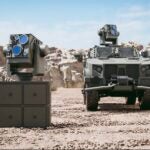
New CRADA. Hanwha Defense USA said on Aug. 5 it has signed a new Cooperative Research and Development Agreement (CRADA) with the Army’s Combat Capabilities Development Command (DEVCOM). “Under the agreement, the two parties will exchange and analyze technical information to help inform DEVCOM Missions, interoperability and growth opportunities,” Hanwha Defense USA said in a statement. The CRADA covers collaboration on technologies ranging from uncrewed to combat vehicles, munitions and energetics development. “We are excited to expand our Army partnership–working together to find new research opportunities in development and sustainment. These joint efforts are critical to the learning process and help shrink the time it takes for new and improved systems and munitions to reach warfighters in the field. We believe Hanwha’s global experience and production capacity can be of immediate assistance as the Army continues its efforts to restock and modernize its current capabilities,” John Kelly, CEO of Hanwha Defense USA, said in a statement.
PNT. The Army said on Aug. 2 it has placed a $96.8 million order with RTX’s Collins Aerospace for more Mounted Assured Positioning Navigation Timing Systems (MAPS) Gen II systems. This is the fourth delivery order under the Army’s $583 million MAPS Gen II contract with Collins Aerospace and covers 1,212 devices for Army units, 400 systems for the Marine Corps and another 29 for “client and platform integration” on Army watercraft, according to the service’s Project Manager for Positioning, Navigation and Timing. The Army has described MAPS as an anti-jamming capability designed to allow soldiers to continue operating seamlessly in GPS-contested environments, as well as “allowing multiple users to access an assured GPS signal, and other sources of PNT, from one central point.”
Tester’s Seat. A new poll from Emerson College/The Hill shows Sen. Jon Tester (D-Mont.), the upper chamber’s top defense appropriator, locked in a tight race against his Republican opponent Tim Sheehy for the Montana Senate seat. Sheehy holds a two percent lead in that poll, which falls within the margin for error, with five percent of voters polled as “undecided.” Tester’s seat is one of several Democrats consider critical to retain the party’s Senate majority. Sheehy, a former Navy Seal, has secured an endorsement of former President Trump. RealClearPolitics’ poll average currently has Sheehy with a 3.5 percent lead over Tester.
CENTCOM F-22s. The U.S. Air Force 3rd Wing at Joint Base Elmendorf-Richardson, Alaska sent a squadron of 12 Lockheed Martin F-22s to RAF Lakenheath, England and then to the U.S. Central Command area of responsibility. The deployment to deter Iran came with support from Boeing KC-46A Pegasus tankers.
Digitally Designed SRM Test. Northrop Grumman said on Aug. 8 that it conducted a static fire test of a large, digitally designed solid rocket motor (SRM) at U.S. Air Force Arnold Engineering Development Complex in Tennesssee. “All test objectives were met during the event with performance data anchoring the digital model, confirming the motor’s performance and demonstrating the company’s ability to successfully build to design requirements using a digital environment,” the company said.
…C50HP. In May, Northrop Grumman said that it had conducted its first test of a large, digitally designed SRM–the Common 50 High-Performance (C50HP) upper stage motor. “The second stage motor is optimized for high-altitude flight and provides the required boost to transition payloads out of the atmosphere and into space,” the company said.
Space Policy Personnel Change. Vipin Narang, the Pentagon’s acting assistant secretary of defense for space policy since March 2022, is to return to academia, and John Hill, the deputy assistant secretary of defense for space and missile defense, is to take Narang’s place on Aug. 10, the Pentagon said on Aug. 9. Narang has been a professor of nuclear security at the Massachusetts Institute of Technology.
Cavoli Says. Army Gen. Christopher Cavoli, who commands U.S. European Command and allied forces in Europe, last week said a key lesson from ongoing Russo-Ukraine War is the need to adapt rapidly, including technically, tactically, and operationally. On the battlefield in Ukraine, “The shelf life of a given technology is pretty short,” he said Aug. 8 during a keynote address at NDIA’s Emerging Technologies conference. “It’s pretty easy to develop a new idea, turn it into a technology, put it on the battlefield, find it countered and then have to adapt to the enemy’s adaptation, and so on in a cycle. That means there’s got to be a mentality and a capability and a system to adapt things quickly and then just spread that adaptation across the force.”
…More Complex is Less Adaptable. High cost, complex systems are harder to make adaptations to, at least in large numbers, “especially at the point of use than simpler systems,” he said. Cavoli also said that ability to build defense products at faster rates is another observation from the war. The ability to rapidly produce fighter aircraft and missiles is hindered by their complexity, he said.
…Narrow Modernization. Rather than try to modernize an entire force, Cavoli said the war is showing that legacy systems like “dumb artillery” and “old fashioned tanks” are proving their value. “It appears to me that the advantage is going to go now, and in the foreseeable future, to the side that’s able to mix a certain amount of high- or moderately high-tech to their legacy systems and do it in a clever way that can be adapted rapidly, so that all the big stuff, the steel that you had to pour, continues to be valuable, but that you don’t rely only on technology that runs out a shelf life quickly.”
Location, Location. Epirus, which is developing high-power microwave systems to counter swarms of small drones at low cost, has opened a new office in Lawton, Okla., home to the Army’s Fort Sill, which also houses the Defense Department’s Joint Counter-small Unmanned Aircraft Systems University to standardize counter-drone training. Epirus’ 3,000 square-feet of office space is in the Fort Still’s Fires Innovation Science and Technology Accelerator Innovation Park. The new office “is a natural addition to Oklahoma’s pioneering position in drone and counter-drone technology research and development,” Andy Lowery, the company’s CEO, said in a statement. In July, Epirus also opened a research office on the campus of the Univ. of Oklahoma in Norman.
Critical Minerals Help. The Defense Department has awarded Leidos a $276 million task order to conduct research and development of critical minerals and materials for use in munitions and to strengthen the resiliency of the supply chain for energetics. The award was made under an DoD Information Analysis Center contract vehicle that is used by the Defense Technical Information Center and the R&D community to gain knowledge. Leidos said it has more than three decades of experience supporting energetics R&D at the Army’s Picatinny Arsenal, N.J., home of the Joint Center of Excellence for Guns and Ammunition. Mike Diggins, senior vice president and homeland and force protection business area leader, said “our team will help the DoD synthesize and scale-up domestic minerals and materials production.”
…Another Award. Lithium Nevada Corporation received an $11.8 million award from the DoD Defense Production Act Investment office to accelerate extraction and processing of battery-grade lithium carbonite. The small award supports the National Defense Industrial Strategy’s goal of boosting domestic production of critical minerals used in DoD systems. Lithium Nevada has mine in Humboldt County, Nev., and the award will allow it to test, demonstrate, accelerate, ad scale-up its extraction process and produce battery-grade lithium carbonate at commercial scales, DoD said last week.
AUSV Payload Provider. Britian’s Forcys last week said it has been selected by Mississippi-based Ocean Aero to provide two payloads for the company’s Triton autonomous underwater and surface vehicle (AUSV). Forcys will supply the SPRINT-Nav Mini hybrid acoustic-inertial navigation technology from its technology partner Sonardyne, and the Solstice multi-aperture sonar from its partner Wavefront Systems. Triton is powered by solar and wind, and can travel on the surface at speeds up to five knots and can submerge for up to five days at two knots.
Another Deal. The cybersecurity company SIXGEN has acquired Boldend, which supplies cyber and electronic warfare solutions to the Defense Department and U.S. government, marking its second acquisition since the private equity firm Washington Harbour Partners invested in the company in November 2023. Boldend builds software products that scale cyber capabilities for offensive and defensive missions. “We are excited by this strategic combination and look forward to continuing to enable SIXGEN’s investment in an IP-drive and talent-centric approach to enable national security missions and the digital warfighter,” Mina Faltas, founder and chief investment officer of Washington Harbour, said in a statement.
New Ukraine Aid. The U.S. on Aug. 9 approved a new $125 weapons aid package for Ukraine. The latest security assistance is the 63rd package of equipment to be pulled from current Pentagon inventories using the Presidential Drawdown Authority to assist in Kyiv’s fight against Russia. The new weapons aid includes providing Ukraine with Stinger missiles, ammunition for HIMARS launchers, 155mm and 105mm artillery ammunition, TOW missiles, Javelin and AT-4 anti-armor systems, Humvee ambulances, small arms ammunition and demolitions equipment, according to the Pentagon. The package also includes “multi-mission radars” and “equipment to protect critical national infrastructure,” the department noted.
Palantir/Microsoft. Palantir on Aug. 8 announced a new partnership to offer its software products, including the Artificial Intelligence Platform, on Microsoft’s cloud services for government customers, to include the Pentagon and Intelligence Community. The two firms said the “first-of-its-kind, integrated suite of technology” would allow “critical national security missions to operationalize Microsoft’s best-in-class Large Language Models via Azure OpenAI Service within Palantir’s AI Platform in Microsoft’s government and classified cloud environments.” “Bringing Palantir and Microsoft capabilities to our national security apparatus is a step change in how we can support the defense and intelligence communities,” Shyam Sankar, Palantir’s chief technology officer, said in a statement. “Palantir AIP has pioneered the approach to operationalizing AI value – beyond chat — across the enterprise. It’s our mission to deliver this software advantage and we’re thrilled to be the first industry partner to deploy Microsoft Azure OpenAI Service in classified environments.”
HIMARS for Norway. The State Department last Friday approved a potential $580 million foreign military sale to Norway of 16 Lockheed Martin-built M142 High Mobility Artillery Rocket Systems (HIMARS) and related equipment. The related equipment includes 15 M30A2 Guided Multiple Launch Rocket System (GMLRS) Alternative Warhead pods with insensitive munitions propulsion system (IMPS), 15 GMLRS unitary high explosive pods with IMPS, and 100 M57 Army Tactical Missile System (ATACMS) pods. Ukrainian forces have used GMLRS and ATACMS fired from HIMARS with great effect against Russian troops and assets. Norway’s pending deal also includes Low Cost Reduced Range Practice Rocket pods.