
Department of War. President Trump on Sept. 5 signed an executive order establishing the Pentagon’s “secondary” name as the “Department of War.” The directive is an initial step in moving to officially change the Department of Defense’s title, which would require congressional approval. “This is something we thought long and hard about. We’ve been talking about it for months,” Trump said in the Oval Office. “So we won the First World War, we won the Second World War, everything before that and in between and then we decided to go woke and we changed the name to Department of Defense. So we’re going to [change it back to] Department of War.” DoD was known as the Department of War from 1789 to 1947. Under the EO, the Defense Secretary would also have the “secondary” title of “Secretary of War.”
BlueForge Leadership. The non-profit BlueForge Alliance (BFA) on Sept. 2 announced co-founder Kiley Wren has stepped down from his role as president and co-Chief Executive Officer (CEO), effective September 2, 2025, leaving other co-founder and co-CEO Rob Gorham as both president and CEO. Wren served in that role since November 2022, as BFA grew as an outgrowth of the Texas A&M Engineering Experiment Station (TEES).. Wren and others ultimately left TEES to create the nonprofit, which has been tasked by the Navy with trying to add 100,000 shipyard workers to the submarine industrial base over a decade. BlueForge’s most public effort has been the creation of the BuildSubmarines.com job board and sponsorship of a NASCAR team. Gorham has served in leadership roles spearheading strategic manufacturing initiatives at Lockheed Martin, America Makes – the National Additive Manufacturing Innovation Institute operated by National Center for Defense Manufacturing and Machining, and TEES.
MIB Anniversary. The Navy’s Maritime Industrial Base (MIB) Program marked its one year anniversary on the week of Sept. 4. Matthew Sermon, direct reporting program manager for the MIB program, said the program is focused on “ensuring the Navy has the workforce, suppliers, and manufacturing technology needed to build and sustain the fleet our nation needs.” The Navy noted some accomplishments include how it helped deliver advanced manufacturing improvements like its first Submarine Safety (SUBSAFE) certified Cold Spray Repair on USS Virginia (SSN-774) at Portsmouth Naval Shipyard, which restored the port side dive plane operating rod so it could avoid a dry dock maintenance period; the USS Sampson (DDG-102) successfully operated with three additively manufactured chilled water valves that replaced legacy parts; execution of the first 11 program-funded 3D printer installations aboard ships and at overseas facilities, helping allow onboard repair and reducing delivery times for critical parts; launching a new major public-private collaboration to grow the Alabama Shipyard in Mobile, Ala.; and qualifying PRL Inc as another large casting capacity facility for submarines.
SecLabor. Secretary of Labor Lori Chavez-DeRemer visited Portsmouth Naval Shipyard on Aug. 27, 2025 as part of her “America at Work” listening tour. During the event she received overviews on the Apprenticeship and Workers Skilled Progression Program, STEM Outreach, Strategic Educational Partnerships, Workforce Development, the Learning Center, Machine Maintenance, Additive Manufacturing, Air Room Workload Reduction, and a narrative on the evolution of Shop 31.
CH-53K F-35 Lift. A CH-53K heavy lift helicopter transported an inoperable 20,000-pound F-35B Joint Strike Fighter airframe from Naval Air Station (NAS) Patuxent River, Md., to Marine Corps Air Station (MCAS) Beaufort, S.C., on Aug. 27, the second time the helicopter transported an F-35. This specific F-35 was the first of the kind to perform a vertical landing and was transported without mission and propulsion systems, outer wings or additional equipment. It is due to become a permanent static display at MCAS Beaufort.
LCAC 114. The Navy accepted delivery of Ship-to-Shore Connector (SSC) Landing Craft, Air Cushion (LCAC) 114, from Textron Systems on Aug. 28. Acceptance came after the vessel finished the Navy’s Board of Inspection and Survey acceptance trials. The new LCACs are built to configurations and dimensions to match the legacy systems to keep them compatible with current well deck-equipped amphibious ships, but they can carry an improved 60 to 75-ton payload as well as improved engines and subsystems. Textron is in serial production of LCACs 115 to 126.
Shift5 Investment. Shift5, a software startup with tools that give users insights into the performance of their operational technology, has raised $75 million in a Series C round to scale its technologies across defense and commercial transportation sectors facing cybersecurity threats and aging infrastructure challenges. The round was led by Hedosophia and included repeat investor Booz Allen Hamilton’s venture arm, and others. With the funding round, Shannon Clark, head of defense growth at Palantir Technologies, joins Shift5’s board.
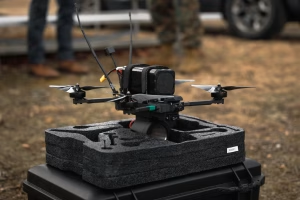
USMC FPV Guidance. The Marine Corps last week issued fielding guidance for the Neros Archer first person view (FPV) attack drone, which the Marine Corps Warfighting Laboratory expects to begin fielding this month. The Sept. 3 Marine Corps Administrative Message issued by Lt. Gen. Benjamin Watson, commander of Training and Education Command, is the basis for a near-term training effort for the attack drones as the service develops a “broader phased training approach,” Watson says in the MARADMIN. “This initiative aims to accelerate the integration of attack drones into Marine Corps formations, enable Marines to begin developing and refining tactics, techniques and procedures, and signal to industry the Service’s commitment to employing low-cost, expendable drone systems at scale.” The Marine Corps is planning to award Neros an contract for around 8,000 of its Archer FPV drones (Defense Daily, Aug. 15).
Seattle Upgrades. The Coast Guard in late August awarded The Whiting-Turner Contracting Company a potential $137 million for the Phase 1A activities to support modernization of Base Seattle, Wash., to eventually homeport the service’s future Polar Security Cutters (PSCs). The contract includes dredging of Slip 36 and construction of two modernized cutter berths that can host the PSCs. The upgrades include widening a slip, providing new utilities, stabilizing the waterfront, and recapitalizing the base’s small boat docks and boathouse. The service plans future Phase 1B and 1C contracts for further modernization and provide four major cutter berths.
More AM for Ursa Major. Ursa Major is acquiring three more metal additive manufacturing (AM) systems from EOS, bringing to six the number of the company’s AM systems it has so that it can scale hypersonics production at its facility in Youngstown, Ohio. “Ursa Major’s work with EOS demonstrates the next era of additive manufacturing, where advanced users are empowered to innovate on their own terms,” Greg Hayes, global senior vice president of Additive Minds at EOS, said in a statement.
People News. Bollinger Shipyards has hired retired Coast Guard Master Chief Petty Officer Heath Jones as vice president of government relations and strategic partnerships. Jones joins the company as the Trump administration begins spending upward of $25 billion under the One Big Beautiful Bill Act on Coast Guard recapitalization and modernization efforts. The Cybersecurity and Infrastructure Security Agency has appointed Nick Andersen as executive assistant director for cybersecurity, leading the agency’s cybersecurity mission. Andersen has had executive cybersecurity roles in industry and the federal government. Finally, spacecraft and related software developer True Anomaly has hired Sarah Walter as chief operating officer. Most recently, she was vice president of engineering at satellite manufacturer and integrator York Space Systems.
Common Tactical Truck. The Army does not plan to release a draft Request for Proposals (RFP) this month for its Common Tactical Truck (CTT) production competition, the service said in a Sept. 5 notice and will instead use industry’s responses to an earlier Request for Information to inform the final RFP and “the associated timeline for release.” The opportunity to provide feedback on the RFI and draft performance specifications, published back on Aug. 21, closes on Sept. 22. CTT is intended to replace the Army’s current Family of Heavy Tactical Vehicles truck fleet. The RFI noted the Army plans to include “right to repair” language in the eventual production contract.
Czech CV90. BAE Systems on Aug. 28 delivered the first CV9030 MkIV infantry fighting vehicle to the Czech Republic. The vehicle is the first of 246 CV90s to be delivered under a $2.2 billion signed in May 2023 that was negotiated between the Czech Republic and Sweden, where BAE Systems Hägglunds business, which builds the CV90, is based. BAE Systems noted that 39 of the vehicles will be produced at BAE Systems facilities in Sweden and 207 CV90s will be built in the Czech Republic. Deliveries are expected to conclude in 2030. “The CV90 provides an unrivalled combination of mobility, firepower, and protection, and will significantly strengthen the capabilities of the Czech Army,” Tommy Gustafsson-Rask, managing director of BAE Systems Hägglunds, said in a statement. “This is just the beginning – by joining the CV90 User Club, the Czech Republic also gains access to a community of experienced operators across Europe, enabling the exchange of operational insights, joint training opportunities, and accelerated introduction of future upgrades.”
NOMAD UGV. Scout AI and Hendrick Motorsports Technical Solutions on Sept. 2 announced a new partnership on the NOMAD, which involves bringing together the latest iteration of the former’s Fury autonomy system with an unmanned ground vehicle built by the latter. “NOMAD also introduces Scout’s second-generation Fury hardware stack, which is more than 90 percent smaller and significantly more power-efficient than prior versions,” Scout AI said in a statement. “The system remains low-signature and passive-sensing, enabling NOMAD to operate autonomously beyond line of sight, follow a human teammate from a safe distance, and integrate a wide range of payloads for light tactical ground missions.”
Ernst Decision. Sen. Joni Ernst (R-Iowa), a member of the Armed Services Committee and chair of the panel’s Emerging Threats and Capabilities Subcommittee, has announced she will not seek reelection in 2026. “This was no easy decision. I love my state and country. It’s the very reason why I decided to wear our nation’s uniform and run for elected office in the first place,” Ernst said in a statement. “By the grace of God, 11 years ago, Iowans elected me as the first female combat veteran to the U.S. Senate. And they did so with a mission in mind, to make Washington squeal. And I’m proud to say we have delivered. We’ve cut waste, fraud and abuse across the federal government and reined in overburdensome rules and regulations.” Ernst also serves on the SASC Cybersecurity and Personnel Subcommittees and has led the Senate’s Department of Government Efficiency (DOGE) Caucus.
Tranche 1. The launch window for the first U.S. Space Force Space Development Agency (SDA) Tranche 1 satellites opens Sept. 10. The satellites are to be the first non-test birds for the SDA Proliferated Warfighter Space Architecture. The launch is to be from Space Launch Complex-4E at Vandenberg Space Force Base, Calif.
Incentive Fees. The F-35 Joint Program Office told the Government Accountability Office (GAO) that “Lockheed Martin plans to begin delivering combat-capable [F-35] aircraft with TR-3 [Technology Refresh-3] that will enable Block 4 capabilities in 2026, a three-year delay due to hardware and software issues,” according to a new GAO report, F-35 Joint Strike Fighter: Actions Needed to Address Late Deliveries and Improve Future Development (GAO-25-107632). The $16.5 billion Block 4 effort to field dozens of new weapons and sensors on the F-35 is in its seventh year, GAO said. “In recent years, the [F-35] program paid contractors, such as Lockheed Martin, hundreds of millions of dollars in incentive fees that were intended to improve on-time delivery,” the report said. “However, the structure of on-time delivery incentives allowed the contractor to deliver aircraft up to 60 days late and still earn some of the fee. To avoid rewarding late deliveries, the program should reevaluate its use of fees in future contracts and better align them to achieve desired production outcomes.”
Markey/Golden Dome. As the Senate gets set to consider its version of the fiscal year 2026 National Defense Authorization Act, Sen. Ed Markey (D-Mass.) said he has filed several amendments for floor consideration to include a measure that would limit funding for President Trump’s Golden Dome project, which he called a “destabilizing…missile interceptor scheme.” “Golden Dome is a trillion-dollar mistake in the making. It will be much more effective at wasting taxpayer dollars than countering missile attacks. It is a defense contractor’s dream and a taxpayer’s nightmare. Golden Dome is Fool’s Gold,” Markey said in a statement. “Before we waste a trillion dollars on an outdated idea that history tells us is a fool’s errand, we owe it to American taxpayers to have a plan, to know how much it will cost, and to know if it will work.” Markey’s amendment would limit funding for Golden Dome’s space-based interceptors until the Pentagon submits to Congress details on a deployment plan, cost estimates and “assurances that the program will not ignite a new arms race with Russia and China.”
Navy Logistics. The Navy on Sept. 4 awarded 59 companies a total $10 billion for a global logistical support and services contract to combatant commands, coalition partners and other federal agencies. This is under the Naval Supply Systems Command’s Worldwide Expeditionary Multiple Award Contract (WEXMAC) initiative started in 2021 to provide faster and more flexible contract support to expeditionary forces by maintaining a group of pre-selected companies to use for this kind of work. The announcement said the vendors will “provide supplies and services in support of, but not limited to, supporting the six phases of the continuum of military operations in support of the geographic Combatant Command’s joint operations, coalition partners, and other U.S. federal agencies in setting and sustaining the theater.” The award aims to provide for requirements like theater opening, sustainment; theater distribution; and stability operations and Defense Support of Civil Authorities support. It also described services under this contract vehicle as humanitarian assistance/disaster relief, contingency, exercise, lodging, logistics, water-based, and land-based support. Work for the contract will occur concurrently under task orders and they will have one five-year option period for the task orders. The base work will start in October 2025 and run through 2029 or 2034. DoD noted that if the option period is exercised, the total contract value for all vendors combined could rise to $20 billion.
SSBN-827. General Dynamics Electric Boat conducted a keel laying ceremony for the second Columbia-class submarine, the future USS Wisconsin (SSBN-827) on Aug. 27. The ceremony marked the start of construction as a vessel moves from design to fabrication. This will be the third Navy ships to be named after the state, following a Illinois-class pre-Dreadnought battleship commissioned in 1901 and an Iowa-class battleship commissioned in 1944. The new SSBNs will replace the Ohio-class nuclear-armed ballistic missile submarines.