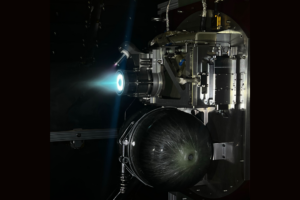
Orbit-raising activities for the first Advanced Extremely High Frequency communications satellite (AEHF-1) are going according to plan, according to Air Force officials. Shortly after the launch last August, the plan was modified as a result of an anomaly with the bi-propellant propulsion system, which was intended to place the spacecraft near its operational orbit. The new plan entails two phases: one phase using hydrazine thrusters, which is now complete; and the other using the Hall Current Thruster (HCT) electrical propulsion…
Recommended
Trending
Congress Updates
Counter-Drone Needs Will Be Addressed In Next NDAA Based On Iran War Lessons, Banks Says
A Republican senator on Armed Services Committee on Thursday said that defending against Iranian drones has been challenge for U.S. warfighters and will be an area of focus in the […]
Pentagon ‘Working Options’ On Iran Supplemental, May Seek Funds For New Capabilities
The Pentagon is “working options” for a potential supplemental spending request to fund the operation against Iran and replenish munitions used in the strike campaign, with a senior official noting […]
Wicker Backs “Crash Program” To Supply Ukraine With Low-Cost Weapons
Senate Armed Services Committee (SASC) Chairman Roger Wicker (R-Miss.) on Thursday proposed a rapid effort to supply Ukraine with low-cost weapons to aid that country in turning back Russia. “We […]
Dem Lawmakers Want To Codify Trump’s Push For More Defense Contractor Accountability
A group of four Congressional Democrats want to codify President Donald Trump’s push to hold defense firms accountable for prioritizing production investments over paying out stock buybacks, and are seeking […]
Job Feed
-
Senior Cloud Detection Engineer
Bank of America - Washington, DC -
Senior Cloud Detection Engineer
Bank of America - Chicago, IL -
Senior Architect
GBS IND - Bank of America - Chennai, India -
Cloud Security Operations Senior Analyst, Global Information Security
Bank of America - Sydney, Australia