 By
By The Senate Appropriations Committee (SAC) tentatively plans to provide almost $63 billion less in its fiscal year 2018 defense appropriations bill than its House counterpart has advanced through its own chamber.
According to the committee’s recent “funding guidance” to its subcommittees, the Senate defense bill would contain $595.2 billion, including $513.1 billion in base funding and $82.1 billion in overseas contingency operations (OCO) funding. By contrast, the House-passed defense bill would provide $658.1 billion, including $584.2 billion in base funding and $73.9 billion for OCO.

The SAC indicated in a July 20 statement that its subcommittee funding levels could change but that until Congress reaches a FY 2018 budget agreement, it will work with the FY 2017 funding levels to adhere to budget caps mandated by the Budget Control Act of 2011.
“Negotiations within Congress and with the president may eventually produce a new budget agreement,” said Sen. Thad Cochran (R-Miss.), the SAC’s chairman. “Until such time, however, it is reasonable that we move forward using FY 2017 funding levels.”
Sen. Patrick Leahy (D-Vt.), the committee’s ranking member, offered an amendment to increase defense and non-defense funding by $54 billion each above the budget caps, but his proposal failed by a 15 to 16 vote.
The SAC has not yet announced when it will mark up its defense bill.
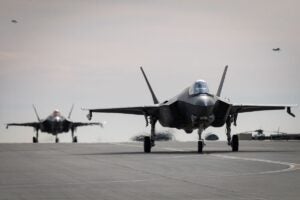
The House bill adds tens of billions of dollars to the Trump administration’s request. It would fund the purchase of 84 Lockheed Martin [LMT] F-35 Joint Strike Fighters, 14 above the request; 11 Navy ships, two more than requested; and 24 Boeing [BA] F/A-18E/F Super Hornets for the Navy, 10 more than requested.
Separately, Sen. John McCain (R-Ariz.), chairman of the Senate Armed Services Committee, confirmed in a statement July 31 that Senate floor consideration of the FY 2018 defense authorization bill will wait until he returns to Washington in September. McCain had hoped to have the Senate take up the bill before the August congressional recess, but he ended up heading home early to undergo treatment for a brain tumor.
McCain’s statement also indicated that he plans to offer an amendment aimed at creating a “strategy for success” for U.S. involvement in Afghanistan. “Eight years of a ‘don’t lose’ strategy has cost us lives and treasure in Afghanistan,” he said. “Our troops deserve better.”