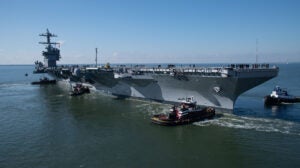
CVN-79. HII announced its Newport News Shipbuilding (NNS) division successfully completed builder’s sea trials of the second Ford-class aircraft carrier as the ship came back to port on Feb. 4. The future USS John F. Kennedy (CVN-79) started initial trials on Jan. 28 when it sailed to sea for the first time. According to the Navy’s fiscal year 2026 budget request, the carrier is now set to be delivered in March 2027 in order to accommodate finishing Advanced Arresting Gear certification and continued Advanced Weapons Elevator work, two new systems that help catch landing aircraft on the deck and move ordnance between the deck and storage areas. The service noted acceptance trials is the carrier’s next milestone, “the timeline for which is currently under review.”
MQ-25 Taxied. A Boeing MQ-25A Stingray unmanned aircraft completed it first successful low-speed taxi test when controlled by Navy pilots, Naval Air Systems Command (NAVAIR) revealed on Jan. 30. NAVAIR posted a video of the test on X where the aircraft taxied from Boeing’s production facility to the taxiway at MidAmerica St. Louis airport. The Navy noted during the test the aircraft was under the control of Air Test and Evaluation Squadron (VX) 23 while Air Test & Evaluation Squadron Two Four (UX-24) monitored. UX-24 conducts the research ,development, test and evaluation on MQ-25 alongside other Group 1 through 5 unmanned aircraft systems.
Exchanging Positions. Air Force Brig. Gen. Jason Voorheis became the service’s first portfolio acquisition executive (PAE) for command, control, communications and battle management (C3BM) on Feb. 2. Lt. Gen. Luke Cropsey, now the military deputy to acting acquisition chief William Bailey, had been the program executive officer for C3BM before the Air Force took up the direction of Defense Secretary Pete Hegseth to move to the PAE set up. Voorheis had headed the service’s program executive office for fighters and advanced aircraft from 2023 to 2025 before becoming the acting military deputy to Bailey between December 2025 and this month. “I’ve watched the Advanced Battle Management System and C3BM story unfold over the last decade from various perches,” Voorheis said in a statement. “What the dynamically evolving C3BM team has built over the last three years has been impressive.” Voorheis is to oversee more than 50 programs, according to the Air Force.
USV Divisions. Commanders of Unmanned Surface Vessel (USV) Divisions 31, 32 and 33 assumed their commands during a Jan. 22 ceremony at Naval Air Station North Island, Coronado, presided over by Vice Adm. Brendan McLane, commander, Naval Surface Force, U.S. Pacific Fleet. These USV Divisions fall under Unmanned Surface Vessel Squadron (USVRON) 3 in San Diego, commanded by Cmdr. Sophia Haberman. All three commanders are the inaugural heads of their divisions, marking their establishment.
CASR Awards Coming. This year, the Space Force’s Commercial Space Office (COMSO) plans to make its first award under the Commercial Augmentation Space Reserve (CASR), beginning with space domain awareness, Col. Tim Trimailo, head of the office, said on Feb. 6. Trimailo told attendees at the Miami Space Summit that he will take a “crawl, walk, run” approach to capabilities acquired through the CASR, and with space domain awareness “we’re gonna sort of crawl.” CASR is the Space Force’s Space Systems Command’s effort to ensure access to commercial capabilities in times of conflict and crisis.
…What’s Ahead. Beyond space domain awareness, which Trimailo equated crawling with a “minimum viable product,” the COMSO is “thinking, ‘how would we do things like manufacturing as a service?’” he said. “’How do we do all kind of mission sets and think outside the box when it comes to CASR,’ because the opportunities are endless.”
Harpoon Block II. The Navy on Feb. 5 announced it completed the third and final planned fight test of the Harpoon Block II Update Obsolescence Update program on Jan. 16. Naval Air Systems Command’s Precision Strike Weapons (PMA-201) program office and Boeing conducted the test at Naval Air Weapons Station China Lake and the Point Mugu Sea Range in California where they demonstrated a successful Coastal Target Suppression mission against a representative land target. In the test, an F-15 launched the Harpoon at about 12,000 feet above ground level, the missile descended to 5,000 feet then proceeded to the target area while performing several altitude changes to simulate a coastal engagement. The test ended with a steep terminal dive leading to impact. This flight test series includes three events meant to progressively validate systems across mission sets. The first test verified guidance and aerodynamics performance, the second focused on engagement of a moving maritime surface target and the last test confirmed its utility against a land-based target, the Navy said. Initial deliveries are planned for later in 2026.
Polymer Parts. The Reverse Engineering, Additive, Design and Inspection (READI) Lab at Robins AFB, Ga.’s Warner Robins Air Logistics Complex is using additive manufacturing to build polymer parts to replace metal ones from now defunct suppliers for such aircraft as the C-130, C-5, C-17, B-1, B-52, KC-135 and the F-15, according to Air Force Materiel Command and the 78th Air Base Wing at Robins AFB. “The additive manufacturing mission began roughly 10 years ago with polymer machines,” according to the wing. “Approximately 2 years ago, the lab brought on metal additive machines to increase their mission scope and efficiency at which they create and produce parts.”
Manufacturing Raise. Machina Labs, a startup developing factories of the future, closed a $124 million Series C funding round to accelerate deployment of its first U.S.-based factory for advanced metal structures. The Los Angeles-based company last week said the 200,000 square foot factory will include up 50 of its RoboCraftsman cells that consist of artificial intelligence-driven industrial robotic arms that shape metal sheets into complex geometries without specific dies, molds or presses. Machina Labs is focused on the aerospace, automotive and defense industries. Woven Capital, Toyota’s ventures arm, Lockheed Martin Ventures, Balerion Space Ventures and Strategic Development fund participated in the round.
…Upper Ocean Investment. Apeiron Labs last week closed a $9.5 million Series A round to expand its engineering and commercial teams and scale its Tensor platform, an autonomous underwater vehicle and related data analytics for scientific observation and surveillance of the upper ocean. The funding round was co-led by S2G Investments, RA Capital Management and DYNE Ventures, with participation from Assembly Ventures, TFX Capital and Bay Bridge Ventures. “The atmosphere has its satellite constellations. The ocean needs its own,” Ravi Pappu, co-founder and CEO of the Boston-area company, said in a statement. “We’re applying CubeSat thinking to ocean observation through a data platform designed for continuous insight at a scale that matches the scope of the challenge.”
TNT. The Army on Jan. 30 selected Accurate Energetic Systems in Tennessee, Nammo Perry in Florida and Spectra Technologies in Arkansas to compete for orders to produce TNT and plastic-bonded explosive N-9 supplementary charges under a new $377.7 million contract. The three companies were the only firms to bid for the work, according to the Pentagon. Work on the deal is expected to be completed by the end of January 2031.
More ACV-30s. The Marine Corps on Dec. 18 awarded BAE Systems a $195 million order to build more turreted variant Amphibious Combat Vehicles (ACV-30), the company said on Feb. 3. The deal follows a $184.4 million order BAE Systems received on Dec. 1 for 30 ACV-30s. “The additional ACVs keep the program aligned with operational requirements so that Marines are ready for any mission,” Rebecca McGrane, BAE Systems’ vice president of amphibious vehicles, said in a statement. The Marine Corps is pursuing a family of vehicles approach for ACV, which includes the ACV-30, the base personnel platform and a command and control version in full-rate production and a recovery variant going through development.
Ukrainian Parts Deal. The State Department on Feb. 6 said it has approved a potential $185 million Foreign Military Sale (FMS) of Class IX spare parts and related equipment to Ukraine. The spare parts would support U.S. Army supplied vehicles and weapons systems previously provided to Ukraine. “Ukraine has an urgent need to strengthen local sustainment capabilities to maintain high operational rates for U.S.-provided vehicles and weapon systems,” the Pentagon’s Defense Security Cooperative Agency said in a statement.
…Iraqi FMS. Last Thursday, the department approve a potential $90 million FMS to Iraq for VACIS XPL Passenger Vehicle Scanning Systems and related equipment supplied by Leidos. The sale would support an Iraqi request to extend Contracted Logistical Services, including round-the-clock help desk service, for two years in support of the Ministry of Interior’s VACIS XPL systems. Iraqi border forces use VACIS to detect weapons, CBRN agents, drugs and other contraband being smuggled into the country.
More FMTV A2s. Oshkosh Defense has received a $25 million order from the Army to deliver more FMTV A2 Low-Velocity Airdrop (LVAD) 4×4 cargo vehicles and kits, the company said on February 5. The latest deal follows a recent order from the Army for 97 FMTV A2 LVAD 4×4 and 6×6 vehicles. “As the Army adapts to future operations that assume contested terrain, limited access, and increased mobility, the FMTV A2 LVAD fills a critical sustainment gap for airborne and rapidly deploying units. Designed to be parachuted from aircraft, the FMTV A2 LVAD delivers both critical supplies and a mission-ready vehicle immediately upon deployment, even in areas without established infrastructure. Delivered alongside maneuver forces, the vehicle reduces early reliance on vulnerable ground convoys and improves sustainment for forward-deployed units,” Oshkosh Defense said in a statement.
NGC2. Persistent Systems said on Feb. 4 it has received a second order from the Army worth $87.5 million to supply more Wave Relay mobile ad hoc networking (MANET) devices in support of the Next Generation Command and Control (NGC2) prototype initiative. The new deal follows a $34 million award for MANET devices that the company announced last October. “Faster information delivery times and more reliable access to data enable faster, more efficient decisions, streamlining command and control (C2). The MANET radio continues to demonstrate it can serve as part of the transport layer, with the speed, resilience, and capacity required for combat operations,” Persistent Systems said in a statement. The Army has said NGC2 will provide “commanders and units at echelon an open and modular C2 ecosystem across hardware, software and applications with access to a common and integrated data layer,” and has described it as a “fundamental change in how the U.S. Army conducts digital mission command.”
Navy Helmets. The Navy awarded Gentex Corporation a $22.6 million contract to deliver over 5,000 Next-Generation Fixed Wing Helmet (NGFWH) systems and spares to be fielded across all Navy fixed wing aircraft, the service said on Feb. 4. The Navy plans to use the NGFWH systems to help “streamline and modernize life-support capabilities for fixed-wing aircrews” and ultimately replace the aging HGU-55/P and HGU-68P legacy helmets. Naval Air Systems Command said it focuses on two sets of improvements, ergonomics and safety as well as integration into other systems. The helmet system uses a lighter carbon-fiber shell that reduces head-borne weight with a better center of gravity to mitigate neck and back strain with an inner liner that keeps it secure during high-G maneuvers. It also has a modular design to allow the integration of future head-mounted displays and communications systems without overhauling the entire helmet.
Lockheed, Fujitsu MoU. Lockheed Martin and Japan’s Fujitsu last week agreed to a Memorandum of Understanding that will leverage the former’s expertise in integrated systems and the latter’s technologies and commercial scale to advance dual-use solutions in quantum computing, edge computing for sensing and data fusion, artificial intelligence, microelectronics and multi-domain network solutions. “This collaboration accelerated technologies that are critical to meeting the future needs of our customers,” Craig Martell, Lockheed’s chief technology officer, said in a statement. “Coupling the expertise of Lockheed Martin and Fujitsu across technology areas will be a force multiplier, advancing leadership in critical technologies like microelectronics, inference at the edge and quantum solutions.”
BlackSky Award. BlackSky Technology last week said it received a seven-figure contract from a new international defense customer to provide imagery from its Generation-3 electro-optical satellites to support “time-sensitive tactical ISR operational needs” after the unidentified customer had “early access” to the technology. “This partnership reflects continued traction against our land-and-expand strategy and demonstrates the growing recognition that dynamic space-based intelligence in no longer optional, it’s essential,” Brian O’Toole, BlackSky’s CEO, said in a statement. “Assured gives our customers guaranteed, priority access to Gen-3 capacity over their operational areas of interest.”
Air Force Security. Picogrid last week said it received a $9.3 million contract from the Air Force to transition pilot projects of its Legion software to operational deployments at key sites, giving security operators and forces a common operating picture that integrates data from existing sensors into a unified system. The California-based company says its software orchestrates sensors and effects spread across different locations and applies artificial intelligence-base analytics to provide real-time threat awareness to multiple mission systems so that security operators have the situational awareness to protect assets.
C-UAS at the Border. Parsons Corp. said in January its DroneArmor counter-unmanned aircraft system (C-UAS) solution is being used by a federal customer to protect personnel, communities and critical infrastructure on the southern border of the U.S. As an integrator, Parsons uses sensors and effectors from different industry partners and weaves in artificial intelligence to create DroneArmor, which autonomously tracks, identifies and mitigates potential UAS threats.
Another HC-130J Delivered. The Coast Guard last week said it has taken deliver of its 18th mission ready HC-130J long-range surveillance aircraft. L3Harris Technologies completed the aircraft missionization at its facility in Waco, Texas. The missionization of the baseline Lockheed Martin-built C-130J includes integration of the Minotaur Mission System Suite, Coast Guard-specific multi-mode radar, sensors and communications systems, and enhanced approach and landing systems, expanded diagnostics and civil GPS. The Coast Guard has appropriations for 25 HC-130Js and one HC-130J simulator.
Lethal Payloads. The Army on Jan. 29 issued a Request for Information related to lethal payload packages that could be integrated onto remotely operated unmanned ground vehicle systems. The RFI will gather input to support the Army’s plans for its Human Machine Integrated Formations effort. The Army noted it’s interested in technologies related to small and medium caliber remote weapons stations, medium caliber remote turrets, remotely-operated mortar systems, lethal UAS launch systems, anti-tank capabilities and smart munition delivery systems.
Group 4 S/VTOL Summit. The Army will host a Group 4+ Short/Vertical Takeoff and Landing (S/VTOL) Summit with industry from March 10-12 in Huntsville, Ala., according to a new notice. “The initiative is designed to foster early and deliberate collaboration with dedicated industry partners to shape future acquisition, development and procurement strategies. The goal is to field modular, runway-independent weapon systems that reduce logistics footprints, enhance operational flexibility and provide a decisive advantage to the warfighter,” the Army wrote. The Army said it aims to engage with industry that works on air vehicles, UAS sensors and payloads, autonomy and onboard mission software.
Starfish and Quindar. Quindar, a developer of ground-based systems to automate mission services across different constellations of spacecraft bus operations, has partnered with Starfish Space to bring its support solutions for Starfish’s first three deorbit as a service missions. Starfish’s Otter space vehicle can capture satellites in different orbits and safely remove them from orbit when necessary. “Quindar automates spacecraft bus operations—providing reliable access, health monitoring, commanding, and fault response—so Starfish’s vehicles maintain continuous uptime of their core systems,” Nate Hamet, co-founder and CEO of Quindar, said. “Mission-level decisioning and autonomous rendezvous and proximity operations remain with Starfish’s cutting-edge software and vehicle capabilities.”