More SHIELD. The Missile Defense Agency (MDA) on Jan. 15 announced it made another 340 awards under the Scalable Homeland Innovative Enterprise Layered Defense (SHIELD) multiple award contract, raising the total number of contractors to 2,440. SHIELD aims to develop missile defense systems for the Golden Dome initiative, with the first 1,014 awards announced on Dec. 2, 2025, followed by another 1,086 on Dec. 18. The SHIELD vehicle allows DoD to quickly compete orders under this contract across a broad range of work. If all options are exercised, work will continue through December 2035. MDA repeated this contract was competitively procured and maintained the same total number of offers named in earlier SHIELD updates at 2,463.
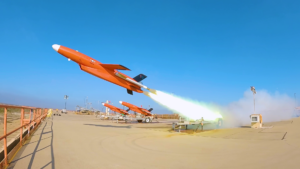
Navy CCA Test. In December the Navy completed a second successful demonstration to advance multi-platform coordination of autonomous systems as a step towards developing the future Collaborative Combat Aircraft (CCA). The Dec. 11 test was performed by Program Executive Officer for Unmanned Aviation and Strike Weapons’ Aerial Targets (PMA-208) and Strike Planning and Execution Systems (PMA-281) program offices at Point Mugu Sea Range, Calif., alongside industry partners Shield AI, Kratos Defense & Security Solutions and CTSI. In the test, two Kratos BQM-177A subsonic aerial targets flew autonomously with Shield AI’s Hivemind software and connected to a Live Virtual Construction environment, which itself included a virtual F/A-18 and two simulated adversary aircraft.
…Mission Scenario. In the scenario setup, the virtual F/A-18 acted as mission lead, directing the BQM-177As to defend designated Combat Air Patrol locations. “When the simulated adversary aircraft attempted to move into those areas and threaten U.S. forces, the autonomously controlled BQM-177As responded according to their mission tasking,” the Navy said. The demonstration marked progress implementing the Navy’s Autonomy Government Reference Architecture (A-GRA) interfaces, an important factor in improving interoperability and accelerating the integration of mission autonomy across future unmanned platforms.
Overmatch Numbers. The Navy on Jan. 15 disclosed more than 80 ships have been deployed with Project Overmatch capabilities, providing naval forces with manned and unmanned systems used in a common operating picture to allow commanders to match the best sensors to shooters via networks and battle management tools. The Navy started with work on the Vinson Carrier Strike Group and in early 2024, the Naval Information Warfare Systems Command said Project Overmatch capabilities were expanding to several other unspecified Carrier Strike Groups. In a statement, Cmdr. Rebecca Adams, fielding lead for Project Overmatch, said in 2025 her team trained 590 sailors on five different Overmatch systems, developed eight instruction courses, and worked with 20 ships to install equipment and train crews. Project Overmatch is also the Navy’s contribution to DoD Joint All-Domain Command and Control effort to better connect all the military’s networks, sensors and shooters and sensors.
DoW Name Cost. The Congressional Budget Office last week estimated the cost to statutorily rename the Department of Defense to the Department of War to be between “a few million dollars” to $125 million. The estimated range varies base on how widely the name change “was adopted and how intensively it was applied at each level of the department,” CBO wrote Democratic Sens. Chuck Schumer (N.Y.) and Jeff Merkley (Ore.), who sought the estimated. President Donald Trump last September directed the use of the Department of War as a secondary title for the DoD.
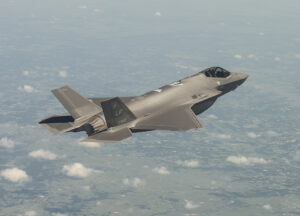
1,500th Fuselage. Northrop Grumman says its factory automation and advanced manufacturing technologies have helped it deliver its 1,500th center fuselage for the F-35 fighter from the Integrated Assembly Line (IAL) in Palmdale, Calif. “Using advanced manufacturing technologies, the IAL delivers one center fuselage every 30 hours and seamlessly produces center fuselages for all three F-35 variants on a single production line,” according to Northrop Grumman. “The use of augmented reality and virtual reality tools on the IAL led to a 35 percent reduction in center fuselage assembly time and a 20 percent reduction in technician learning curve.” Northrop Grumman is also the contractor for the F-35’s AN/APG-81 AESA radar, the integrated communication, navigation, identification system, wing skins “and leads the industry team in low observable technologies” the company said. In addition, Northrop Grumman is developing the AN/APG-85 radar to replace the APG-81.
FMF Funds. The House on Jan. 14 voted 341 to 79 pass a two-bill fiscal year 2026 spending package that includes $6.2 billion for the State Department’s Foreign Military Financing (FMF) program, a $1 billion increase from the Trump administration’s request. The legislation specifically covers $3.3 billion in FMF funds for Israel and $300 million for Taiwan, which can be used to to purchase U.S.-made military equipment. The legislation now heads to the Senate, and Congress may also begin considering a separate spending package next week that would include FY ’26 defense appropriations.
EPF-16. The last Flight II Spearhead-class Expeditionary Fast Transport Ship, the future USNS Lansing (EPF-16) was christened during a ceremony at shipbuilder Austal USA’s Mobile, Ala., shipyard facility on Jan. 10. EPF-16 is the first ship named after the capital of Michigan. This EPF Flight II includes a Role 2E (enhanced) medical capability that includes surgery, basic secondary care, intensive care unit, ward beds, and other support systems. The ship can also support V-22 Osprey flight operations and launch and recover 11-meter Rigid Hull Inflatable Boats. The ship is set to be crewed by 31 civilian mariners and can embark up to 155 embarked forces or an Expeditionary Medical Unit.
Robotic Welding. Fairbanks Morse Defense (FMD) on Jan. 12 announced the expansion of its robotic welding program that is aimed at boosting ship repair and maintenance efficiency for the Navy and allied fleets. The company said its technology combines automation, precision and data-driven performance to reduce operational downtime, improve safety and extend the service life of naval assets. “By merging robotics with human expertise, FMD can accelerate repairs while ensuring each weld meets stringent naval standards. This innovation is part of the company’s broader strategy to modernize maintenance operations and strengthen mission readiness across the maritime defense sector,” the company said in a statement. FMD said robotic welding is particularly useful in confined or challenging environments and works three times faster than manual welding.
Mobile Ship Target. The Navy Mobile Ship Target, its newest test ship, arrived at Port Hueneme, Calif., on Jan. 14. Next, Naval Air Warfare Center Weapons Division (NAWCWD) teams will prepare the ship for operations to support advanced weapons testing. The 260-foot vessel, known as MST-2 and designated MST-2301, was built by Gunderson Marine in Portland, Ore. The company launched the ship for builder’s sea trials in July. NAWCWD teams will outfit the ship for operational use, which entails installing a government-developed remote-control system so it can operate safely during live-fire events. “Once complete, the MST will give us a safe, repeatable way to run some of the toughest weapons tests the fleet depends on,” Kevin Gross, director of the Threat Target Systems Department at NAWCWD, said in a statement. The ship is designed for long-term use and will perform sensor and tracking evaluations in live-fire events for weapons launched from ships or aircraft. MST-2 replaces the Advanced Target Launch System, MST-1 after decades of supporting maritime testing operations.
V-22 Facility. Fleet Readiness Center Southwest (FRCSW) opened its new purpose-built V-22 repair facility on Naval Air Station North Island in San Diego, Calif., the service announced on Jan. 15. The 65,000-square-foot hangar complex is designed to enhance capacity, increase safety, and reduce turnaround time. Of that space, 40,000 square feet are dedicated to the main hangar while 25,000 square feet are focused on shops, storage and administrative spaces. It can accommodate up to four V-22s at a time, a 25 percent increase in bay capacity. John Goolsby, FRCSW V-22 program manager, said the facility positions FRCSW as the premier V-22 repair depot on the West Coast.
Dual-Hat Role. The nominee to serve as the next head of U.S. Cyber Command and director of the National Security Agency said during his Senate confirmation hearing that he supports maintaining the dual hat leadership arrangement. “What I’ve seen from the perspective of U.S. INDOPACOM and, really, throughout my career since that [dual hat] arrangement’s been in place [are] the effects of unity in command and unity of effort across two different organizations that I believe and understand…[bring] effectiveness that fosters integration and speed,” Army Lt. Gen Joshua Rudd, who is currently deputy commander of U.S. Indo-Pacific Command, told lawmakers last week. Sen. Roger Wicker (R-Miss.), chair of the Armed Services Committee, said there’s a “great deal of support up here on this committee for that dual hat responsibility.”
New Commandant. Adm. Kevin Lunday last Thursday was sworn in as the 28th commandant of the Coast Guard after serving as the service’s acting top officer for nearly a year following the dismissal of his predecessor Adm. Linda Fagan on Jan. 21, 2025.
New DIU Director. Owen West, a retired Marine who also served as assistant secretary of defense for special operations and low-intensity conflict during the first Trump administration, has been appointed as director of the Defense Innovation Unit (DIU). West will be sworn in this spring. Emil Michael, the Defense Department’s under secretary for research and engineering, is currently acting director of DIU. The DoD innovation arm was previously led by Doug Beck, who resigned last August as part of leadership shifts during the new Trump administration.
FPV Down. Epirus last week said its Leonidas VehicleKit high-power microwave system in December successfully defeated a fiber optic-guided first person view (FPV) drone during a live-fire demonstration at a U.S. government test site. Fiber optic-based FPVs are being used routinely by both sides in Ukraine’s fight against Russia’s illegal invasion of the country to avoid jamming and spoofing by electronic warfare-based counter-drone systems. The company said the “event marks the first known instance of electromagnetic interference being weaponized to defeat a fiber optic-guided drone.”
UAS Detection. The Army DEVCOM’s C5ISR Center has issued a Request for Information for a new project to develop a system for detecting Group 1 and 2 unmanned aircraft systems (UAS) using acoustic signatures. “The desired system shall passively detect UAS signatures through acoustics to determine location, bearing and classification of the target. The system will then notify a soldier through their smart device and display the location of the detected UAS via [the] Tactical Assault Kit,” the Army writes. The Army is gathering input on industry’s complete systems to meet the requirements or subsystems to support UAS detection algorithms, hardware solutions, software applications and dismounted displays.
York IPO. York Space Systems last Friday launched its initial public offering, aiming to raise between $480 million and $544 million through the sale of 16 million shares of its common stock. The company will also grant underwriters the option to purchase up to 2.4 million shares of stock at the initial public offering price. York, a privately-held satellite developer and manufacturer, is pricing its shares between $30 and $34 a piece.
Speedy SRM Development. Ursa Major developed a 7-inch diameter solid rocket motor (SRM) in four months—from clean sheet design to a static fire test—as part of an internally funded effort, the company said last week. The test met all performance and test objectives, the startup said. Ursa Major used its Lynx advanced manufacturing cell to produce the SRM that was filled with Highly Loaded Grain, which allows for more propellant in the case for extended range and improved tactical performance.
SkyFi Raise. SkyFi last week said it raised $12.7 million in an oversubscribed Series A funding round co-led by Buoyant Ventures and IronGate Capital Advisors. The Austin, Texas-based startup offers customers a self-service Earth observation platform that leverages satellite imagery, analytics and maritime data from various providers. SkyFi said the investment will be put toward product development, enhancing the platform’s user interface and analytical tools, enter new partnerships with satellite operators and expand data offerings.
Canadian Startup. Juno Industries, a Vancouver-based startup focused on autonomous systems, emerged from stealth last week. Co-founded by Harjit Sajjan, Canada’s former defence minister, Juno closed a $3 million seed financing round last fall that included Geordie Rose and Sanctuary AI. The startup is developing dual-use autonomous systems to strengthen Canada’s security, including in the Arctic region.
Kratos Continues Expanding. Kratos Defense & Security Solutions, which is adding capacity across the company, has added a 40,000 square foot facility in Birmingham, Ala., for electro-mechanical systems and integration space in support of its products center. Kratos’ work at the facility includes the HORUS high-altitude intelligence surveillance reconnaissance imaging system, the CRADLE mobile bistatic radar communications platform, and the UltraSpec non-destructive inspection technology for advanced composite materials. The company now occupies 150,000 square feet of space at its Oxmoor Valley campus.
GPS Alternative. Space-based positioning and navigation solutions provider TrustPoint last week said it successfully transmitted for the first time Low Earth Orbit Navigation System (LEONS) time-transfer and tracking signals from the company’s compact ground node to spacecraft in orbit. The Northern Virginia-based company said its LEONS is independent of GPS and offers an alternative position, navigation and timing layer for spacecraft in low Earth orbit, and for users on Earth. TrustPoint conducted the demonstration under a SpaceWERX contract.
Space Force Award. Space domain awareness provider Slingshot Aerospace last week said it received a $27 million contract from the Space Force’s Space Training and Readiness Command to help modernize the service’s training by integrating artificial intelligence technology into scenarios to replicate evolving threats on orbit. The 18-month contract for Slingshot’s TALOS AI product follows testing of TALOS by the command. “TALOS simulated adaptive, machine-speed threat behaviors, enabling faster scenario development, larger-scale simulations and more realistic missions,” the company said.
IFVs for Ukraine. Rheinmetall said on Jan. 12 it will soon supply Ukraine with its first Lynx KF41 infantry fighting vehicles, under a contract in the “mid double-digit million euro range” that the German government signed in December. “The IFVs will feature the two-man Lance turret and be configured specifically for the Ukraine’s armed forces. The next step is to procure additional batches, including production in Ukraine,” Rheinmetall said.
ARSAG Conference. U.S. Air Force Gen. Randall Reed, the head of U.S. Transportation Command, is to be the keynote speaker at the Aerial Refueling Systems Advisory Group (ARSAG) conference on April 21-23 in Orlando, Fla. Three years ago, Reed addressed the conference as the deputy head of Air Mobility Command. ARSAG has been the Pentagon’s Joint Standardization Board for aerial refueling systems.
Editor’s Note. In observance of Martin Luther King Jr. Day, Defense Daily will not publish on Monday, Jan. 19. Our next issue will be published on Jan. 20.