A Dividend Boost. While President Donald Trump rails against publicly traded defense contractors paying dividends and buying back their stock, L3Harris Technologies on Jan. 23 said its board approved a 4 percent increase to the company’s quarterly dividend, from $1.20 to $1.25 per share, payable March 20. Trump on Jan. 8 issued an executive order immediately prohibiting “major defense contractors” from paying dividends or repurchasing their stock “until such a time as they are able to produce a superior product, on time and on budget.” The legality of the directive is questionable. L3Harris is scheduled to report its 2025 financial results on Jan. 29, with sales expected to be around $22 billion.
FMS Risk. President Donald Trump’s threat to annex Greenland may decrease U.S. foreign military sales (FMS) to North Atlantic Treaty Organization (NATO) nations significantly, according to Sheila Kahyahoglu, an aerospace and defense analyst with Jefferies. Between 2023 and last year, U.S. FMS to NATO countries was $195 billion—55 percent of total U.S. FMS notifications, according to Kahyaoglu. Last year, RTX led the pack with $26 billion in sales to the alliance, followed by Lockheed Martin at $7 billion, and Boeing at $4 billion. During a recent Jefferies call with Jennifer Kavanagh, the director of military analysis at Defense Priorities, “we discussed Greenland and the potential implications for NATO,” Kahyaoglu wrote. “Dr. Kavanagh thinks that while Greenland offers value to the U.S. for missile defense, Arctic access, maritime monitoring, and critical minerals, coercive moves to acquire the territory would severely strain NATO cohesion and could accelerate European defense spending that is independent of the U.S. While this could be a tailwind for European and global defense spending, it could also be a headwind for U.S. FMS. If the EU [European Union] increasingly views the US as unreliable, NATO countries in the EU are likely to attempt to reduce reliance on the US with a further prioritization of local defense contractors.”
First Convoy. Two MH-139A Grey Wolf helicopters by Boeing and Leonardo escorted their first nuclear convoy for Air Force Global Strike Command (AFGSC) on Jan. 8, according to AFGSC and Boeing. “The MH-139s shepherded a column of missile maintenance and armored security vehicles to and from a launch facility located more than 100 miles east of Malmstrom AFB, Mont., without needing to refuel during the six-hour movement, demonstrating the superior capabilities of AFGSC’s newest helicopter as the Air Force prepares to retire the UH-1N Huey after more than five decades of service,” AFGSC said. “Not only is the MH-139 Grey Wolf approximately 50 percent faster than the Huey and can arrive on-site several minutes sooner – armed and with twice as many troops on board – it also has enhanced defensive systems and is built to support missile field security missions across vast and austere terrain. The recent convoy escort mission gained valuable operational experience for AFGSC as 20th Air Force progresses toward initial operational capability of its Grey Wolf fleet.”
GPS III Launch. A SpaceX Falcon 9 rocket is to launch the M-code GPS III Space Vehicle 09 (SV09) satellite from Cape Canaveral Space Force Station, Fla., on Jan. 25 or 26, according to U.S. Space Force’s Space Systems Command (SSC) and Combat Forces Command. “The two field commands are executing this mission using the model established by the Rapid Response Trailblazer launch in December 2024 and GPS III-7 (SV08) launch in May 2025,” according to SSC. “Being pre-postured with the right equipment has enabled the launch teams to process and integrate the GPS III (SV09) satellite with the Falcon 9 rocket on a shortened timeline.”
APFIT for ANELLO. ANELLO Photonics last week said it received a $20 million award from the Defense Department under the Accelerate the Procurement and Fielding of Innovative Technologies (APFIT) program to “fast-track the procurement, production and scaling” of the company’s GPS-denied navigation technology for the Marine Corps. DoD in December announced the latest round of APFIT awards but did not disclose awardees (Defense Daily, Dec. 22, 2025). ANELLO’s award is for Miniaturized Gyroscope for Resilient Navigation. “This award marks an important step in bringing GPS-independent navigation to the forefront of operational autonomy,” Dr. Mario Paniccia, ANELLO’s CEO, said in a statement.
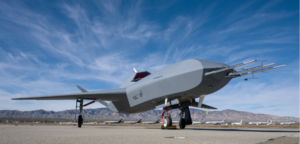
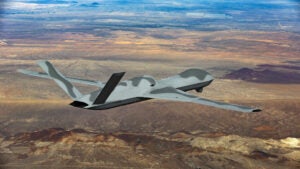
Autonomous Intercept. General Atomics Aeronautical Systems, Inc. (GA-ASI) last week said its MQ-20 Avenger unmanned aircraft successfully conducted an autonomous intercept of a manned aggressor aircraft in a company-funded demonstration. The Avenger was “equipped with the latest government reference autonomy software,” GA-ASI said. The demonstration included the MQ-20 using a live infrared search and track sensor supplied by Anduril Industries that allowed the autonomy system on the unmanned jet to independently establish a track, calculate an intercept solution, and simulate firing a weapon at a live target, all “without human supervision.”
…More Highlights. GA-ASI also said that just as manned aircraft often do, the MQ-20 flew a “pre-designated route to a standard instrument hold in which the aircraft pauses and orbits” before flying to its next objective and “executing routes commanded via heading, speed and altitude, all while successfully avoiding the designated keep-out zones.” In addition to staying out of the keep-out zones, the Avenger adhered to the keep-in-zones.
…Co-Production Deal. Separately, GA-ASI said it signed a memorandum of understanding (MoU) with Calidus Aerospace to collaborate on the potential co-production of its MQ-9B remotely piloted aircraft and its Gambit collaborative combat aircraft (CCA) in the United Arab Emirates. The MoU also covers command and control and battle management systems. GA-ASI said the collaboration “will be historic” given it will be the first time its aircraft will be manufactured in the region. Gambit is competing in the U.S. Air Force’s current CCA program.
M109A7s. The Army has awarded BAE Systems a $473 million deal to produce more M109A7 Paladin Self-Propelled Howitzers. The deal covers 40 sets of M109A7s, which includes the associated M992A3 Carrier Ammunition Tracked ammunition-loading vehicle. BAE Systems noted the deal also includes support services, post-production refurbishment and welding compliance.
Cargo Vehicles. The Army has placed an order with Oshkosh Defense to deliver 97 more FMTV A2 Low-Velocity Airdrop (LVAD) 6×6 and 4×4 Cargo vehicles, the company said on Jan. 20. “The FMTV A2 LVAD Cargo variant is a critical sustainment asset that ensures the Army’s Mobile Brigade Combat Teams (MBCTs) remain supplied, mobile, and mission-ready from the moment they enter the fight. Designed for rapid airdrop deployment, the FMTV A2 LVAD delivers essential equipment, supplies and sustainment capabilities directly into austere and contested environments, reducing reliance on fixed infrastructure and extending the operational reach of MBCTs,” the company. The order follows the Army’s award of a $792.4 million contract extension to Oshkosh last year for continued FMTV A2 deliveries.
Autonomous Base Construction. AIM received a $4.9 million contract from the Air Force to provide its autonomous bulldozers and excavators to remotely construct bases and airfields in austere and inaccessible terrain, the Washington-based company said last week. “Airfields and remote bases are critical to our national security but their construction is often reliant on putting soldiers and airmen in harm’s way,” Adam Sadilek, founder and CEO of AIM, said in a statement. “The AIM platform not only allows for fully remote Rapid Airfield Damage Recovery operations, it enables the construction of bases in remote locations where dropping heavy machinery by parachute is the only way in.”
New DroneHunter. Fortem Technologies last week said it has begun customer deliveries of its DroneHunter 5.0 unmanned aircraft system (UAS) that uses a net to capture threat drones in the air. The DroneHunter 5.0 was recently selected by the Defense Department’s Joint Interagency Task Force (JIATF)-401 under the Replicator 2 initiative to allows operators to assess the counter-drone solution for potential follow-buys (Defense Daily, Jan. 13). The JIATF-401 expects to take delivery of two DroneHunter 5.0s in April. Fortem said the system it will provide DoD can detect, track, identify and defeat drones.
…Features. The new DroneHunter delivers a “step-change” in improvements over previous models in “autonomous decision-making, maneuvering and speed of capture,” Fortem said. The 5.0 system integrates with the company’s SkyDome command-and-control system to coordinate up to five interceptors against five threats simultaneously, and includes a redesigned airframe and landing gear for faster setup and reliability, safety enhancements, and an optional four-net-gun configuration—double the existing capability—for increased capture capability. The net capture system allows for low-collateral counter-drone operations, “making it suitable for use over sensitive locations such as military bases, airfields, energy infrastructure and major public events,” Fortem said.
GM Defense UK. GM Defense on Jan. 19 announced the launch of its new GM Defense UK business unit. The firm said GM Defense UK will operate from its current sites in Leamington Spa and Silverstone in England and will lead its engagement with the United Kingdom Ministry of Defence and “anchor GM’s wider NATO and European defense activity.” The launch coincides with GM Defense’s working alongside NP Aerospace and BAE Systems on the Team LionStrike effort to pursue the U.K.’s Light Mobility Vehicle program. “Standing up GM Defense UK is a major milestone in our long‑term commitment to the United Kingdom,” Bradley Watters, GM Defense’s vice president of international business development, said in a statement. “Team LionStrike is different because GM—backed by more than a century of engineering excellence—is directly embedded as the vehicle OEM. That level of involvement delivers real capability, efficiency and long‑term assurance for the UK Armed Forces.”
LHD-7. The Navy has awarded BAE Systems a $204 million firm-fixed-price contract to perform the fiscal year 2026 Selected Restricted Availability that will maintain, modernize and repair the USS Iwo Jima (LHD-7) Wasp-class amphibious assault ship. This award covers the labor, supervision, equipment, production, testing, facilities, and quality assurance necessary to prepare for and accomplish this Chief of Naval Operations Availability “for critical modernization, maintenance, and repair programs,” the Navy said in a contract notice. The award also includes options that would raise the value to $256 million. BAE will perform the work in Norfolk, Va. and is expected to be finished by Feb. 2028. The Navy noted this was a competitively solicited contract with three offers, but as usual, did not disclose the two other offerors.
Welding Certification. The San Diego-based Marine Group Boat Works won a $633,000 grant from the Navy to establish a maritime welding program designed to expand the workforce to support Navy shipbuilding and repair needs. Under the grant, the government covers 75 percent of total program costs while Marine Group covers the remaining 25 percent. The program primarily works by increasing the number of highly skilled welders certified to Naval Sea Systems Command (NAVSEA) standards. Marine Group partnered with the Maritime Institute in San Diego to develop and deliver a customized curriculum that includes accredited technical instruction and quality and safety standards needed for Navy projects. The shipyard also offers a scholarship that pays new and existing eligible employees to learn how to weld while covering the costs of course materials and instruction through the whole NAVSEA welding certification process. After reaching certification, graduates transition to full-time welding positions at the company.