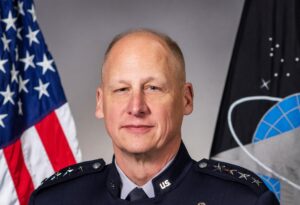
Golden Dome Industry Talks. Space Force Gen. Mike Guetlein, head of the Golden Dome initiative, recently minimized concerns about too much secrecy on the Golden Dome architecture and what the government seeks from industry. “I think our industry partners have a pretty good insight into what we’re doing. We’ve been having a lot of one on ones. I’ve met with well over [200] to 300 companies, one v one, to explain to them what we’re trying to do,” he said Dec. 6 at the Reagan National Defense Forum.
…More In 2026. Guetlein added he hopes they can broaden the discussion and provide the public more details on Golden Dome in 2026. “I’m still hoping that we can start opening up dialogue up in the new year. We will have some things in place that allow us to start having those kinds of conversations.”
T-7 at Randolph. Boeing on Dec. 5 delivered the first T-7A Red Hawk jet to the Air Education and Training Command at Randolph AFB, Texas, for pilot and instructor integration. The trainer is one of the engineering and manufacturing jets built by Boeing for the Air Force. The T-7A will be assigned to the 99th Flying Training Squadron at the 12th Flying Training Wing.
UAS Summit. General Dynamics Land Systems recently held a Maneuver Warfighter Industry Symposium in Detroit with nearly two dozen companies to discuss the employment of drones in a ground maneuver formation. “We felt there’s probably not enough people probably talking about how to integrate drone technology into the offense. And, frankly if we’re completely honest, our company has been doing a lot of work off and on for several years on how to install drone technology designed for dismounted applications onto our vehicles but not as much from a grassroots, bottom-up refinement integration,” Scott Taylor, GDLS’ business development director for U.S. Army and SOCOM programs, told Defense Daily. “And so, we thought it’d be good to get a bunch of companies [together]…involved in way or another in drones, and most of them were defense [firms] but some of them were commercial with zero defense application. But we know that commercial problem solving can have application in the military.”
…Participants. The participants at the summit included Accipiter Radar, AiroGroup, Airspace Link, Anduril Industries, Applied Intuition, ARES Geospatial Intelligence Services, Autonodyne, AV, Birdstop, blueflite, CACI International, DPI UAV Systems, GDIT, General Dynamics Mission Systems and Ordnance and Tactical Systems, Hidden Level, Mistral Inc., MyDefence, Orb Aerospace, Palantir Technologies, Primordial Labs and uAvionix. Taylor said the event also intended to get after senior Pentagon and Army leaders’ calls for industry to “self-organize” into new teams. “They [have said] they really need industry…to work together to solve the most complex problems and not rely entirely upon the military to come back with an approved set of requirements in all cases [but instead] to start working and have selected companies determine that they’re going to take the leadership role and start trying to self organize, Taylor said.
…Cognitive Burden. The event included a panel with one Army and three Marine Corps colonels, which Taylor said included discussing resupply and retrofit matters as it relates to drones as well as reducing the cognitive burden on the crew. “Frankly, the one [user] to many [drones] concepts can seem a little bit daunting. We know it cannot be one-to-one or, worse, two-to-one. We’ve got to figure out how to enable our military to be able to operate in the one-to-many type of situation with drones that don’t create undue hazards to other key enablers like manned aircraft and rotary-wing helicopters flying in the sector,” Taylor said. “There are some that brought up what if we got to ‘none-to-many,’ meaning, with artificial intelligence, we’re able to employ the drones but there’s a human on the loop for dynamic tasking and re-tasking. And, certainly, most likely I can’t imagine a time where the critical decision to conduct a kinetic kill would ever be relegated to a machine to decide. So, human on the loop and none-to-many, that was an interesting idea.”
GMLRS IM. Lockheed Martin has awarded L3Harris Technologies a $200 million production deal to continue building Insensitive Munition (IM) propulsion units for Guided Multiple Launch Rocket Systems (GMLRS). L3Harris said the award is the largest such GMLRS IM deal it’s received for a 12-month period of performance and it will be the first order processed through its new facility in Camden, Ark. The new 60,000 square-foot energetics facility in Camden will enable a 30 percent increase in GMLRS IM production, L3Harris said. “L3Harris and Department of War investments in expanding capacity and modernizing solid rocket motor production are bearing fruit, ensuring L3Harris continues delivering critical propulsion capability at scale and at speed to the U.S. and its allies,” Scott Alexander, L3Harris’ president of missile solutions, said in a statement.
Romulus. HII announced a prototype of its new Romulus unmanned surface vessel (USV) is 30 percent complete and is scheduled for sea trials in the fourth quarter of 2026. The company pitches Romulus as a modular high-performance USV built to commercial standards, manufactured quickly, has a range of 2,500 nautical miles and can carry up to four 40-foot payload containers, in line the the Navy’s Modular Attack Surface Craft medium USV program. The announcement came as company executives toured the Breaux Brothers Enterprises shipyard in Loreauville, La., a Romulus build partner along with Incat Crowther. HII intends Romulus to use its own Odyssey autonomy suite as well as Shield AI’s Hivemind Enterprise software development kit.
NGI Facility. Lockheed Martin on Dec. 10 announced it is almost done constructing a new facility to support production of the Next Generation Interceptor (NGI) , the 88,000-square-foot Missile Assembly Building-5 (MAB-5) at its Courtland, Ala., facility. The company said it is on track for completion by early 2026, to be followed by a formal grand opening ceremony. “We’re building out nearly 100,000 square feet of manufacturing and production spaces in Courtland dedicated to the NGI program. The new Missile Assembly Building represents a major investment in our ability to produce the NGI at scale and meet the government’s need for rapid delivery,” Johnathon Caldwell, vice president and general manager of Strategic and Missile Defense Systems at Lockheed Martin, said in a statement. About 100 of the current 500 personnel at the Courtland site are set to work on MAB-5 once ready and the company’s adjacent facility in Troy, Ala., will support hardware integration and large-scale manufacturing for NGI.
BAE Mast. BAE Systems on Dec. 8 announced it won a $36 million production contract from Lockheed Martin to deliver the Multifunction Modular Mast (MMM) systems for integration onto U.S. Navy submarines. The MMM is a radio frequency receiving antenna that gives submarines the ability to detect, identify and direction-find adversary communications signals before it rises to the surface. These MMMs antennas are set to be mounted on new Virginia-class attack submarines and also work with Lockheed Martin’s AN/BLQ-10 electronic warfare system. BAE works on the MMM system at its Hudson, Merrimack, and Nashua, N.H., facilities.
L3 Satellites Update. L3Harris Technologies has integrated the first eight of 16 Tranche 1 Tracking Layer satellites it is producing for the Space Development Agency’s (SDA) missile warning layer, the company said last week. The satellites are being built at the company’s newly expanded integration and test facility in Florida. L3Harris also said it has completed the subsystems for its first two of 18 Tranche 2 Tracking Layer space vehicles. SDA is expected to launch the Tranche 1 spacecraft in 2026.
Cool Names. To help strengthen its identity, and maybe further boost esprit de corps, the Space Force is beginning to name the space weapon systems it operates. First on the list is Ursa Major, the new name of the Ultra-High Frequency Follow-On military satellite communication system, Chief of Space Operations Gen. B. Chance Saltzman said on Thursday at the Space Power conference. The name was chosen by the 10th Space Operations Squadron. “The Big Dipper, as you all know, part of the Ursa Major constellation, famously points to Polaris, our north star, always linking us to our most important missions,” he told attendees.
…Nordic Name. The service’s 1st Space Operations Squadron has named their Operationally Responsive Space (ORS)-5 system Bifrost, which “is a bridge between Earth and the realm of the gods,” Saltzman said. The ORS-5, now called Bifrost, operates in low Earth orbit to provide space situational awareness. “Much like the Army has the [M-1] Abrams tank and the Air Force has the [F-16] Fighting Falcon, we needed a way to own the identity of our space systems as they enter the joint fight,” he said. There will be more to come, he added.
HawkEye International Deal. HawkEye 360 last week said it received a $100 million-plus contract from a “strategic international partner” who will receive the company satellite-based radio frequency data and analytics to support tactical operations. The deal includes HawkEye deploying a dedicated cluster of its satellites that will be fully operational in early 2027 and provide the customer with priority access to the RF data.
Lunday Moves Along. Acting Coast Guard Commandant Adm. Kevin Lunday, who has been nominated by President Donald Trump to be commandant, passed a nomination hurdle last week when the Senate Commerce Committee voted 23 to five in favor of the selection. The no votes were all Democrats, including Ed Markey (Mass.), Tammy Duckworth (Ill.), Ben Ray Lujan (N.M.), John Hickenlooper (Colo.) and Lisa Blunt Rochester (Del.).
OPC Keel Authenticated. The Coast Guard this month authenticated the keel for the first Offshore Patrol Cutter (OPC) under construction by Austal USA. The medium-endurance cutter Pickering is slated for delivery in 2027.
Funding Raises. Satellite platform developer K2 Space last week said it raised $250 million in a Series C round led by Redpoint to position it to ramp production and design new spacecraft. The California-based startup is developing large, high-power satellites it says are for the “heavy lift era.” The company’s first satellite, GRAVITAS, is a “mega class” spacecraft designed to fly on Falcon 9, Vulcan, and Ariane 6, and provide about 10 times the power of other satellites in that class it said. K2 said it will unveil design plans for its next large-class satellite, Giga, which will launch on heavy lift vehicles Starship and New Glenn.
…Biomachines. Aether Biomachines has raised an additional $15 million, bringing its total Series A round to $64 million, which the San Francisco-based startup will used to expand its Protein Function Model to design and optimize proteins for industrial and environmental applications. Aether’s artificial intelligence-designed proteins help create “super materials” that are faster and stronger and include aerospace and defense applications. The 25-employee company says it has aerospace and defense customers in the U.S. and Europe. “By combining AI and robotics with chemistry, Aether can tackle problems that were once considered too complex or costly,” Jay Zaveri, the company’s president, said in a statement. “Our process for developing new proteins will bring the future of manufacturing and sustainability into the present, reducing chemical factories to the size of shipping containers.”
DoD AI Platform. The Defense Department last week said that Google Cloud’s Gemini for Government, a generative artificial intelligence platform, as the first of several frontier AI capabilities in the department’s new GenAI.mil platform. Google’s platform can streamline workflows, sort through and summarize documents, generate videos and images, generate compliance checklists, create risk assessments and more.
Space Surveillance Data. Space domain awareness radar provider LeoLabs this fall received a contract from the Commerce Department’s Office of Space Commerce and the Space Force’s Joint Commercial Operations (JCO) cell to license the company’s Object Catalog of space objects in low Earth orbit. Commerce will integrate the catalog into the Traffic Coordination System for Space, which provides space situational awareness for satellite operators. The catalog, radar observations, object updates and maneuver detection data will flow into the Space Force’s Unified Data Library for use by Commerce and the JCO.
…Launch Detection. The California-based company also said it received a Tactical Funding Increase from the Space Force’s SpaceWERX innovation arm to add a software upgrade to its expeditionary Scout radar to detect and track foreign launches. Scout was introduced in April, adding a mobile product to LeoLabs’ lineup for rapid deployment worldwide to close coverage gaps in space domain awareness.
DRS and Saudi. Leonardo DRS said on Dec. 8 it has signed a Memorandum of Intent (MoI) with Saudi Arabia’s Ministry of Defense to explore opportunities to support the country’s Vision 2030 defense modernization effort. The company said the MoI will specifically focus on battle management systems to provide digital command-and-control tools, C6ISR solutions, rugged vehicle computing hardware, vehicle communication systems, mobile situational awareness capabilities and vehicle integration and engineering services. “By signing this MoI, Leonardo DRS is reinforcing its commitment to support the Kingdom of Saudi Arabia with its cutting-edge battlespace communications architecture and vehicle integration services that will deliver a more connected, protected, and combat effective land force,” Bill Guyan, Leonardo DRS’ head of business development and international business, said in a statement.
Belgium FMS. The State Department on Dec. 8 said it has approved a potential $79 million Foreign Military Sale (FMS) with Belgium for up to 240 Hellfire missiles. Along with the Lockheed Martin-built weapons, the new FMS case would include U.S. government and contractor engineering, technical and logistics support services and communications and training equipment. “The proposed sale will improve Belgium’s combat capability for counterterrorism operations. Belgium is a long-time operator of several advanced air-to-ground munitions via its F-35 and F-16 programs,” the Defense Security Cooperation Agency said in a statement.
M1 FSN Team. M1 Support Services said its team pursuing the Army’s Flight School Next (FSN) competition now also includes Quantum Helicopters and the UND Aerospace Foundation to support the pilot training aspect of the program. “Quantum’s established safety culture, instructor professionalism, and scalable training processes make it an ideal partner for Flight School Next,” George Krivo, M1’s chairman and CEO, said in a statement. Krivo added that UND Aerospace, a non-profit associated with University of North Dakota’s John D. Odegard School of Aerospace Sciences, has a “decades-long history of producing high-quality pilots, including many who went on to distinguish themselves as Army aviators.” FSB is the Army’s effort to update its initial rotary wing training program, to include exploring a new training helicopter and shifting to a contractor-owned, contractor-operated approach. M1 previously said Robinson Helicopter Company will provide the R66 helicopter for its FSN offering.
sUAS Industry Day. The Army will hold an industry day in February at Fort Drum, N.Y., to discuss a forthcoming blanket purchase agreement for small unmanned aircraft systems (sUAS). “The industry day…is intended to provide vendors the opportunity to demonstrate capabilities, share input, and engage with the [Army] regarding this requirement,” the Army said. The industry day is for vendors interested in providing sUAS capabilities, repair parts and sustainment support or technical expertise that could help shape the requirements and scope of the blanket purchase agreement.